I recently came across these gems among my sixth-form reports:
School reports: a “confidential and private record of the pupil’s progress”
“I should like to see a minimum of 15 hours study per week at home to begin with; then a greater commitment to the detail of his subjects and less reliance on his natural flair. If he exerts himself next year, the reward could be some very good grades.”
“Lloyd has clearly not put enough work in for this element of his course. He must accept that, at this level, innate ability is simply not enough to secure a satisfactory grade in the public examinations.”
“There has been some progress in Latin, but what of the rest? I cannot believe that a boy of his ability and potential is going to let himself down. We recommend at least 15 hours per week of study at home. Is he doing even this minimum?”
This is all forty years ago, but it still hangs in my psyche. I still think that, no matter what I might have achieved, the only truly valuable things are those that are the result of great exertion, that my “natural flair” and “innate ability” are never enough.
And yet, for most of that time, I’ve continued to find that exertion harder to exercise than most, while my flair and ability have gained me attention and love, I’ve seen less of whatever today’s equivalent is of “a satisfactory grade in the public examinations”
Maybe it will always be this way, that I’ll never be satisfied with my own efforts. But my diagnosis with ADHD nearly four years ago also sheds some light on “How do you solve a problem like Lloyd?” By the time I showed up for the Sixth Form, I’d lost a driving interest in my subjects. I got cornered into three language A-levels when my stubbornness came head to head with the titanium-plated wall of the school timetable, so the only variety in my attention was the fairly tame difference between translating Catullus or Camus or Kafka.
Plus, I had the exhaustion of executive function that characterises my experience of ADHD. Relief came from the variety between school and not-school – and “not-school” was a no-contest between home (TV, food, bed) and everything else that catches the fancy of an eighteen year old “boy”. There simply weren’t another fifteen hours.
Since the end of 2022, I’ve been part of this thing called Hard Art, a collective working on cultural responses to all the things we’re facing right now, but particularly various climate-related ugh-nesses.
Over the last year, as a kind of ice-breaker, people have made blind contour line portraits in pairs and then amazing artist/musician Ian Bruce has coloured lots of them in.
Now, as a fundraiser for the collective, 100 of them have been collected in an exhibition, “Drawn Without Looking” which is on in London for the next few days (through to Saturday 1st June) at the Paul Stolper Gallery in Museum Street. Astonishingly, the one of me (by Love Ssega !) is still, as yet, unsold – get your credit cards out, people!
They’ve also been collected into a book which has been released on metalabel – there’s other Hard Art stuff on the metalabel page too, so have a dig around.
Keir Starmer is quoted as saying there’s an “anti-politics mood” at the moment (as we move towards a General Election in the UK).
I don’t believe there’s an anti-politics mood, but I understand why professional politicians see it like that, because they believe that politics is only what politicians and activists do.
Politics is too important to leave to politicians in the same way that your health is too important to leave to doctors, the education of your children is too important to leave to teachers and your relationships are too important to leave to online social networks.
I think that we all need to take responsibility for actively participating in those things that have been professionalised out of our communal experience, not because we’re anti-expert (some of my best friends… etc) but because professionalised expertise only gets us so far and over a (shockingly short) period of time it reduces our ability to care for ourselves and others.
I saw a demo of a new platform called “metalabel” on Monday. I was excited by what I saw.
How do you split the pot ?
I saw a solution to a problem that we’ve chatted about for the last 15 years or so, a problem that’s easy enough to understand at a simple level, but once you get to the levels of complexity that make it interesting enough to pursue, it seems just too hard to bother with. Or at least that was my experience.
The problem, as I would state it is: how can members of a community release a series of collaborative works and share any commercial gains according to pre-arranged splits without either bleeding money away in financial transaction fees, paying lawyers for creating, interpreting and enforcing contracts or creating a managerial class within the community whose only function is to make the whole machine work (and to take a slice for themselves)?
See, when I started writing that sentence, I thought it was going to be much simpler than it turned out. And that’s what happens with these projects too.
The promise of metalabel is that you can create a series of works with (or without) splits that can evolve over time and the platform does all the work for you. Your community (or group of pals or whatever) becomes a “meta label” that can release all sorts of different creative works.
The proof of the meta-pudding will be in the meta-eating of course, and it’s invitation-only for the time being, but that’s what I took away from seeing it shown off by founder, Yancey Strickler. I’ve been fortunate enough to get pulled into the artist collective known as Hard Art. Hard Art is still being a bit mysterious ahead of “The Fete of Britain” event in a couple of weeks at the Factory International’s Aviva Studios in Manchester (a venue takeover that I’ve been likening to 2013’s “Hack The Barbican” except in the service of making a cultural response to Climate Crisis and the rest of the shitshow we’re experiencing these days). But this metalabel “release” gives you some hints and more will be revealed as the event approaches.
The best social art and community building that I’ve made has resulted in bunches of people who get inspired and trust each other enough to undertake projects – what people quickly notice is that these situations “have great potential” – the realisation of that potential though can be patchy – and while some projects find their feet (and their revenue stream!), lots of them fizzle out, often because the people are already busy and because things just get hard very quickly.
Some examples from my glorious past to help me think this through:
Tuttle Club
As well as having fun, learning lots about the social media scene at the time and inspiring a ton of blog posts, vlogs and podcasts, the people who came to Tuttle, especially in the early days, also ended up getting a new job or starting a business or some other project that ended up being their job. We (I) struggled for a long time with how to make it work financially for myself, given that most of those opportunities were being created while I was giving a friendly greeting to a newbie and I didn’t want to take the “easy” route of selling out or being responsible to a funder for (in)consistent results. Many times it was suggested that if people made stuff there that generated revenue, that a percentage could go into a central pot to support group expenses and me. But as I say, things get pretty complex, pretty quickly and it turned out that this was the kind of “why can’t you just” suggestion that I couldn’t implement (especially back in 2008/9). Even when we did Tuttle Consulting the headaches were in the various informal contractual arrangements and the difficulty of paying for non-billable work.
Centre For Creative Collaboration
One of the ways I did manage to turn the Tuttle conundrum round for myself for a while was by working with Brian when he (and his partners) created C4CC for the University of London in 2010. As Social Artist in Residence though, there was enough to do in curating the social space and relationships in the building. I probably clung onto it a bit long as a source of small but stable income. The question of how to fund and run such a space was, in the end, the thing that killed it off. And this wasn’t for want of trying – very talented people with big brains were grasping for a way to balance revenue and costs without relying on a big (and fickle) sponsor – a way that projects could contribute to the financial well-being of the space and the management overhead, when they mostly in start-up mode themselves.
We Will Gather
We had funding for this platform for a year in 2012/13. That paid us some salary/fees but mostly went on developing and hosting the tech – you could initiate up a “good” thing in your neighbourhood with it’s own web page, just by tweeting and using the hashtag #wewillgather. And lots of good things happened, but it didn’t reach a critical mass partly because of the Twitter API fuckery, but also because it needed some income and some curation/promotion/community building work that we just couldn’t maintain for free.
Workshop34 and other empty shops
These projects were shops! They’re actual retail premises where people are used to going in and spending money – what could possibly go wrong?! Dan and I only had 6 months in Workshop34 in Sittingbourne in 2014/15 but we established a way for the local community, especially local artists to show and sell their work and reap the benefits of working with other people, gaining confidence to keep trying other projects after our EU-funding had dried up. And we did deals with everyone that usually amounted to a 10-15% commission on any revenue they took. This would go into a pot for tea, biscuits and other expenses I incurred. But nobody wanted the hassle of earning money there – whether they were people who might risk their means-tested benefits or people who just didn’t want the responsibility of holding cash for a loosely-organised community. And nobody wanted to manage it afterwards – one of the hardest bits of the work for me was finding someone who’d take the £300 that was left in the community pot at the end.
In all of these situations, the primary purpose (and survival) of the group was ultimately undermined by the difficulty of paying for overheads or organising collaborative work once money was involved.
In each case, people (including me) could see that we were creating something of value. That as collaborative communities, the value had the potential to be realised by making creative assets – learnings, souvenirs, joint celebrations etc. and use the network effect of our joint social capital to promote and sell them. But it was always just too hard. We always ran out of juice (physically, emotionally and financially) before we could get it going. And I started to believe that the common denominator in all this was me and that it was my fault that it never worked, so I stopped trying.
I had a flicker of hope for this situation, when Imogen Heap asked me to help facilitate conversations about her Mycelia for Music idea and I got to see that this problem wasn’t just about me, my collaborators and the communities that we worked in – it was also there in the messy way music gets made. And at the time (end of 2015) it looked like crypto was the way to do this – distributed ledger so that nobody can tinker with the splits or metadata and nobody has to run it, the fees are all included in the blockchain etc. etc. You remember 2015? Yeah, good times!
Metalabel brings me renewed hope. I got it as soon as I heard Yancey say that one of the inspirations was the foundation of the Royal Society – people getting together in pubs and coffee shops and then publishing their work and incidentally creating a whole new method for creating and testing and disseminating knowledge? Well I can’t claim the whole new method thing, but it does sound familiar, doesn’t it?
In a nutshell, it’s a bit of infrastructure for individuals or collectives to release work for digital or physical distribution and, if there’s money involved, a way to set up how the money gets distributed between the people who did the work (and a commission for the platform) – so you can publish a book/EP/film/artwork and have a set of splits that operate while the initial costs are recouped and then a new set of splits thereafter or whatever you and your community want to do.
The difficult bit is still pull together a group of people who want to make cool innovative stuff and won’t kill each other in the process of deciding what gets published and who gets paid. But y’know, that seems a lot more fun when you’ve got a platform to do it on.
PS this is based on a privileged (and otherwise uninformed) sneak peek behind the scenes. I might have got the wrong end of the stick on something. If you go to metalabel.com right now, the concept may or may not jump off the page at you, but I believe the first curated releases (it’s invitation-only for the time being) will be available soon and then it will be a lot clearer.
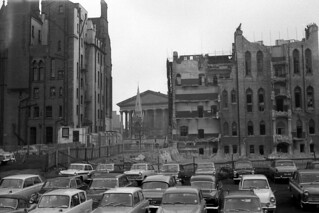
The Chamberlain Memorial and Birmingham Town Hall, from a car park between Chamberlain Square and Gt Charles St, showing the partly demolished buildings believed to be the Mason Science College (later to be the site of the 1970s Central Library)
I spent a little time in Flickr today, and it reminded me of so many good intentions. I could easily (not easily) spend all my time tagging and annotating photographs and putting them somewhere with some commentary on my life and what was going on. Obviously the one above wasn’t taken by me, but I know a few things about the man who did take it. #
I’m irritated by Threads. The only reason I go there is because Instagram and FB have little clickbaity embeds and I sometimes can’t resist the bait. I don’t want to write there. I don’t like the way it’s becoming, for some, the Twitter replacement – I don’t think FB/Meta can be trusted with that any more than any other platform-owners. I don’t like the way they’ve implemented tags. It might have to be the first instance of me proactively deleting a social media account. #
That’s the second time I’ve seen Dave point to Indieblocks – it does look like the sort of thing I ought to at least have an opinion on. #
I like this format because it reminds me of primary school, where the first thing you had to do was write today’s date at the top of the page. #
Today I learned that Stanley Baxter is a) still alive at 97 and b) out of the closet since 2020. #
A reminder that the four horsemen (or Gupta’s Path To Riches, depending on your perspective) are Blockchain, AI, VR/AR and IoT. Just because there’s been lots of focus on one or other of these of late, doesn’t mean the others have gone away. #
Dave asked about how much of a hassle it was to do anchor tags in wordpress. Not much faff, in my experience using the wordpress.com block editor. I have a sidebar menu for the paragraph block I’m typing. Under ‘Advanced’ I add the same Block Name and HTML Anchor for the first paragraph of a new section – for ease, yesterday I just used S1, S2… SX for sections but for readability, if I were doing a longer piece, I think I’d use somethin more descriptive. Then I add a hash symbol at the end of the block which is linked to the anchor tag (just type eg “#S2” in the link creation dialog). This is meant to be a demonstration of the degree of faff involved (ie non-zero), not a polished set of instructions, ymmv. Yes, of course I’d like something automagic and better fitted to my dainty hands but I also like making more work for myself than is needed sometimes. #
The main way in which it’s beginning to look a lot like Christmas is that the overall volume of incoming messages has increased – mostly from people trying to clear things off their todo list before the end of next week (or earlier). I am not altogether innocent of doing this myself, either, soz. #
I usually write *something* at the end of the week, but rarely (if ever) manage to publish it. For me, writing is thinking more than it is anything else and giving my thoughts on the week an extra polish in order to share them is usually too much effort. But I’m remembering the benefits of sharing this rough stuff in public and every now and then the internal battle turns out with a victory for openness rather than discretion. Week 49 seems to be one of those now and thens (that’s now a then).
I hate raising expectations. And I know that writing here raises expectations (even if it’s only in a very small number of people) that I will write here again, every day or, if not then perhaps every week. I’d love to be the sort of person who puts this first. But I’m not, I’m just not. At least not at the moment.
Black Elephant had a little press last week. There was a feature in the weeked Culture supplement of Politiken, the Danish broadsheet (though I’ve been banned from calling it that in official communication, apparently ‘broadsheet’ is too British for an international audience). Part of the benefit for me of being in an international team is that I get to see where some of my blind spots are. I may think I’m pretty good at writing for a general audience, but, without turning this into a self-inflicted Struggle Session, there’s a lot that I’ve been able to get away with in a small UK pond that doesn’t fly so well (oh god, the metaphors I’m mixing) with people who have English as a second, third or fourth language or who’ve grown up in places where the British are seen, perhaps not as the enemy, but definitely as colonialists, insisting that the world run on our terms. Oh, wasn’t Dr Who good, on Saturday? I’m glad to see in the trailer for the Christmas special that he will eventually put some trousers on. #
Spent a lot of time on “Project Hidden Gems”. Trying to get the invitation right and out to the right people, but also working out more clearly what it’s for and how it helps us do what we want to do.
Oh and what it might cost. Again, I notice an overhead of working internationally. Not only do we have to think about timezones, like *all* the time, but also when we talk about money we have to be explicit about which currency we’re talking about. I’m getting better at thinking in multiple currencies at once, but it’s hard.
I’m glad that we’ve created a bit more project management infrastructure for this one. It’s a delicate balance when the team is so small, we don’t want to over do it (I mean honestly, this is always the case though, isn’t it? Who really wants more PM bureaucracy than you absolutely need? Other than people who make a great deal of money selling PM bureaucracy, obvs.) but I think one of the things I’ve appreciated since I got my ADHD diagnosis is being able to focus on clarity that helps other people, rather than the vagueness that really only helps me. #
We wrote a newsletter together this week, to highlight the press piece and what we’re doing in the New Year. I drafted something that was too long and wordy and then had my insides pulled out by the team slashing it down to three bullet point paragraphs. Having spent most of my career butchering other people’s wordy and over formal prose for the sake of comprehension and engagement, I didn’t like to be on the receiving end. I got over it. #
“Project HA!” is not a Black Elephant project, it’s with a larger, more local and more openly creative bunch of folk. It’s much closer to what we were doing at C4CC. It’s fun, but not without moments of difficulty and personal growth. I was glad that at our meeting this week, we sat in a circle for the first time (having a table between us, just feels wrong) and that I got to say that. I’m also glad that I’m very far from leading this. It’s great to be part of a thing that’s doing stuff, but not have to own every bit of it. #
I hosted two parades this week. My regular Thursday morning “On Golden Sands” and another, that was arranged with more of an invited crowd, on Friday evening. All the parades I’ve attended have different characters, and it’s not just about the people who come and the questions we ask. Partly, I think, there’s something about how I change and react to people that I don’t already know, but also time of day. Most of all, I think it’s the very difficult aspect to pin down, of “diversity” in the group. While you may understand beforehand, the checkboxy kind of differences between people: age, gender, race, geography etc. once you get in the room, you never know quite how the mix is going to play out. It’s exciting but a bit tiring on a Friday night. #
I’m enjoying having a weekend again. Different from when I was working at church and the weekend could always have the possibility of needing to attend a service or a church meeting. As well as having a very nice lunch and the necessary preparations for what’s happening in a fortnight, I spent too much time on the new Fortnite update, particularly the Lego and Racing extras that were released last week. Highly suitable for a man approaching 59 years old. #
LX I’ve always known that the JFK/Doctor Who 60th anniversaries would mark the 13-month countdown to my own encounter with 2x2x3x5. But it really started last Christmas when I was in the midst of whatever non-Covid knock-out virus that had entered me and I shuddered as I turned 58. 59 was a year a way and then… For now, I’ll settle for 58 and 11/12ths and forget about what’s to come. My daughter is also celebrating her half-birthday for the first time, now that she’s in her thirties, I think it’s a good habit to encourage. #
Our back garden for the time being. The chain is rattling, we could exchange anytime and maybe complete by… (no don’t tempt fate!)
Wisteria is hanging on tight to her leaves. She doesn’t believe that it’s the end of November, either. The creeper has given up. Olive appreciated getting a bit of a trim a few weeks ago. Rosemary is as persistently mad as ever. We’ll leave the leaves for now. #
Ripples I listened to a writer last night talking about his preferred narrative structure being an exploration of the ripples that spread out after an event. Basically taking a seemingly simple (if odd) event and noticing the huge but not obviously connected consequences. I think his point is what complexity people refer to as non-linearity, ie that complex outcomes can arise from the simplest stimuli.
The examples he gave were negative – ie seriously bad things happening as a result of smaller bad things. The problem I have with it is that it’s a creativity killer. For some people, thinking like this has to mean STOP! don’t make this thing, don’t make anything, because you can’t control the unintended consequences. But that can’t be right – if it were then the only people left making art would be people who have no problem with or remorse for doing bad things. Oh… wait…!
When I speak about the ripple effect, I prefer to dwell on the positive version. That small incremental improvements in how we are with ourselves and others can spread out and touch people far away, even people we don’t know. That me taking care of myself means there’s one less angry person on the tube train adding to the madness, one more person ready to smile and help someone who’s lost and afraid and alone. #
I updated my BlueSky profile to say:
You may know me from such hashtags as #tuttle #wewillgather #c4cc #PLATE and #blackelephant Sings with a non-hashtagged ukulele. Blog (like this only bigger chunks) at perfectpath.co.uk
You might not be on BlueSky, but you can infer that it’s like this, only in *smaller* chunks. I don’t know how much longer it’s going to be invite-only, but if you’re interested and impatient, I won’t dissuade you – I have invite codes for those who ask. #
Anchor Links I’m also experimenting with anchor links so that I can more easily link to any of the abovementioned “chunks” – that’s what those hashes represent at the end of each section – if you click on one it should open a new tab with the “cursor” at the top of that section. (Maybe not) obviously, they’re there for you (or me) to easily link to a bit, rather than to be clicked on while reading… or has this sentence made it more confusing? Anyway, if you’re confused, ignore them. If you understand, just nod to yourself. Grand. I’ll probably forget all about it after a while. #
Small talk kills me. I think it’s an attention thing. On my way home from another thing last night, I was having some regret about going, but then I realised that the people weren’t a problem and the majority of the content wasn’t a problem, it’s that it got to a point where we were left to do even more small talk (having already had an introductory bit and a break in the middle) and I don’t like to just rush off immediately, and I also did enjoy talking to all the people that I talked to, it’s just that it drains me completely and leaves me thinking I’ve made a mistake in coming out at all. It doesn’t matter how many interesting things I have to talk about or lovely people there are in the room, I will gravitate to an internal state of thinking I’m boring and surrounded by people who are disappointed to have ended up next to me because they only came over for another of those samosas. It’s not you, it’s me… and small talk. #
60 years ago today, my parents (who were engaged to be married) were taking the bus to get into town and had to change by the cricket ground at Edgbaston. That was when they heard the news from Dallas – on a street, in a crowd of people waiting for their bus on a Friday evening.
Further research is required to ascertain whether either of them watched the first episode of Doctor Who the following evening. Personally, I doubt it.
A sunny spring day in downtown Dallas, TX.
I’ve told the story before about my first experience of downtown Dallas. I was on a train from Chicago to Austin in March 2011 and Dallas was a point where there was an extended stop (half an hour or so) to change engines. I like to think that there are northern engines that can handle Chicago winter and southern engines that are more at home once you get into Texas, but I’ve never dug deep into that one. Anyway. Some friends that I’d made on board and I decided to take a little walk while we were waiting and strolled along the road. As we got into the more built-up area, I started having the weirdest feeling of deja-vu, or really that I’d been there before, but I knew the nearest I’d gotten was to change flights at Dallas-Fort Worth once. But then, as I looked, I saw a sign saying we were in Dealey Plaza and everything suddenly fell into place and came into focus. Those familiar landmarks of the railway bridge crossing the road, the green spaces (one might call one of them a ‘knoll’), the tall redbrick buildings all revealed themselves to be the backdrop of that dramatic day, the location for the Zapruder film, a place where a man got shot and the world shifted. I tend not to want to travel to places just to see sights – to be in places where things happened. I’m more interested in the people who are here and now and what’s going on today, but this shocked me out of that present perspective and said “Oi. There’s something else to pay attention to!”
I’ve had time to think a bit more about the thing I went to last night. I think what disturbed me was focusing on the testimony of the newly converted, or as we call them in recovery circles “the newcomer”. In AA, the newcomer is often described as “the most important person in the room”. This is not just to flatter them into staying (although it worked on me!) it’s also a reminder to the rest of us that a big part of the work is “giving away what we were so generously given ourselves”. Our own recovery depends more on being able to help someone who has no hope than it does on sitting around with the same bunch of folk reinforcing our well-worn stories. And that means that the newcomer needs to be welcome, but also to recognise that they have more to hear than they have to say. Much is made in media portrayals of our meetings of the poor addict who wanders in and gets to tell their story for the first time – it’s great drama, but the more important stuff comes after that, when they sit quietly and hear the testimonies of other people who’ve been in a similar predicament – not telling them what to do, but just letting them know that they’re in the right place, and importantly that there is a solution and it’s a spiritual one. This, of course, is an ideal that is practiced less than 100% and often the newcomer has to step over the line in order to know there is a line (as do we all at times). The bottom line is: just because you’re the most important person in the room, doesn’t mean you get to dominate the space or preach to everyone.
I had a lot of love for Martin and Paul telling their stories of coming to their brand of faith, but the setting was confusing, because people who stand at the front on a platform with a mic (whether it works or not) are taken to be the ones who have more important things to say than everyone else and then the Q&A reinforces that. It’s not that I was desperate to tell my own story, just that it felt off, like the content was being shoehorned into a format that didn’t quite fit. So you can see I’ve thought it through a little, but not completely.
Yesterday, I said in a team meeting that I needed to be working out in the open more. Very soon after, I got an invitation to go to a thing tonight, coincidentally featuring someone who is associated with Black Elephant. Fun.
But really working out loud or working in the open is not restricted to going outside and talking to people (the horror!). It means this place. Or this place and all the other places that I have a tense relationship with – the places we’ve come to call social media, but only because “soul- and relationship-destroying online social networks that feed us more crap than the mainstream media every dreamed of” is a bit of a mouthful.
When I first heard that phrase “social media” it was at a conference, probably in 2005 or 2006. It got an immediate “ugh” from me. At the time I was doing that thing where I’d turn up to a conference and record the speakers (with or without their permission or knowledge) and then publish it online, and everybody (I spoke to) thought it was great. People started paying me to do it for them and to create an RSS feed for them as podcasts. Until they didn’t. Until they (or someone in legal) thought through the ramifications because this did seem to be becoming the new normal and maybe people wouldn’t go to the conferences if they could get them free or bootlegged. Ah well, by that time, I’d got new fish to fry. But anyway, the point is that making media was only the means to an end, it was a way of me thinking out loud and making things that other people could reflect on and think about too. And that’s what this place ought to be too, certainly not a place where media is made or *shudder*… content!
I’ve spent much of today working on a new deck for Black Elephant. And I’m still getting used to how to do this sort of work remotely in a team that exists separately in England, Greece and Mali (at least we’re vaguely on the same time zone). Yesterday we just had a bunch of text and the old deck. First thing this morning we had a first draft of the deck and we spent almost an hour in our morning meeting talking through what was needed. Then two of us worked together in Google Sheets to pull in stuff that we’ve used before and amend new stuff and put new ideas in. Just as with blogging, the writing of these things is the thinking. It’s really hard (for me) to think through an idea for a slide or set of slides without typing something out and then looking at it and realising that it’s wrong and going back over and over. This is the work today. We have a better draft. And as the cult of done manifesto says: “Accept that everything is a draft, it helps to get things done.”
And so this evening to St Ethelburga’s in the City, y’know the one just along from St Mary’s Axe that was blown up by the IRA and is now a Peace and Reconciliation Centre. I heard Paul Kingsnorth and Martin Shaw talk about Seeking God in Wild Places. I don’t know what I think about it yet, so don’t ask me. No, I’m on the train and it’s nearly 9:30pm and it’s getting more and more crowded because there’s only 5 carriages and everyone’s trying to get home.
Martin Shaw obscures Paul Kingsnorth. It’s not a metaphor.
I'm the founder of the Tuttle Club and fascinated by organisation. I enjoy making social art and building communities.





 Perfect Path