Mycelia: a chance to build a distributed metadata commons for/with musicians

This is a thing that came up at #tuttle last week and I’m ashamed that I haven’t written it up yet, but here it is.

Mycelia is Imogen Heap‘s name for her project to reboot music production and publishing as a “Fair Trade for music environment with a simple one-stop-shop-portal to upload my freshly recorded music, verified and stamped, into the world, with the confidence I’m getting the best deal out there, without having to get lawyers involved.”  That quotation comes from the first of two articles published last month on Forbes.com.  If you’re at all interested in the music business, you should read them both.

My interpretation of it is this – artists will have a way to share their work while retaining control over credit for the works; the assignment of rights of copying, distribution and sale; and how payment by listeners makes its way fairly back to those who made the work.  It implies to me a blockchain-based smart contract platform (don’t worry too much about what that means, the important bits are it is not centralised, transparent and very hard to tamper with and which can have rules embedded in it about eg ownership, rights, payment etc) for metadata about music.

It’s a distributed metadata commons for musicians (and possibly a model for other artists too).

That’s great.  As long as it’s musicians doing it for themselves.  But they are not the only actors in this scenario.  Music Industry Professionals (the ones who have been running the business side of things rather than the creative) stand to lose out here.  Again.  The involvement of the old-skool corporate music biz raises the fear of a tragedy of the Mycelia commons and hard-coding of 20th Century practices into our new fair network-based thing.

I believe that this thing needs to have the chance to grow without commercial interference from corporations, so I’d like us to discuss how that could happen.  How can we defend, govern and manage this emerging metadata commons?  What sort of licencing could or should apply to re-use of the data, for example?

I’d like to get some people together to talk this through (yes probably in one place at the same time and that means London) and take the thinking forward as soon as we can, and preferably before this event at the end of September.

I think we need:

  • Working musos who have successfully ridden the first wave of disruption;
  • Lawyers with an interest in music rights;
  • Academics looking at new models for creative industries;
  • Representatives from organisations interested in open data and digital rights; and
  • Technology experts who get how this might all hang together.

Is that you?  Can we get together soon?  Get in touch.  I’ll be looking for a venue and trying to set a date over the next week.  Could you provide a venue?  Great!

Do you understand this better than me?  Where are you writing about it?  If you haven’t written anything yet, could you please write something and link to this post?

Thank you, lovelies.

Postscript: 

Why is this a thing, why does something so cool need defending?  Because it’s open and most vulnerable to influence by vested interests early on.  When we started #tuttle it was like “everyone come along and be part of it, you can do whatever you want” and so some people be like “woah there’s this great open thing where I can do whatever I want so I’m going to hard sell my shit and use this thing to capture new customers and their eyeballs forever!”  and so we had to establish that even though it looks like there are no rules, there are some things that you need not to do in order to let the commons bloom and continue to be fruitful for everyone.  That’s what I’m aiming for here, not fighting anyone, but setting up some expected norms as defences against the natural urges of capital.

Podcast with @leashless : Blockchain, Smart Contracts and The Social Need for Jobs.

Today I chatted with Vinay Gupta about the impending (when? when?) arrival of full white collar automation.  Along the way we talked about ethereum, smart contracts, social attachment to jobs as a means of making one’s living and the internet of things.

This is part of my work on my Contributoria article “The City of London. Eaten by Code, Replaced by Robots?” which will be published at the beginning of September.  If you’d like to be interviewed for this piece or you know someone else who could represent the views of non-tech City workers, please let me know.

Other useful links for you to click as you listen:


Hacklands Podcast with Helen Keegan @technokitten

 
I got together today with Helen Keegan (we last podcasted together 10 years ago!) to give you an idea of what to expect on the weekend.

During our chat you’ll hear references to

and most importantly of all how to Book Your Tickets!

Rooster Recorded by Mike Koenig
Cow Recorded by BuffBill84

On @hitchBOT and trusting the kindness of strangers #hitchbotinUSA

A hitch-hiking robot has been damaged beyond repair, by person or persons unknown, two weeks into a trip across the USA having successfully travelled around Canada and Germany.  I have some identification with little #hitchBot after my own trips across the USA.  For those who don’t know the story, I spent the month of March 2011 travelling coast to coast across the USA.  I turned up in San Francisco on March 1st with a plane ticket back from New York City on 31st March and very little planned in between.  I then used blogging and social media to move across the continent through members of my online social network.  So the main differences are: I am not a robot; I have built relationships with people online over many years; I did not hitch-hike.

That last one is the most important factor, I think.  If I had insisted on hitch-hiking with total strangers rather than relying on the kindness of my existing network (albeit many friends-of-friends or people who didn’t actually know me well) I’d have had a very different experience.  If I’d been found in the woods outside a small town in Louisiana, dismembered and decapitated, quite a few people would have said “I told you so”  (because yes, they did tell me so).  I used to hitch-hike in Worcestershire in the early-eighties but pretty much everyone who gave me a lift back then told me that I shouldn’t be doing it.  It’s only got more dangerous and it’s always been considered more hazardous for women than men, let alone small robots with a limited vocabulary.  So I’m tempted to say that running an experiment like this is a bit like sending a young child out hitch-hiking.  Most people would look out for them, but sooner or later, they’d meet someone nasty.

Much has been made of the fact that it survived around Canada and Germany but the journey ended in the USA (particularly the irony of it ending in the “city of brotherly love”, Philadelphia).  Well yes, the irony is always there whenever any harm being done to anyone in Philadelphia, ever.  But that doesn’t stop it happening.  I’ve seen Americans beating themselves up for the fact it happened in their country and making this mean something about the USA.  I wouldn’t leap to any conclusions about national cultures.  Also I do think this was always going to be a time-limited project, the robot was defenceless and entirely dependent on who it met.  When I did my trip, I’ve no idea how many times I made a decision to go with one group of people rather than another, and I could always have talked my way out of trouble or run off even if my actual fighting, self-defence skills aren’t tops.  I felt as safe in the US as i have done in any European city and much more so than in some parts of some cities here.  So no, I don’t think it’s about the USA particularly – bad things happen to good robots everywhere.

I also doubt whether machines can build personal social capital within a human network.  They’re just too different.  Yes we think it’s sweet and its interactions through social media seemed to mimic those we have with people we don’t know very well.  It acquired some fans, though not quite enough to keep it carried safely.  I relied on some people who I had known for many years and I had also built up capital through many small interactions and bits of help of service.

The aim of the #hitchBOT experiment was to “see whether robots can trust humans”.  I don’t think that’s been disproved.  Trust is reciprocal, though that goes without saying in human circumstances – I trusted in my network not to chop me up into little bits in the woodshed and they people who helped me trusted me enough to let me into their homes and meet their families.  Trust comes from perceptions of your actions and your motivations.  For there to be reciprocal trust between humans and robots, those pesky robots are going to have to actively do trustworthy and helpful things for people with no expectation of rewards.

Ongoing Support for #Tuttle through @Patreon

support lloyd on patreon

So, #Tuttle turned 7 years old, six months ago.  There have been times when I’ve walked away from it and let others carry the show, but for most of those seven years, I’ve been showing up every week and helping something beautiful happen.

The conversations these days are not so much about social media, they’re more about how work is changing right now and how technology is affecting that.  And just like when we started in 2008, growth in our technological capacity is outstripping our social capacity to understand and deal with it.  We don’t know how it’s all going to work out.  And free-form conversation like you get at #Tuttle is the best way I know to address that situation.

During the last seven years, many of you have supported my projects through crowd-funding and by participating directly in them.  I’m grateful for all of that.  I thought that #Tuttle would lead to new stuff and it has done, but the thing itself, the Friday morning meetups haven’t gone away.  Now I’m asking you to support the ongoing work of keeping #Tuttle useful and expanding the range of activities  I can do.

Patreon has been around for a while now as a platform.  It does all the bits that are difficult for me to do on my own and lets me get on with making cool stuff happen.  I’m hoping that it will also help me to do more to hold the community together – that’s what the Goals in the left-hand sidebar are about.  The process has also helped me to get clear about what I want to do – summarised in this video.

It’s not make or break.  I’m going to keep doing this stuff because it’s my calling, it’s become who I am and every time someone comes back or turns up for the first time and I see that look in their eye, that says “Thank you for making a space for me to be nourished in today”, I know that I’ve just got to keep doing it.

You can contribute as little as one US dollar per month (there’s no choice on currency unfortunately) but there’s a scale of rewards for more generous contributions.  If you can’t or don’t want to commit to a monthly payment, you can cancel at any time or there’s a range of options for a one-off donation here.

Most importantly of all, if you can’t afford to give anything, the best thing you can do is send me a note of solidarity and maybe come and see me on a Friday morning, I need you much more than I need your money.

That Question, The Answer

IMAG1572

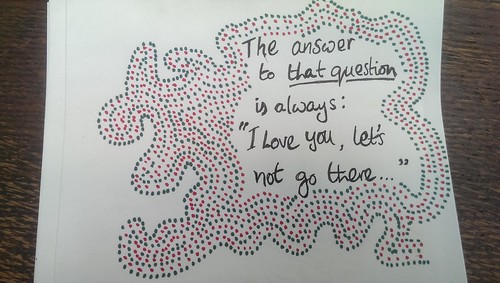
There’s (at least) one question in every important relationship, whether it’s your lover, your mother, your best mate or your favourite client, which can trigger the most almighty meltdown of communication. Something that seems to be taking a lifetime to resolve. Something that presses her buttons and presses yours just as hard. You know what it is. He knows what it is. You both know not to touch it, but every now and then one of you forgets and drifts into this dangerous territory.

Whatever it is you are unlikely to resolve it by talking it out just one more time. It represents something important that needs to be worked out through your experience of relating to each other, not through words. So, no matter how tempting it seems when they say “I know we’ve been over this, but could we just…” Smile, remind them (and yourself) that you love them and get on with being the solution not trying to explain it.

Here’s what I did the day after 7/7

It’s a bit slow to start and despite my protestations that “It’s really quiet for a Friday” there’s plenty of background traffic noise, but I’m really quite proud of ten years ago me, stepping out and doing what was normal for me (but seemed bonkers to most), walking around London talking into a recording machine and publishing what I’d said on the internet.

We had no Twitter that day, or Facebook. YouTube was a couple of months old and video still seemed out of reach to me. Most of us had phones whose only non-voice function was SMS. The photos that I took and put on flickr were taken with my Pentax Optio compact. All I had was my blog and a podcast.

The day before I’d been at home waiting in for an engineer to come and install my broadband and TV. And so when I could I got back into town and carried on and tried to talk about forgiveness and peace.

Here’s the flickr set

Eaten By Code, Replaced By Robots?

I’ve put a proposal to write an article for Contributoria on the possibility of city workers being hit hard by the next round of FinTech development – Bitcoin brought us programmable money, Ethereum brings us programmable companies.

From the pitch: “is it reasonable to expect Financial and Professional Services to undergo the same kinds of disruption and rejigging that the web brought to film, TV, newspapers and music? And if so what happens to all the people who ‘do something in the City’?”

Contributoria is a journalism site where the articles are written, chosen and collaborated on by members of the community.  In my opinion, it’s managing to inspire and curate some really good writing on subjects that you won’t necessarily see in more mainstream media.  The choosing function is like crowd-funding but you allocate points that you get through membership rather than your own actual cash, but if enough of you give me your points, I get to write the article and I get paid.  You may remember that I was interviewed for one of Jon Hickman’s pieces there about a year ago.

So it’s like all those other crowd-funding things I’ve asked you to support, but this one won’t cost you anything, instead you get to play with the Guardian Media Group’s money – yay!

Here’s what you do:

  1.  Sign up at contributoria.com – you’ll see that there are paid options (including one that gets you a print copy, if that floats your boat) but you get 50 points to play with if you go for FREE.

  2.  Find my proposal page

  3.  Pledge as many of your points to me as you like (obviously I would like all 50 please!)

  4.  Tell all your friends to do the same (there are handy social share buttons for FB & Twitter)

  5.  If you’ve any left over do have a browse of the other articles being proposed and pledge for them too.

  6.  Sit back and wait till the end of the month when you can start to read my drafts and guide my writing if you like, or wait until it’s published on 1st September.

  7.  Also, probably get ready for me to ask you to ask all your friends again toward the end of the month, when I’m frustratingly close but not quite at the target!

Thanks my lovelies!

What was all that about? #llobo

Four years ago today, I sat in the park with my new girlfriend (now my wife), kissed her for the first time and then walked over to C4CC to pick up the suitcase, laptop bag and ukulele that would be my items of stability over the next year while I experimented with living with friends, colleagues and strangers.

I used this blog to tell you what I’d been doing but also to say “Hi, I’m here, but I’m ready to be somewhere else, do you have some work I could do?”  It was a great exercise, a stretch for me.  I gained humility and confidence in the value of my work.  I learned how to ask for what I needed and I learned about what happens when you present yourself as in need.  Throughout the year, people assumed that openly asking for help like this equated to helplessness.  And then I experienced three basic forms of reaction:

  • Identification: “Yes, I feel helpless about this too.”
  • Rescue: “Oh you poor thing, let me sort you out.”
  • Attack: “You lazy bastard, get a job like everyone else.”

It’s a well-recognised and strong dynamic.  But the year, in the end, turned out to be a daily practice to step out of the whole drama triangle dynamic, to let go of being helpless and with it let go of being bashed or rescued.

Tomorrow’s World

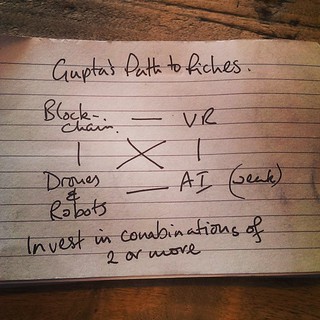
Breakfast with Vinay #tuttleA couple of months ago at Tuttle, Vinay expounded on his recommended VC strategy: invest in any startup whose product combines two or more of the following –

  • virtual reality;
  • weak artificial intelligence;
  • drones & robots; and
  • blockchain.

It’s been rolling around in my head ever since.  Of those people who are working on any of these, I think they’re mostly focused on a single silo as core – so when a VR company does something controlling drones, they’re probably just using drones as a use case rather than thinking “We’re in the Virtual Reality Drone Business.”

I think.  I don’t know enough of them to know.

But I do think this stuff is worth knowing more about because they all feel like unstoppable strands of the near-future.  They all feel like the internet did twenty years ago – yes you’ve heard of them, you know people are doing stuff with them but what really is that going to do for me?  And the combinations with other technologies are quite hard to think about because of this.  Even fifteen years ago the people saying that the future of the internet was mobile phones seemed to be few, probably right, but possibly nuts.

Here’s what I think is interesting about each.

Virtual Reality: means we can visualise and interact in some way with stuff that doesn’t or can’t exist in reality or we can make things that do exist look different, easier to interact with or more palatable.  Using sensors in the real world we can also mix things up, what we call “augmented reality”

Drones & Robots: I heap these together with devices on the network whose primary function is not computing (or computing as we know it)  they are machines that do stuff for us and replace some part of undesirable human labour, ultimately allowing us to do stuff we just could barely imagine before.

Artificial Intelligence: the “weak” modifier is important here, we’re not talking about sentient computers, rather things like voice recognition, machine translation, helpers like siri.  This is the software version of human-replacing robots.  Get a machine or a network of machines to replace some thinking-like function: decision making or sensory recognition or pattern matching.

Blockchain tech has started off by replacing currencies, but it’s becoming clear that the generalised form of bitcoin – a distributed ledger that gets its authority from the consensus of the network is a candidate for replacing all sorts of centralised databases and thus making all sorts of human activities in firms look horribly inefficient and redundant.  The best corporations may turn out to have been relatively inefficient cyborg machines weighed down by their meatware compared to a Decentralised Autonomous Organisation.

Within these silos, each of these technologies are on the road to being mainstream – it’s those combinations that make me think.  A robot that senses and makes decisions about its environment through a virtual reality interface but ultimately controlled by a DAO sounds Terminator-ish.

But there’s another thing.

In all technology, we face a tension between our desire to make life easier by replacing human labour with code or machines and our attachment to human labour as the primary sense-making tool of life and the means by which most of us get the things we need to live.

We seem to understand that work is changing but most of the #futureofwork stuff I’ve seen assumes capitalism based on corporations as a given.

I do have an opinion on this, I think we need fewer jobs and to really accept that people don’t need any more to work as hard or as long doing stuff to justify staying alive.  What I want to do more though is point out the incongruity that our tech efforts go into replacing human labour but our politics, culture and society, our communities and social interactions assume that everyone should have a job or some easily understandable means of income like owning or a company or assets that create value.

I spent a year a little while ago not living how most people live.  I lived out of a couple of suitcases and moved around, asking for work and places to stay through my social networks.  More than once I was asked “What if everyone wanted to live like this?”  At the time, I took this as an admonishment mostly, as a way of saying “You’re taking advantage of our work which has gone into acquiring this space for our use.  You’re working and storing it in social capital rather than in bricks and mortar or a career path, but we can’t all do that can we?”

Well, what I’m asking now is “What if we all have to do that?”  What if we make a huge leap in replacing types of work? What if, in the British economy, we made things that made our Financial and Professional Services as “not economically viable here” as coal-mining, steel work or mass manufacturing – the things that were the cornerstones of our economy when I was a child?

Whatever happens, it will be in the context of big demographic change too.  A lot of the way our bit of the world looks is down to the post-war baby boom.   All the boomers are over fifty now.  They’re going to die in the next twenty, thirty, forty years (me too!)

How’s it all going to work out?  Is this all what we really want?  Would knowing how the world is now have helped us at all forty years ago?  Can we just pause and check?

I think we need to talk a lot more about these things.  Tuttle is one place, but I’m going to be making time for other ways to engage over the next few months.  Please join me.

I'm the founder of the Tuttle Club and fascinated by organisation. I enjoy making social art and building communities.