Future of Work: AI – with @benjaminellis

This was the first of a series of evenings at Truphone looking at the future of work in the context of four currently maturing technologies.  We started off with a focus on Artificial Intelligence and were given a great overview by Benjamin Ellis of Redcatco.

Discussions that followed included:

  • What happens when the AI is wrong?
    Social Machines (where/how/what)
  • The social acceptability of AI decisions, even if they are better than human ones
  • I want IRON MAN’s suit!
  • AI & Regulation Self/Gov
  • Are we driving AI… or does it drive us?
  • Why AI? Are we creating stuff because we can or because it adds to the human condition or…?
  • UIs How do we talk to them and them to us? How do they sell their ideas? Spectrum from Sound Hound to C3PO to HAL
  • If a machine/AI does something bad (kills someone) who is responsible? The owner, the manufacturer, the programmer or the victim?
  • What will we be using AI for in the next few years? What can I use it for now?
  • Is AI artificial ie not human?

We finish each evening with a circle where we pass around an audio recorder to capture people’s immediate reactions.  Have a listen to get more of a feel for what it was like in the room.

David Terrar did a write up for the Agile Elephant Blog.  If you were there and have written anything yourself, do let me know and I’ll add a link.


Future of Mobile AI with @jamestagg @truphone

Last Thursday, we kicked off a series of evenings at the offices of Truphone with James Tagg leading a romp through the current thinking about the future of artificial intelligence in the context of mobile, ie “When will your smartphone be smarter than you?”

We then went into a short open space session with people suggesting conversations about “How & when the laws of robotics will apply to smartphone AIs”, “How can AI be used for creating world peace?” and “What does the AI world really look like in 2025?”

I managed to catch a few snippets of the conversations:

The format worked well, here’s audio of the final circle (a sentence or two from everyone who wants to) many people said it was very refreshing and stimulating to have a chance to talk about what they wanted to talk about while also having plenty of time to quiz James.  Last night we returned to Artificial Intelligence again, but this time, helped by Benjamin Ellis, looking through the lens of the Future of Work (which is the overall theme for the four remaining sessions) and after that come Blockchain, Drones Robots & IoT and Virtual/Augmented Realities. Do join us!

Ethereum #Devcon1 Day 1

12194850_10156152534235697_3489534277009311602_o//embedr.flickr.com/assets/client-code.js
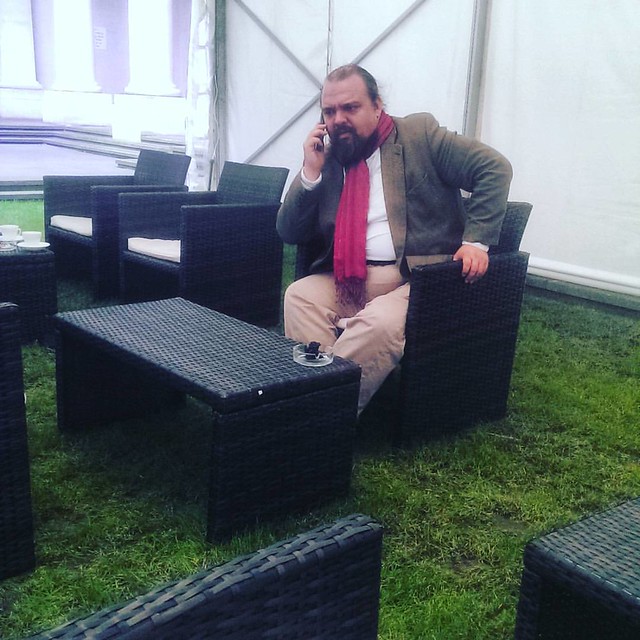
I’ve dropped in to the Ethereum Devcon1 at the Gibson Hall, slap bang in the middle of the City – at the junction of Threadneedle Street and Bishopsgate.  And Vinay and I sat in a marquee on the lawn (how surreal was your morning?) until we reckoned it would be more comfortable in the “Black Bar”.  I’m there now.  I ducked out of the session on “Monads and Comonads”. Because.

I’m mostly interested in the social and economic effects of blockchain tech especially the coming wave of white collar automation, so please piing me if you’re here and want to have a chat.  i’m not on-site all day every day but I will be dropping by regularly.

Podcast with @jamestagg: Are The Androids Dreaming Yet? #artificialintelligence

On the Sunday morning at Hacklands, after we’d heard some lovely Chopin, James Tagg got up to speak about his new book “Are The Androids Dreaming Yet?” a popular science look at the history and potential future of Artificial Intelligence.  I sat down with James a few weeks later to talk more about the ideas in the book.

Back in August, listening to the talk, I realised just how strongly ingrained our idea is that machines will just get smarter and smarter until they meet and then exceed human capability but also the implication that we’re advanced machines ourselves.  Many people are resigned to it, accepting that it will happen sometime in the near future.  And we do see machines doing things routinely now that a few years ago would have been impossible – the example I always think of is language translation, I would have argued (even five years ago) that it was just too complex a task for machines to do, and while Google Translate isn’t quite perfect, it does a much better job than I would have predicted.  I was wrong.

But.  I also believe that there are human qualities and activities that machines might mimic well, but that that isn’t the same as them being intelligent.  But what if I’m just wrong (again…)?

In his book and in the conversation we’ve recorded, James moves the argument from beliefs and faith, to the arena of mathematical proof.  He shows how the work of Hilbert, Gödel and Turing (among many others), which formed the basis of digital computing in the last century, also holds the key to understanding its limitations.

The good news is that creativity and free will remain something we can reserve for ourselves – and to prove it, I woke up this morning and decided to write this post, and I made up which words to use and the order in which I put them.  I think.

Download the podcast (21MB)

Buy the book!

PS if you like talking about this stuff and you’re near London, you can join in the conversation at Future of Work: Artificial Intelligence on November 10th.

#futureofwork evenings at @Truphone in November(ish)

As well as the sessions in Leeds, Helen and I are organising a series of events on the Future of Work and emerging technologies with our friend James Tagg of Truphone (his was the farm where we did Hacklands).

The subjects are the four areas that we’re focusing on at Tuttle these days with an emphasis on how they’re changing the world of work:

Artificial Intelligence – 10th November
Blockchains – 19th November
Drones Robots and the Internet of Things – 24th November
Virtual & Augmented Realities – 1st December

All the events are happening at the Truphone offices on 21st Floor of 25 Canada Square and since the clocks will have gone back by then, you’ll see the night-time version of the view of Docklands and beyond.

However, it is the conversation you will come for!  We’ll have a couple of contributions to kick things off at 6pm but then we’ll get into Open Space and you get to talk about what interests you.  Here’s some more blurb:

“Our relationship with work and technology is complicated.  We strive to reduce the difficulty and danger of work for people, but we want to keep our jobs-based economy.  For many people, work gives meaning to their lives and yet they hate their job.

In this series, we’ll be looking at the gap between advances in technology and our social capacity to deal with them, especially in the context of how work is changing.”

Also if you’re interested in this stuff, but not already a member of the Tuttle Group on Facebook, you should join.

Open Spaces in Leeds #futureofwork with @heroesofmobile

People of the North!  I’m going to be holding three, short(ish), daytime Open Space sessions in Leeds in the first week of November as part of a series of events organised by Helen Keegan and Heroes of the Mobile Fringe.

Come along and talk about the future!

The sessions (more details of each on their booking pages) are:

Future of Work
“How will you survive and thrive in the future of work?”
Tuesday 3rd Nov 10.00-12.30

Future of Mobile (inc. a talk from James Tagg of Truphone)
“What does the future of mobile hold for us?”
Wednesday 4th Nov 10.00-12.30

Future of Mobile Advertising (with Helen Keegan)
“What does the future of mobile advertising look like?”
Wednesday 4th Nov 15.00-17.30

All the events are at

aql Salem Bar
11-15 Hunslet Road
LS10 1JQ Leeds

If you can’t make daytime, but would like to say hello, come to Swedish Beers on the Tuesday night.

First Week In #TuttleCoWork

It’s a week since I decided to spend my work time in the public spaces of the National Theatre.  It’s been good.  I’ve turned up every day.  People have dropped by for a chat more than sitting and working together, which is OK and it’s been nice to see some unexpected faces.  My weekend was wiped out by a rotten cold and I’m not back at 100% yet but I’ve come in and done little bits of writing and audio editing.

I’ve wandered throughout the building and I’m finding some favourite spots.  The Olivier cafe area between level 2 and 3 is quiet a lot of the time, but popular with chatty staff meetings.  The wifi holds up all over – it’s not great for VOIP, it seems to dip up and down too much for that (I’m sure there are smartphones trying to connect all the time.)

There are lovely outside spaces on the balconies and the weather has been perfect.

I realised this morning that it’s turned into a bit of a duty, I feel like I’ve got to be there in case people show up, which is ridiculous, but it’s really helped me to have more of a routine and somewhere to go.  It also is good for me to be overhearing staff conversations and remembering just how many people it normally takes to get seemingly small things done so I can let myself off the hook for not achieving as much on my own.

It will continue.

Come work with me! #TuttleCoWork @NationalTheatre

The rest of this post is a lot of justification and explanation blurb – the core thing is this:

I’m planning to work in the public spaces of the National Theatre in London for the time being

and would love to have you along as a co-worker.  Check #TuttleCoWork on twitter, or you can SMS or DM me if you’re around and there are no details for today.

I wrote this last year about workspaces:

  1. We’ll work anywhere
    We recognise that no environment will ever be perfect, but we can make the most of any space that comes along.  Stop worrying about making somewhere that fits every need – keep it simple and we’ll adapt.
  2. But not necessarily the same “anywhere” everyday
    There is no single space or form of space in which people can best work.  There are times when conversation is required, there are times when the group needs to work quietly side by side and then there are times when everyone needs their own private space and total isolation.  So it can be anywhere, but it will not be the same anywhere all day everyday.

I can’t work at home.  I’ve tried, but there isn’t enough structure, there’s not enough room, there are too many distractions, too many little domestic tasks that could be done and do get done, in between dithering about whether to do them or do some “real work”.

Co-working spaces don’t work for me.  There’s just too much structure.  There’s probably a fee, which means I feel obliged to maximise my value for money – if the wifi stops working, I’m quickly and excessively indignant because I’m paying for a service.  If there isn’t a fee, then it’s too easy to become a cog in the machine of someone else’s business model.  It’s often hard to invite others in, informally.  There’s someone or something on the front door stopping just anyone walking in.

I moved Tuttle to the Southbank a couple of years ago and that works well.  We moved along the river this year to the National Theatre cafe, because it’s less likely to be disrupted than the RFH (which often gets rented out for big events), but also it’s slightly less welcoming (yeah, paradox!) and has more diversity in its spaces – there are tables you can work at and comfy bits and a cafe and they’re all pretty much all on top of each other.  It does have regular matinee performances which mean that the space is madly busy for about an hour at lunchtime, but otherwise it’s quiet with a gentle buzz.

So I’m experimenting with working here on weekdays for the time being.  And I’d love you to come too.

It’s an informal arrangement.  I don’t know how long it will last.  I don’t know how much time I’ll spend here, but I’m making a commitment to try it and an invitation to you to join me if I’m here, or work here alone if I’m not.

If you’re thinking of coming, it’s probably best to send me a text or DM me on twitter (my phone number is in the left-hand sidebar of this blog)  but I will also try to remember to tweet that I’m here, and which bit I’m in, with the #TuttleCo hashtag and tweet again when I’m leaving.

This is not (just) an invitation to conversation (Tuttle on Friday is a great place for that)  I shall probably have stuff to get on with and you should bring something too, but I promise not to just blank you and stick my ear buds in.

I’d be especially thrilled if people working elsewhere in the building decide to come and join me.

Thinking about Decentralization is hard

So my article on block chains and the potential for disruption in financial services is published today on Contributoria.com

I’ve had lots of lovely feedback, thank you.  But it does show for me that we’ve got a long way to go in thinking about decentralized models for anything at all.  Our experience of decentralizing media, for example, has been that we started out with high hopes of revolution and found that what happened was  our tools were co-opted by the big players and new players came along who used blog technology to build a new kind of newspaper – cheaper to run, but still along the same lines: we’re going to collect all the stuff and sell advertising off the back of it and we’re in competition with everyone else who tries to do the same.

I do think that decentralizing finance is a different matter, but maybe we’ll just build decentralized markets that are supposed to belong to the participants but then get taken over by the incumbents.  That’s what we’re trying to guard against with the stuff around mycelia.  Maybe extractive capitalism is just too strong, or maybe we just need to get better at helping people think in decentralized models.  I’m aware of the irony that the partially decentralized publishing platform that paid me for writing it is folding after 21 months.

I'm the founder of the Tuttle Club and fascinated by organisation. I enjoy making social art and building communities.