

Tag Archives: networks

Who do I know in…?

Wayback Archive of my Dopplr page
Wayback archive of my dopplr page

I liked dopplr – in 2007/08, I mostly liked the idea of dopplr, it let me fantasise that I was able to travel the world, dropping in on friends, while in their town to speak at one of those shiny conferences they had then, being able to help out people in my network wherever I happened to be. By the time I’d actually built my network a bit (only a year later…) and was able to do that kind of thing, the service had been swallowed whole by Nokia, as part of the smartphone wars. It went quiet and died.

I also gradually had less of a desire to show off at big conferences and more of a yen to connect with people directly in smaller groups. My focus went more local and hyperlocal. But since working on Black Elephant, the pendulum has swung back suddenly to give me a global perspective again. It’s not that I’m going to be suddenly hopping on planes and living that fantasy life, but I heard a colleague say the other day that he thought that “being generous in supporting local community can cut you off from how the rest of the world is changing” and that rang true for me. Doing this work is opening me up to people I’ve neglected because they were far away, as well as introducing me to new folk in places I’ve never heard of before.

We’re working on two versions of the Black Elephant product (“parades”) at the moment. You can sign up for a virtual parade that happens on Zoom, but we’re also introducing more in-person events that are a bit longer and over dinner. Obviously those give you more of an opportunity to get to know other participants and they’re the best way to introduce people to the concept, but they’re relatively expensive to organise. Also, diversity can suffer. For all parades, the level of diversity at them is some function of the diversity of the host’s own network, but my gut feel is that it’s still easier to gather a group of widely diverse people online than it is in-person simply because of the logistics of getting people together in meatspace and the bigger pool of folk who are available in a range of timezones, as opposed to who’s in, say, Barcelona right now.

Wayback Archive of Dopplr's Bogotá page
Wayback Archive of Dopplr’s Bogotá page

So that’s why I’m thinking about dopplr again. I need a tool to tell me where I know people or rather, who’s currently in a particular place or easy travelling distance – I see Mike Butcher using his FB to ask this sort of question occasionally, but I’d rather have a more geographically-aware network so that if someone’s trying to set up a dinner, I can honestly say “No I don’t know anyone in Tblisi right now” or “Yes, you should speak to my friend X, they know everyone in Bogotá, let me introduce you.

Which raises the other important point – this only works if my friend X in Bogotá is happy to have me share their location. dopplr and foursquare, et al may have let everyone manage their privacy to some extent, but the shortcomings inherent in that privacy model (mainly that it such openness is much much easier for rich white straight dudes than it is for everyone else) meant that most people just couldn’t afford to play.

I don’t want a fully-automated system that only builds the value of my network at the expense of my friends. So for now, it will all have to be “manual” and slow, and rooted in conversation, and talking to people directly, making introductions the way we always have done, even if that doesn’t scale as quickly as we’d like. The model I work with is generally this:

Friend1: “Oh, do you know Friend2? I’d really like to speak with them.”

Me: “Sure, I’ll let them have your details, if that’s OK, and they can decide whether they want to be in touch, let me know how it goes”

Maybe it will always have to be like that, in order to maintain the trust, or maybe, by paying close attention to what we’re doing we might find a way of doing it in partnership and for mutual benefit.
The Airbnb of Brains #tuttle

Consulting around technological change is a very large market indeed, dominated by accounting and strategy consulting firms – if you were going to build a firm from scratch to compete with the big four/five/six professional service firms, you’d need to spend a lot of money over a long period of time, wouldn’t you?

When Tuttle started, eight years ago, I called it a prototype but I wasn’t quite sure that I knew what it was a prototype for.  At the time it felt like we were making a new kind of space for work, and that looked like the emerging co-working model, of which, at the time, there were no real examples here in the UK.  So yeah, we were probably going to be a co-working space.  But then we carried on meeting and it turned out that even when there were co-working spaces, there was still something to be done, there was still much life in the marketplace for people and ideas that is two hours between 10 and midday every Friday, somewhere in London.

We created together a consulting offer, which we took out with some success, but most of the economic, commercial and energetic work happened in small autonomous groups, peer-to-peer.

I’ve been thinking again recently about how we can open up aggregated knowledge and skills, sliced in interesting ways to help businesses and large organisations deal with technological change.

Silicon Valley may be bubbling right now, but it’s unlikely to ever stop lobbing over these little bombs of change and disruption in the form of new hardware and software and ideas for organising the world more effectively.  When I’ve spoken to people recently about VR, Blockchain, IoT and Artificial Intelligence, they’ve expressed weariness in the face of yet another wave of tech.  Most people my age say “We lived through the introduction of PCs to the workplace, then we had to deal with e-mail and the web and now you’re saying it’s all going to be turned upside down again?”  Well yes and the biggest mistake we can make is to think this is the last round.

Silicon Valley is an engine for ongoing disruption and if we can accept that, stop fighting it and instead accept that we need people who can map out what’s really going on;  distinguish between hype and those things that look crazy but are true;  and help you make good decisions about what to do next.

Tuttle can do this.  We have many people in our near and extended network who have immersed themselves in watching how technological change happens and coming up with new processes for dealing with it.

I’ve been thinking about how to unlock the capacity that we have in the network.  And so I’ve been looking at co-operative business models, blockchain-based methods for recompensing creative work, internal currencies etc.

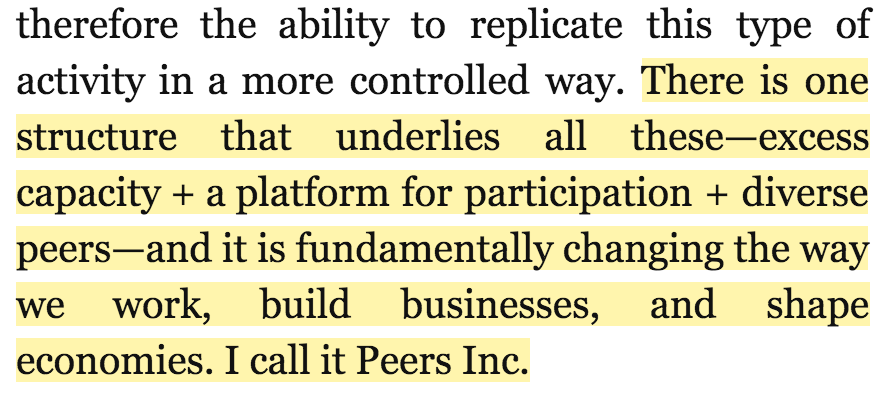
And then on Tuesday night I met Robin Chase and finally looked properly at the ideas in her book Peers Inc.  There, in the introduction, was a sentence that echoed what I was thinking and helped me make sense of our network in a different way.

Screen Shot 2016-03-04 at 17.06.15

We are definitely a group of diverse peers – one of the sticking points for many people hearing about us for the first time is “If these people don’t all have something specific in common, then what do they talk about, and how can it be of any value?”

We have a platform for participation – it’s every Friday morning at 10am for a couple of hours, it’s a marketplace where ideas and opportunities are traded.  It’s a very very limited form, compared to what it could be but because we’ve practiced it for many years now, some of us understand it very well.  I’m starting to think about what a web platform for this might look like.

And we have excess capacity, as I wrote yesterday – lots of people with underused or misused brains.

What if we could leverage these things together in the service of large organisations?

Which is why I just tweeted:

That’s what we’re going to make next.

Join me, comment, argue, nod vigorously, come and help, whatever works for you – but if you need help with thinking about how you can ride the waves of technological change  instead of being swamped by them, my friends and I are the ones you should be talking to.