Category Archives: words

Eaten By Code, Replaced By Robots?

I’ve put a proposal to write an article for Contributoria on the possibility of city workers being hit hard by the next round of FinTech development – Bitcoin brought us programmable money, Ethereum brings us programmable companies.

From the pitch: “is it reasonable to expect Financial and Professional Services to undergo the same kinds of disruption and rejigging that the web brought to film, TV, newspapers and music? And if so what happens to all the people who ‘do something in the City’?”

Contributoria is a journalism site where the articles are written, chosen and collaborated on by members of the community.  In my opinion, it’s managing to inspire and curate some really good writing on subjects that you won’t necessarily see in more mainstream media.  The choosing function is like crowd-funding but you allocate points that you get through membership rather than your own actual cash, but if enough of you give me your points, I get to write the article and I get paid.  You may remember that I was interviewed for one of Jon Hickman’s pieces there about a year ago.

So it’s like all those other crowd-funding things I’ve asked you to support, but this one won’t cost you anything, instead you get to play with the Guardian Media Group’s money – yay!

Here’s what you do:

  1.  Sign up at contributoria.com – you’ll see that there are paid options (including one that gets you a print copy, if that floats your boat) but you get 50 points to play with if you go for FREE.

  2.  Find my proposal page

  3.  Pledge as many of your points to me as you like (obviously I would like all 50 please!)

  4.  Tell all your friends to do the same (there are handy social share buttons for FB & Twitter)

  5.  If you’ve any left over do have a browse of the other articles being proposed and pledge for them too.

  6.  Sit back and wait till the end of the month when you can start to read my drafts and guide my writing if you like, or wait until it’s published on 1st September.

  7.  Also, probably get ready for me to ask you to ask all your friends again toward the end of the month, when I’m frustratingly close but not quite at the target!

Thanks my lovelies!

What was all that about? #llobo

Four years ago today, I sat in the park with my new girlfriend (now my wife), kissed her for the first time and then walked over to C4CC to pick up the suitcase, laptop bag and ukulele that would be my items of stability over the next year while I experimented with living with friends, colleagues and strangers.

I used this blog to tell you what I’d been doing but also to say “Hi, I’m here, but I’m ready to be somewhere else, do you have some work I could do?”  It was a great exercise, a stretch for me.  I gained humility and confidence in the value of my work.  I learned how to ask for what I needed and I learned about what happens when you present yourself as in need.  Throughout the year, people assumed that openly asking for help like this equated to helplessness.  And then I experienced three basic forms of reaction:

  • Identification: “Yes, I feel helpless about this too.”
  • Rescue: “Oh you poor thing, let me sort you out.”
  • Attack: “You lazy bastard, get a job like everyone else.”

It’s a well-recognised and strong dynamic.  But the year, in the end, turned out to be a daily practice to step out of the whole drama triangle dynamic, to let go of being helpless and with it let go of being bashed or rescued.

Tomorrow’s World

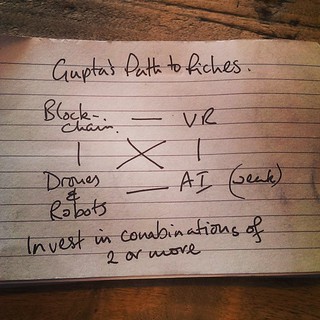
Breakfast with Vinay #tuttleA couple of months ago at Tuttle, Vinay expounded on his recommended VC strategy: invest in any startup whose product combines two or more of the following –

  • virtual reality;
  • weak artificial intelligence;
  • drones & robots; and
  • blockchain.

It’s been rolling around in my head ever since.  Of those people who are working on any of these, I think they’re mostly focused on a single silo as core – so when a VR company does something controlling drones, they’re probably just using drones as a use case rather than thinking “We’re in the Virtual Reality Drone Business.”

I think.  I don’t know enough of them to know.

But I do think this stuff is worth knowing more about because they all feel like unstoppable strands of the near-future.  They all feel like the internet did twenty years ago – yes you’ve heard of them, you know people are doing stuff with them but what really is that going to do for me?  And the combinations with other technologies are quite hard to think about because of this.  Even fifteen years ago the people saying that the future of the internet was mobile phones seemed to be few, probably right, but possibly nuts.

Here’s what I think is interesting about each.

Virtual Reality: means we can visualise and interact in some way with stuff that doesn’t or can’t exist in reality or we can make things that do exist look different, easier to interact with or more palatable.  Using sensors in the real world we can also mix things up, what we call “augmented reality”

Drones & Robots: I heap these together with devices on the network whose primary function is not computing (or computing as we know it)  they are machines that do stuff for us and replace some part of undesirable human labour, ultimately allowing us to do stuff we just could barely imagine before.

Artificial Intelligence: the “weak” modifier is important here, we’re not talking about sentient computers, rather things like voice recognition, machine translation, helpers like siri.  This is the software version of human-replacing robots.  Get a machine or a network of machines to replace some thinking-like function: decision making or sensory recognition or pattern matching.

Blockchain tech has started off by replacing currencies, but it’s becoming clear that the generalised form of bitcoin – a distributed ledger that gets its authority from the consensus of the network is a candidate for replacing all sorts of centralised databases and thus making all sorts of human activities in firms look horribly inefficient and redundant.  The best corporations may turn out to have been relatively inefficient cyborg machines weighed down by their meatware compared to a Decentralised Autonomous Organisation.

Within these silos, each of these technologies are on the road to being mainstream – it’s those combinations that make me think.  A robot that senses and makes decisions about its environment through a virtual reality interface but ultimately controlled by a DAO sounds Terminator-ish.

But there’s another thing.

In all technology, we face a tension between our desire to make life easier by replacing human labour with code or machines and our attachment to human labour as the primary sense-making tool of life and the means by which most of us get the things we need to live.

We seem to understand that work is changing but most of the #futureofwork stuff I’ve seen assumes capitalism based on corporations as a given.

I do have an opinion on this, I think we need fewer jobs and to really accept that people don’t need any more to work as hard or as long doing stuff to justify staying alive.  What I want to do more though is point out the incongruity that our tech efforts go into replacing human labour but our politics, culture and society, our communities and social interactions assume that everyone should have a job or some easily understandable means of income like owning or a company or assets that create value.

I spent a year a little while ago not living how most people live.  I lived out of a couple of suitcases and moved around, asking for work and places to stay through my social networks.  More than once I was asked “What if everyone wanted to live like this?”  At the time, I took this as an admonishment mostly, as a way of saying “You’re taking advantage of our work which has gone into acquiring this space for our use.  You’re working and storing it in social capital rather than in bricks and mortar or a career path, but we can’t all do that can we?”

Well, what I’m asking now is “What if we all have to do that?”  What if we make a huge leap in replacing types of work? What if, in the British economy, we made things that made our Financial and Professional Services as “not economically viable here” as coal-mining, steel work or mass manufacturing – the things that were the cornerstones of our economy when I was a child?

Whatever happens, it will be in the context of big demographic change too.  A lot of the way our bit of the world looks is down to the post-war baby boom.   All the boomers are over fifty now.  They’re going to die in the next twenty, thirty, forty years (me too!)

How’s it all going to work out?  Is this all what we really want?  Would knowing how the world is now have helped us at all forty years ago?  Can we just pause and check?

I think we need to talk a lot more about these things.  Tuttle is one place, but I’m going to be making time for other ways to engage over the next few months.  Please join me.

City Folk Eaten By Code

Out of the woods, into the City!

I went to the Ethereum Meetup last night. A suitably informal tuttle-ish mess of conversations about blockchain applications. Developers, startup founders and me, the social artist elephant in the room, wondering what this all means for the milling crowds of financial services workhorses I’d just passed through at Liverpool St Station.

It’s early enough for the “scene” to fit into the upstairs room of an Aldgate pub. And the talk reminds me of the way the web was in the mid-nineties. “All of this sounds great, it’s conceptually beautiful, but after working in a bank, actually running a business, trying to sell this stuff to people, it’s all just so messy!” said one participant.

It may be a long way off, but there is a feeling of inevitability about it, the way that it was obvious that our manufacturing industry would be replaced by some form of technology or sent somewhere else, but we just didn’t want to talk about it. I do feel a bit like someone standing in Longbridge in the late 1970s saying “You’re going to be a robot. You’re a robot. You’re a robot…”

#tuttle tokens

“Tuttle is like networking but isn’t the kind of thing where you pass around your business cards”

There was a time when this was a radical statement.  We were doing something new here by putting the focus on the personal relationship rather than the exchange of information.  You come along, you talk to people, you have ideas, you go away together and do stuff.  As opposed to: We meet, we exchange data, I give you a line in my database and hope that you’ll reciprocate, then our customer relationship management systems spam each other until one of us gives in.

I haven’t seen so many business cards on Friday mornings lately.  But when we closed down C4CC I found that the kindly folk had been preserving my card collection and so it was one of the few things I took away at the end.

This weekend, I sat down to look at them all. Now, not all of these are from tuttle, I will have picked some up from other meetups or through working with people at C4CC but there’s a lot of them.  I met a lot of people since 2008.

The first thing that jumps out is the weird branding choices we were making five or six years ago.  Mainly in the form of oddly-spelled business names and kooky sounding job titles.  I’m not going to single anyone out because we all did it in one form or another.  I suppose it was part of a whole bunch of people creating their own personal brand for the first time through trial and error.

There were a lot of people who are now Facebook friends or whom I follow on Twitter.    We’re connected, I can get in touch with them, I know who they are – was there a time when they had to give me their card?

And then there are the hundreds of people who I have no idea about at all, I don’t remember their name, I don’t remember their business, I kind of understand why I might have bumped into them, but the handing over of the business card was the last I knew of them (presumably because neither of our customer relationship management systems were that hot).

We talked about exchanging tokens last Friday.  A general conversation about cryptocurrency turned into a more specific “What would a TuttleBuck be like, what would it be for, how would they be created, what would they be worth, how long would they last, would there be unexpected consequences?”

I’m interested in the idea of creating something that marks attendance and then seeing what happens to it.  If you accumulate 20 Tuttlebucks in the next six months what would you do with them?  It’s not meant as an incentive, it’s not for the purpose of increasing attendance, but wouldn’t it be interesting to see what effect it has?  Which points me to thinking “What are the questions to ask when you’re creating a currency like this?”  Because there are going to be a lot of them and we’re going to have to get used to dealing with other more sophisticated forms of contract than cash.  Is there a checklist of things you have to think about?

Postmodernist Parties

Not well thought through, but rattled off after a good night’s sleep – fill in the gaps and polish up for me, would you?

I’m noting that one issue is political parties’ separation from culture which means they’re unconsciously driven by cultural trends rather than being on top of them.  Long words made shorter: this election was not a fight between political parties but between re-enactment societies.  We were asked to choose between present-day representations of aspects of the 20th Century.

So Labour offered the Spirit of ’45 – the party of the NHS and the broader Welfare State.  UKIP are Mosley’s blackshirt re-enactors, while the Tories and LibDems present the Downton Abbey tableau, respectively taking the stereotype roles of firm but fair toff and the wild idealistic toff.  Actually the LibDems also still have a strong social democratic streak and so get blurred with some Wilson-esque “White Heat of Technology” stragglers.  The Greens are probably the most present of the bunch but that’s just because it really is the dawning of the Age of Aquarius!  Or something.  Still, to most people they’re muesli-knitting Greenham Common protesters with an “Atomkraft? Nein Danke!” bumper sticker.

About Last Night…

When the exit poll came in, I was just thinking of writing something here about the likelihood of a shock election result, given the filter bubble/echo chamber effects in social media.  I didn’t know what the shock would be, but it seemed to me that my feed was so strongly in tune with what I was thinking that it was likely to be Facebook’s algorithm trying to make me happy rather than a true reflection of the polls.

And that’s as far as I got when the first shock came.  It was like hearing something that sounded like a car crash outside your house just when you were expecting visitors – things slowed down as I raced (while marvelling at the haircuts and overall maleness of the BBC coverage) to understand what might have happened – surely it would be alright, don’t be silly, go to bed, it will all seem better in the morning.  I stayed long enough to see the Tory win with only a tiny swing to Labour in my constituency.   It was going to be bad.

It was.  In the morning, the BBC was (correctly as it turned out) forecasting a Tory majority.  This was really not what I’d expected.  I hadn’t even thought of that as a likelihood, to me it had all been driven by the opinion polls pointing to a neck-and-neck race, so all the talk was about what compromises would have to be made.  Now we know that the only compromises that will have to be made will be within the Tory party.

I thought, this morning that, I felt disappointed.  But disappointments pass – I saw people pick themselves up, dust themselves down, start all over again, but I didn’t feel able to do that.  I went to Tuttle and we picked over the bones of it – it was good to not be alone with my head.  Then I walked all the way home and had a cry and had a sleep.

When I woke, I realised what I was feeling.  It feels like grief.  It feels like someone died.

It’s not quite grief for the Labour Party, that died for me in the early nineties, Blair never worked for me although I have continued to faithfully vote for them (and I still will until something better comes along).  I’ve marveled at people who said they needed to think about who to vote for.  I’m just not that sort of person and no amount of information, reasoning or shouting abuse will move me, save your energies for someone else.

No I think what I saw dying overnight was the Welfare State.  We, as a country, voted against the Welfare State yesterday – the NHS is the most obvious part of that but, as a country, we said yes to the Bedroom Tax and no to a Mansion Tax.  Saying “I believe in the Welfare State” used to sound ridiculous to me, as ridiculous as saying “I believe in sausages” – sausages just are, there’s no believe or not believe.  And, in truth, the idea has been dying since 1979 but now it really feels like it’s gone.  We’re going to have to come up with another way of looking after each other.

I can see the positive in there, because I’ve held on to ideas and behaviours that needed to die and eventually gone through the process of letting them go and finding that there’s something so much better on the other side, but I’m afraid of going through it and I’m afraid for other people who might not be as strong as I am.

We are going to have to come up with another way of looking after each other.  Because the state isn’t going to do it and the market isn’t going to do it and the Big Society isn’t going to do it and if we don’t do this we stop being civilised.

Dougald wrote some great notes today.  Including: “11. This is not just a battle of ideas, it is a battle for the soul.” For me, the root of this is “Thou shalt love thy neighbour as thyself”.  Easy to say, hugely rewarding to practice, bloody hard (though not impossible) to do.  There aren’t any quick and easy ways through this, but accepting that it’s here and that the solution is within us is the key.

In the meantime, I’m going to look after myself the best I can, talk about things, preferably in a more human way than writing blog posts and posting to Facebook, be as excellent as I can be to everyone around me.  And I shall be looking out for those who are suffering too.  Especially to anyone with mental health issues, disabilities or long-term illness who might feel like hope has gone, you’re not alone, we’ll get through this together.

Living in the future

I’m sitting here in my living room, listening to Louis Prima, recorded in 1956, somehow ending up on my phone and being played through my phone’s network connection to my television set.  I’m typing on a computer that’s not much larger than an A4 pad of paper and you’re reading this wherever, however, whenever you might have made the mistake of clicking on a link or firing up your feed-reader.

I can also use my phone to watch TV versions of comics that I read as a child.  I could probably, but don’t, get digital copies of those same comics to view on whichever device I choose.

I can find and play just about any piece of music recorded (just about) just by asking my computer and I can record my own music and make it available to you in the same way.

Wow! Still haven’t got over this.  Wow!

I went to see the latest Avengers flick this week.  I’d been looking forward to it but felt a bit dissatisfied at the end, it was a bit like Christmas, so much anticipation and it was fun while it lasted, but then… then well back to the future.

Every now and then I’ve seen artists asked “What do you think you’d be like if you’d had access to YouTube when you were a kid?”  I have no idea.   It would have been so different.  How could I tell?  I expect I’d be very different.  I mean, all of the above is still wowing me but my way of interacting with culture through my teens was to engage intensely with a (relatively) small pool of stuff and to do so over and over again.  Listening to records until I knew every note and cassettes until they literally wore out.  Reading comics and novels over and over, finding more each time.  Getting hugely excited by a re-run of some beloved TV or film.  Let alone organising all free time around the contents of the Radio & TV Times.

Which I guess is why, when given the choice, I’m listening (again) to some Italian-American guy from 1956.

Help Please: #workshop34 Final Report

I’m writing a final report on the work I just did in Sittingbourne, opening and running a pop-up shop and co-working space in the High Street there as part of the EU-funded ReCreate project.

This is mostly a request for help from people who were familiar with or directly involved in the project, but I’m up for feedback from all sides.  In fact, just writing that has helped me see that I’d like to make it much easier for people to read who had no exposure to the project at all, but that might be a longer-term goal than getting the final report submitted with the final invoice!

This section is meant to sum up the Key Successes.  I’d like to know whether:

  • you agree that these are indeed the key successes – and if not what you’d add or take away;
  • you think there are better ways of saying what I’ve said;
  • you have better examples than the ones I’ve used to illustrate the success; or
  • any of it doesn’t make sense at all to you.
  • Or, y’know, anything else that would make it better.

Thank you!

Key Successes

Reactivating the High Street
We made a difference to how the street felt to local people and to how people thought about using empty spaces.

Sittingbourne High Street has lots of empty shops, especially towards the eastern end where workshop34 was. We immediately brightened this area, simply by cleaning the exterior, removing fly-posting and putting the lights on. Once we opened the doors for business and hung the bright yellow sign above the doorway we made a real difference to the feel of that end of the street – many people would simply come in to see what was going on because they were so surprised to see anything happening there.

We had good relations with neighbouring shops from the start. The owner of one local jeweller visited in the first week and we got to know especially well the local cafe owners, encouraging shop users to buy their lunches, cakes and coffees in one of the three nearest ones.

We encouraged Belinda Gyampa, a local hairdresser specialising in African haircare, who had become a regular user of our shop first to visit and then take on one of the retail units for hire in the building opposite.

Led by Community
Many spaces supported by ReCreate designed an offering and then fitted local people into it. We took the opposite approach – asking people what they wanted to do and then saying “Yes, do it!”  As a result we squeezed a wider range of activities into the short time-frame than we might have otherwise done.  

While we know a lot about what works in pop-up shops and creative collaboration spaces, we are also strongly committed to doing things with people rather than for or to them. During the month of November, Lloyd sat in the shop most days and simply talked to people about what they would like to do ithere. He almost always said “Yes! Please!”, partly because there was little time to be fussy and turn down stuff, but also knowing that only a small proportion of people would come back.

The other reason for giving power to the community from the start is that it makes it much easier at the end of the project. Lloyd works on the basis that the best success is when the group believes that they did most of it themselves.

We also wanted to break the dynamic of dependence – the cycle of someone with grant-funding coming and doing something for the community and then disappearing without empowering anyone doesn’t help in reactivating the High Street. So we stepped outside of giving people what (we think) is good for them and gave them what they wanted: space to work together, the power to decide and the power to change their mind if it didn’t work.

Building Confidence
Together we all grew in confidence as we tried things and they worked. Most obviously, some people showed and sold their creative work for the first time, but others benefited in more subtle ways.

Giving people the responsibility of deciding what to do and of delivering it means that they get to do things they might not have done before. Even those who had run or worked in the previous pop-ups gained from being able to focus on making good work and selling it, rather than the tedious admin and management responsibilities.

People in Sittingbourne are used to people saying “No” to them. Saying “yes” to everything meant that we were able to reduce scepticism and support a much larger number of artists than expected. And for every artist who put their work on sale there were probably twice that who didn’t bring anything in, but who went away encouraged and reminded of their creative dreams.

We were grateful in particular for the opportunity to work with young people from Sheppey through the YAF project and help many of them show their work for the first time, make decisions about how to present it and price it for sale. The festival’s poster was designed and laid out in the shop with one of the young people working alongside an older experienced designer/photographer.

Several artists, regardless of age, showed and sold their art work for the first time ever in workshop34 and while selling is not the primary motivation for most people, they did feel added validation when one of their pieces was bought.

Sharing Space
In most spaces, one vision has to win – here we chose to help the vision emerge from hearing everyone’s point of view equally.  People learned valuable skills in negotiating a common vision.

A challenge for this disparate group of artists, entrepreneurs and those who volunteered in the shop was to let everyone to do what they wanted and needed to do, but without preventing others from doing the same.

This was hard. People expected either someone to make all the decisions or else to be left to get on with what they’re doing and ignore the rest of the group. In workshop34 we encouraged them to negotiate conflicts over space usage. Whenever Lloyd was approached to decide who was right or who had the better idea, he always pushed it back to the group and got them talking to work it out for themselves. As a result, more things happened, people gained new skills in negotiation and learned to let go of their attachment to winning at all costs.

Creating Financial Flow
We didn’t want to just be a subsidised space that gave everything away. While we believe the High Street is more about health than wealth, making money is an important part of reactivating community.  Many of the people involved made money, and made progress developing business ideas.  We made great progress towards being self-supporting.

It was important for us to put the project on a commercial footing from the start rather than starting with everything free and then had to impose charges. Lloyd took the approach again of letting the space users lead this. We quickly established a 20% commission deal with no hanging fee for artists but whenever someone wanted to run a workshop or hire a room we talked through what they could realistically afford – most people were running events for the first time, or just starting a business and rather than put pressure on by insisting on a standard fee, we were able to work with them to find the best deal for all of us.

As it was, from the beginning of December onwards, we ended up taking just over £3500 in sales and workshop fees/room hire, three-quarters of which went directly to the artists, makers and workshop leaders.

Most Admired Creative People

I’ve been writing a thing about Creative Collaboration – it’s a subject I’ve spoken about a lot and I often assert that all creative work is dependent on more than one person and that nobody does amazing creative work on their own – we just have a habit of ascribing genius to individuals because, well, individualism. See I’m never going to do a PhD 🙂

Anyway, it made me think yesterday when I wrote the following:
“Think of your favourite creative person, the odds are that you can quickly see that they required collaborators in one form or another even if those ‘others’ are not normally credited, whether it was a supportive spouse or life partner, a teacher, a muse, a tireless editor or a creative partner who brought something to the work that one person couldn’t achieve alone.”

And I thought, “I wonder who people would think of as their favourite creative person.”

And so I asked my Facebook friends

“Which creative person do you most admire or envy? All disciplines. All of history. Go!”

and they told me.

There were a few names that came up more than once:

Leonardo da Vinci x3
Pablo Picasso x3

Frida Kahlo x2
Miles Davis x2
Patti Smith x2

Here are the others in lazy alphabetical order of their first name (some of them only have one name!) There’s at least one married couple in there and more than a couple who are well known for not getting on very well. I haven’t counted how many are dead and how many alive. Some are characters from creative works themselves. A quick scan suggests they are mostly musicians, painters and writers, but there’s also a footballer, a chef and a carpenter. I might go back and look at the gender split – how many women chose men and how many chose women and vice versa.

I’d be surprised if you knew them all, I certainly didn’t – but I’ve added wikipedia links to help us all rise out of ignorance.

Ada Lovelace
Alan Turing
Amanda Palmer
Anton Chekhov
Arthur Smith
Augustus Pugin
Bessie Smith
Billy Childish
Billy Wilder
Bjork
Bob Dylan
Bob Marley
Charlie Brooker
Clive James
Cory Doctorow
David Bowie
Dennis Bergkamp
Dorothy Parker
Douglas Adams
Duke Ellington
Eddie Izzard
Edward Hopper
Frank Gehry
Frida Kahlo
Geoffrey Perkins
Georgia O’Keeffe
Gilbert & George
Guy Savoy
Harry Tuttle
Iggy Pop
Imogen Heap
Jack White
James Brown
Janis Joplin
Jesus
Joe Strummer
John Coltrane
Joni Michell
Jordan
Katharine Tynan
Ken Robinson
Leonard Cohen
Leonardo da Vinci
Louis CK
Marguerite Patten
Marina Abramovic
Michael Jackson
Miles Davis
Milton Glaser
Mitchell Baker
Moebius
Neil Gaiman
Nickie Wildin
Oscar Wilde
Pablo Picasso
Patti Smith
Philomena Cunk
Prince
Rembrandt
Richard Feynman
Samuel Beckett
Sandra Bernhard
Scheherazade
Sir Harold Nicolson
Steve Jobs
Suzette Haden Elgin
Takeshi Kitano
Thomas Pynchon
Tom Tykwer
Tony Hart
Tony Sale
Virginia Woolf
Viv Albertine
William Blake
William Gibson
William Turner
Yuri Pysar

Oh and I was interested to see that people weren’t quick to go with “envy” rather than “admire”. I don’t think it’s very easy to admit to envy anywhere, even Facebook.