
Category Archives: words

Some things from my head following #commscamp13

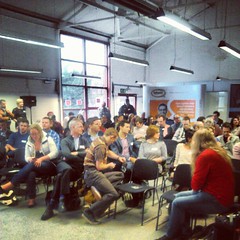
View from the front #commscamp13I’m grateful to have been asked to facilitate CommsCamp13 which was organised by @annkempster @danslee and @darrencaveney in Birmingham the other day.

These are some the things that are rolling round in my head as a result. Not all of them come directly from experiences at CommsCamp13, they may be things I’ve wanted to rant about for some time, and now seems to be as good a time as any. Some of these may turn into longer pieces, although it’s more likely that they’ll just sit here taunting me, saying “Why don’t you explain what you really mean there Lloyd?”

0. People are amazing. Groups of people are amazinger.  Groups of people allowed and encouraged to talk about the things that they really care about are the amazingest.

1. Lloyd! Stop trying to be right.  I find it really hard, but I try to keep following the golden rule: “Be prepared to be wrong, even when you’re right”.  Having said that, many of the following points read as pompous declarations of my unshakable will.  Prepare your pinch of salt.

2. If you don’t like this thing, start your own thing.  Nobody is gripping onto this “brand identity” nearly as hard as you imagine.  If you don’t like the fact that there’s only one UKGovCamp a year and the same 200 people always seem to go, set up your own (you might even get a grant to help). If you want a #jelly or some tweetup in your town or region, do your own. Use #wewillgather for smaller things if it helps.

3.  Run sessions your way.  This is a development of the previous point – nobody has decreed, nor do they have the right to decree, that all sessions at a camp have to be sitting round in a circle having a therapy session.  We can do whatever we like – some of the best sessions I’ve been to at other camps have been “I know nothing about X, please come and enlighten me” or “Let’s make a Y in 45 minutes”.

4. No spectators.  I felt that we’d lost this a bit – it’s much harder in a one-day event and using traditional conference venues but we had 25-35 potential sessions and 140 people attending, so even with every session leader doubling up we’d only have half of the group able to lead even if they wanted to.  The no spectator rule is there, imho, to ensure that we don’t get into an us and them situation – encouraging everyone to have something even in their back pocket is an important part of pre-camp that we forget.  We saw a special case of this on Tuesday which was a lack of women pitching for sessions in the first round, fortunately there were some brave enough to point it out and I think we fixed it, but still, I think it would  help to make it clearer that there’s an expectation that you bring something to talk about, that it’s just part of the process.

5.  We’re all just folk here.  This is hard at UKGovCamp, but it was even harder this week – leave the corporate ego at the door – remember that everyone else is in the same boat as you, no-one has all the answers, we all have an equal responsibility for the success of the event.  Some people are effectively paying to be there, not everyone has a job that either treats this as part of your development or paid leave.

6. I love “Fuck it” moments.  One of the best stories I heard was from Rae Watson talking about her experience of doing the right thing once she’d heard she was being made redundant.  Lovely, nothing to lose attitude which inspired me to call for a rolling programme of redundancies across the public sector 🙂

7. “The future is …not very evenly distributed.” You think?  This may come under the heading of “stop trying to be right” but really, the world *has* changed, hyperlinks really do subvert hierarchies, this is what is going on here, the institutions we work in are struggling and collapsing because the network crosses their boundaries without permission and with great ease.  I heard way more people than I expected to still talking about messaging and selling social media to senior execs.  Keep the focus off technologies and put it on power and service structures.

8. A camp is not about information dissemination.  It probably will happen as a by-product, but the purpose of the day is to encourage conversation and the resultant building of relationships. These are vital elements of the networked world – the ability to have good conversation and the richness of relationship that emerges therefrom.  This is where the value is, both to us as participants and to the organisations we’re part of.

9.  It’s your process. I know I’ve got it right when you don’t credit me and you say “we did this”.  It’s one of my favourite bits of the Tao Te Ching – Chapter 17

The Sage is self-effacing and scanty of words.
When his task is accomplished and things have been completed,
All the people say, ‘We ourselves have achieved it!'”

10.  It’s a 3-day commitment for me.  There’s very little traditional prep and follow-up but I need a good half-day before to warm-up and clear out the rest of the world and then a full day afterwards to recover.  I need to reflect this in my diary-planning and in my fees.

11. We *will* break your wifi.  John Popham has already summed up the connectivity issue for most conference venues. Related: spambots may break your hashtag…

12. The view from the front.  That’s the title I gave the picture above.  It shouldn’t be like this.  There’s no reason to put everyone else face-front: we embrace circles when we go into sessions, we should do the same in plenary.  I think it would do a lot to reduce the sense of us-and-them.

13.  Stop trying to please everyone.  Media folk in public service have to juggle the goodwill of elected representatives, organisational managers, journalists and the public.  You can’t please all of these groups all of the time.  If you have to pick one, pick the public.

Turns out there’s thirteen, which is good since I’ve noticed many events this year have 13 in the title for some reason…

I’ve started watching “House of Cards” on Netflix #houseofcards

I had a long period of TV abstinence beginning in about 2004 (I guess it was about when I started writing here – something had to go to make time for it).  But Netflix has drawn me back into fairly regular TV watching because it’s totally under my control and it makes a decent fist most of the time of alerting me to things I’d like to see.

Lots has been written about the new House of Cards which is not being shown on regular TV.  It’s on Netflix-only, and the 13 episodes were released all in one go last week.  Mostly though people are focusing their attention on the novelty of the release rather than the programme itself.

Which is a shame, because it’s very good.  I haven’t gone full throttle into TV addiction yet so I haven’t succumbed to the temptation of just watching the whole thing in a 13-hour marathon, but I’ve managed the first three episodes and we’re getting used to the characters and seeing some of the storylines start to firm up.

I was initially disappointed to realise (it came in the first few shots when Kevin Spacey turned and started talking to camera) that it’s the Michael Dobbs/Andrew Davies House of Cards remade in today’s US political scene.  Disappointed only because the original was *so* good, so captivating, so of the time and shockingly near to what we suspected the inside of party politics was like, long before The Thick of It.  And because Ian Richardson was so compelling: simultaneously adorable and despicable.  And because I’m rarely won over by American remakes of British TV.  Where I am at the end of episode 3, Spacey hasn’t quite reached Richard III levels of despicability but he’s getting there and I fully believe that he pulls it off by Episode 13 and Robin Wright is an able Lady Macbeth.   Part of the draw for me is seeing how the other recognisable characters might turn out – although it’s pretty much a question of how they will meet their various sticky ends rather that whether they do (I hope).

I like the graphic overlays that denote when people are texting each other.  It lets the acting continue without cutting away to a close-up of the phone screen.  I haven’t seen it done as authentically before.

It’s very interesting to see it transplanted into American politics and the DC village rather than the Westminster one.  Though I am wondering why it took 23 years for this story to be acceptable to a US audience.  Is American politics in a similar place now to where we were at the end of the Thatcher era?  I guess there are similar levels of disillusionment with the system, but has that come about recently? Is it a new thing?  If we got any faith in the system back in 1997 we’ve lost it again since.

One thing that does crop up with the all-in-one release thing is that it makes it hard to have an online social experience around it and so it’s hard to write about without some spoilers – it’s neither like a movie (which you’ve either seen or you haven’t) nor like a standard TV series (where you might allow people to be a few episodes behind, but pretty much you expect everyone to be up to date or avoiding any reviews).  And of course it’s also a remake.

But do I hate spoilers so I shall wait until a significantly larger number of my friends are admitting to having seen it.


Pick-up lines

Karin sat in Caffe Nero and waited for her soup.

When it came she heard a laugh, well, more of a snigger, but not a cruel one.

“Your soup matches your dress!”  The guy sitting at the next table was grinning and looking at her.  She tried to work out whether he was being an idiot or just inappropriately friendly for this part of south London.  She saw a heavy, large-print Bible, it’s pages covered in annotations and faded highlighter, lying open in his lap.  She smiled, but decided against further engagement.

She stirred her soup and looked at it intently.  So did he.

He sniggered again, “I saw a movie yesterday where something just like this happened.”

St Mary Street

My glamorous life #ourdigitalplanet[Written in a notebook while I was in Cardiff in October 2012]

“A quiet morning on the street, the rain hasn’t yet kicked in but the cold wind tells you that it isn’t far off. It’s time for the town’s drunks to converge on the Spar to buy their first tins of the day.

Not their first beers, mind, they needed a beer at home to get out and about but this will be the first they part with cash for.

Ten minutes later “Babyface” appears. He hasn’t saved enough from last night to go in the shop, so he hangs in front of the Spar asking for change until someone buys him a single can of Tennants which he downs almost in one.

A dark haired man in a track-suit walks slowly up from the Morgan Arcade. “Listen to me good. No, you listen to me ya fat c**t I’m calling you now, so just listen…”

A fat bald man, in a grey hoodie and white shorts with black slippers on his feet, goes to the cashpoint. His head is so fat he has to move the phone from his ear to his mouth when he speaks.

Babyface bumps fists with a straggly bearded dwarf and they walk off together.”

Today’s thought

It doesn’t matter how many times you write it out or make a list, do it.  There’s a voice that says it’s avoidance of really doing something, but it’s not.  It’s progress.  It’s getting today’s thought out on the page.  Today’s thought leads to today’s action.

I’m always saying “Screw it!” #LLBS

I’ve been asked to speak at the Late Late Breakfast Show this Wednesday on an occasion in my career when I’ve just said “Screw it!” and how it’s helped.

I think this is the foundation of just about every success I’ve ever had.  Very little has worked for me by trying to follow “business as usual” but it still sings a tempting siren song on every project I start.

Register to hear me pull out some of the more entertaining times I’ve said “Screw it!” as well as some even more interesting people riffing on this subject.

[bds]Last few hours, what happens next?

I started writing something about what happens if I don’t hit the target or what happens if I exceed the target and it just felt all wrong.

The first one particularly felt like:

  • introducing some sort of fake jeopardy to induce people to part with cash;
  • writing a risk register (*shudder*);
  • just a lie really because I know and you know (if you know me well enough) that I only ever do things that I’d do even if it didn’t raise any money at all and that half the fun is making do with what you’ve got instead of throwing money at problems to make them go away.

So it’s going to happen whatever, but I will be able to spend more time on this project if the pot is fatter and less time if it’s slimmer – simples.

So go ahead, make it fatter

The one thing I do want to avoid is having a conversation with someone that goes “Oh what a shame you didn’t come last month, I had a load of old film that I didn’t know what to do with, so I chucked it out.”  So I’m going to get on with this thing as quickly as I can with whatever resources I have.

Today I’ve purchased digitalshoebox.org.uk it points to the campaign page for now, tomorrow it will become the real home of the project!

[bds] Bromsgrove’s just the beginning. Thanks @MMaryMcKenna!

I’m working on a digitised archive for Bromsgrove (last 48 hrs of crowdfunding) first because it’s a space and time that I have some knowledge of, I know the geography, I know some of the people who were there, I have stories of my own to tell.

But as much value as I think is there (and I think there’s loads) I’m just as interested in this as a learning project that can be replicated in other places.  One of the attractions of Bromsgrove is that there’s very little notable about it.  Until you start to dig…  It’s nowhere special (for that value of special that we’ve developed during the last 100 years) but everywhere is special, everywhere has interesting stories to tell, it’s just more obvious to me what they are for this case.

So what about applying it in more conventionally “interesting” places? One of the most idea-sparking conversations I’ve had about possible next steps (always remembering that we haven’t done the first one yet!) came up yesterday at #altukgc13.  I was talking about the importance of standing up for our own home-made media to tell a fuller story than mass media can and Mary McKenna pointed out that while the BBC has loads of archive material about Northern Ireland in the 1970s it’s completely dominated by stuff about the Troubles.  And this might be a really neat way of telling more rounded stories about life beyond the ethno-political struggles and violence.

Oh yes.  I like that a lot.  We’ll do that.

#ukgc13 #altukgc13 A couple of things to remember when watching the stream

Just scribbling this at lunchtime.  For those not in the know, we’re running a massively cut-down informal version of UKGovCamp in a public space at the Royal Festival Hall basically “because snow”

We’re running a live stream via Google Hangouts which then ends up on YouTube.  I’m just sayin’ the following:

The stream is provided strictly on an expectation-free basis.

  • I know it’s frustrating if you’re listening to our conversation and then suddenly you can’t hear anything, but I think we have to make the conversation work foremost for the people in the room.
  • We’re working for free in a public space of public wifi with a macbook air and a snowball mic.  That’s the best we’ve got.
  • None of us is being paid to be here, we’re all showing up for the conversation on the same basis you are, because we want to have the conversation and we’re having it now.
  • No-one’s in charge here, we didn’t make a decision that we would stream this thing and then go about implementing it craply because we’re crap, we just thought it would be a good idea.
  • This is not the only chance ever to join in this conversation, UKGC13 proper will happen soon and you’ll get the chance then.
  • I can get a bit pompous and up on my high horse sometimes, I try not to, but I may be doing it right now.  If you read what I’ve written and think “what a git” I’m sorry you feel that way.

Now we’re going to get talking again.

[bds] It’s a long-tail thing

The reason for stuff staying in the shoebox is often “Who would want to see this?”  This is partly because we’re used to the idea that in order for something to be made publicly available, a lot of people need to want to see it.  The reason that used to be the case is that it cost something to reproduce and distribute media.  That cost has now fallen to practically zero, but our thinking hasn’t quite caught up with that fact.

The work I want to do on this project is not about finding a small number of images or films that will engage thousands of people.  It’s about finding thousands of images, each of which might engage a small number of people.

I spoke to Bill Thompson about this, he’s a big cheese in the working out of what to do with the BBC’s huge amount of archive material. He pointed out that most items are going to have little or no value to the majority of people, but for the *right* people, they will be priceless.

Suppose I show you a picture of a party twenty-odd years ago, you vaguely recognise some of the people in the foreground  but slowly you realise that the slightly blurred couple on the left are you and the love of your life and what’s captured there is the first few moments you ever saw each other.   Now to anyone else, it’s just a picture of some slightly drunk people with a rather strange taste in fashion, but to you and your beloved? It’s *that* moment!

Of course, not every photograph holds images of people who’ve since spent their lives together, but I believe that that sort of value is more common than we usually think.  And it’s the kind of effect I hope to find in this work, the  sort of value I hope to create for people who see the archive.

Help me make this