Smallbizpodder adopts diversification strategy

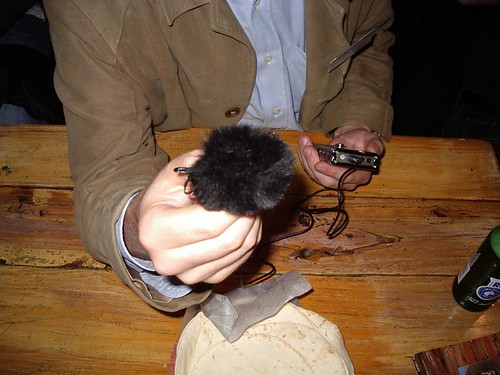
Alex Bellinger (he of the excellent SmallBizPod – small business podcast, inventor of simultaneous podcasting and owner of a hairy wotsit) has a new personal blog called Verbalism.

I think it’s personal in the sense that it’s not the smallbizpod business blog as I haven’t seen anything (yet) about Alex’s cat, crushes on his English teacher nor the size of his hairy wotsit, but it’s still early days.

Alex is a little worried that in the age of ubiquitous RSS you might not get to see verbalism in all it’s shiny clean newness, so I encourage you to go over there and prove him wrong by trampling all over his comments.

Things coming together

Johnnie Moore puts out a great podcast conversation with Chris Corrigan and Rob Paterson about “unconferences”

David Wilcox asks “Why aren’t events about engagement more engaging?”

And Doug Kaye announces his intention to extend IT Conversations

I put all of this together with what I’ve experienced in presenting my part of the results of BARC, LesBlogs, the Geek Dinner and this post that I wrote almost a year ago, not to mention what I said the other day about RTS2005 and there’s a picture beginning to form. A grey, mussy, cloudy and unclear picture but a picture that starts to look like a business opportunity nonetheless. What’s needed after all this talk is action, but which actions to take first aren’t immediately obvious to me.

Which again, is why I blog.

tags: & & &

A new Perfect Path blogchild

Peter Martin of Junkk.com is blogging. A couple of weeks ago, he hardly knew what a blog was. Then he took his company to Internetworld and while on the stand got talking to Geoff Jones and came and heard my talk on blogging & marketing.

I could tell he got it, but wasn’t sure if he’d actually do it this fast.

He writes, naturally enough, on re-use, re-cycling and anthing else re- he can think of . Go taste, and leave him a comment to let him know who sent you.

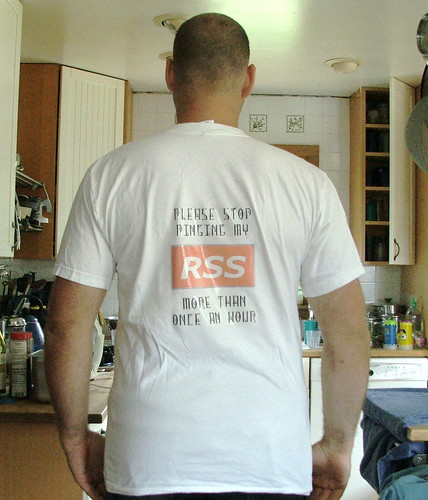
Mmmm… nice RSS

rss_slogan_1rss_slogan_2rss_slogan_3
Maybe now that RSS has come of age these are past their sell-by date, or maybe it’s just the right time to ride the wave, or maybe they’re not nearly as funny as I think they are.

Whatever. They made me laugh as I made them. Take the idea, riff on it, if you like. I release them under the usual creative commons by-nc-sa licence so you can put them on t-shirts, postcards, mugs, posters, pocket-patches, whatever you like, just tell folk where you got it, don’t try to make a buck out of them (without asking first) and pass them on in the same spirit as they’re given – you can get jpegs of each on my photostream at flickr and a pdf with all three from here.

UPDATE: The podchef made one of his own already. Not only that, but there’s a t-shirt too!

UPDATE II: If you can’t be RSS-ed to do it yourself, you can always purchase a ready-made print/t-shirt/mug/postcard

NB: due to the current exchange rate and shipping costs purchases in US$ might be prohibitively high. This weekend probably isn’t the best time to remind my American readers that if only their ancestors had done what they were told and paid their taxes, they could still be British and it’d be easer for them to buy British and therefore they would be much happier all round 😉

tags: &

The Queen’s telly club

The Royal Television Society holds its biennial convention in Cambridge this September.

Charles Allen, CBE, Chair of the 2005 Convention says this in the invitation blurb:

“All of us in the TV industry, producers, broadcasters, are facing what has been described, rather painfully, as ‘Burning Platforms’. Add to that the very real threat of mass piracy about to hit us as it did the music industry and the challenge of delivering to advertisers the attention, rather than just the eyeballs, of a multi-tasking generation, and the issues of the future becomes frighteningly stark. Oh… and we’ve also got an irritating blue frog with airbrushed genitals to contend with!”

So they are coming together to answer these questions:

“How should we rise to the threats and the challenges of a world which is ‘Always On’? How do we ensure that we continue to enjoy in the next 10 years the wealth and depth, the quality and the invention of television that we have enjoyed in the last? And, as this is an issue that we all face, it’s vital that you are there to contribute to the discussion.”

Mmm… I think Charles may be thinking of a different ‘we’ than I am, but may I humbly offer some suggestions?

  • I sense that your chirpy tone is like a small boy, whistling in the dark – that’s OK, this world can seem scary, but it needn’t be, if you approach us in a non-confrontational way, you will find us to be friendly and helpful. If you can’t do that, some of us will find it hard to resist biting you on the arse, the others will just leave you to wither. (Hint 1: start off by giving up the name-calling – don’t label anyone a pirate unless they choose to do so themselves. Hint 2: ‘Mass piracy’ implies everyone’s doing it – that’s the same ‘everyone’ that you usually call your ‘audience’ or the people who pay your wages.)
  • Loosen up, open up and accept that you’re no longer alone in this room. Adopt these new tools and ways of working – they can benefit you too!
  • TV is dead, because broadcasting is dead. Not broadcasting as an industry (yet) but broadcasting as an organising principle for communication and for wider society. Get Dave Winer to speak on this and the death of monoculture. For a taster, listen to Morning Coffee Notes for May 12th especially the last 7 minutes.
  • Get Paula Le Dieu to speak on the Creative Archive and Creative Commons and how they can be your friends.
  • Blog, Vlog and Podcast this as if your life depended upon it – start immediately and you could generate enormous buzz about this.
  • Start a wiki to help get other people working on this with you and to create a record of the event.
  • Hire at least two vloggers and podcasters to cover the convention week (ie last-minute preparation through to closing) and produce a take-away DVD.
  • Create a video of the opening session/dinner, post it, blog about it, get others to do so too. Use flickr, technorati and del.icio.us to pull everything together using tags. (hey I made one up for you below!)
  • Encourage, sponsor, do (whatever!) the organisation of two alternative conferences, one elsewhere in Cambridge and one on-line at the same time – get a video-link between the two physical spaces and have a session where people from each can ask questions of the others.

Finally get someone ultra-cool, switched-on, and plugged-in to help you with all this and to dream even bigger dreams. Oh wait, you already did!

tags: & & &

Photo by sickler

Itune out, drop off, turn in

Having read Neal’s post today and having had something of a blog binge earlier, I thought I’d catch up with the rest of the world and have a look at Itunes 4.9

Perhaps I wanted to wind myself up as an antidote to all the unravelling of ideas that I’ve been doing, I don’t know, but I wish I’d chosen something gentle like self-administered trepanning instead.

I’ve now walked away. I am calm. I have forgiven Steve Jobs, for now.

I cannot be arsed to add their elements to my feed. I cannot be arsed to join up and give them my credit card details so that I can put them straight on my podcasts metadata. I cannot be arsed to dig around to find out how to correct what’s already (half) there.

When at least three people approach me independently of each other and say, “I’ve been looking for your podcast on Itunes, but I can’t find it anywhere” then I shall contemplate doing something about it.

I’m glad my best podcast buddies are similarly cool.

Get to the point Lloyd

hovercraftThere’s actually something else I want to say about this “why I blog” thing. Blogging and podcasting have something really useful buried within them. They’re about ‘dialogue’ and dialogue is a (perhaps the) great tool for unlocking creativity.

When I blog or create a podcast, I’m initiating a dialogue on a couple of levels.

I’m conducting a dialogue with myself, usually with the motivation of understanding better what I think, what I’ve been doing, who I am, who all the people around me are. Regardless of whether anyone else reads/hears/sees what I’ve written/said/erm…y’know video’d, the process of deciding what to say, saying it and reflecting on what’s said has a great value in it for me as a personal knowledge management activity (let alone the emotional or spiritual benefit) – I know better what I know. Importantly, but often forgotten, I’m talking to myself in the future – tomorrow, next week, next year, on my deathbed (btw hopefully that’s way after next year) and I give myself the opportunity to commune with myself in the past to think about what I was thinking then to talk about it, and if I’m brave let it go, let it die so that I can give life to what I think today.

More obviously, I’m conducting an asynchronous persistent dialogue with a self-selecting, global group of people (blimey, now I know why I feel tired after a hard day’s bloggin).

Why is asynchronous important? Well, there’s a difference between a conversation I have face to face with someone and this, where I leave a message for others to find. I don’t get immediate feedback (which can alter what I’m saying as I say it) When I do get feedback, it is usually in the same asynchronous form (except when I meet readers/listeners face to face). This gives us both the chance to step back from the subject-matter, from the message, and to think about it before responding…or not.

Persistent – this stuff stays around, we can pick up the dialogue at any time, because all the bits are still there (Murphy willing) and interlinked. They can accumulate interest and value over time just by sitting there.

Self-selecting? You choose to listen to me or to see my words pop up on your screen. I don’t choose you. I try to encourage you to continue to look at my messages by what I write or say or how I say it. I invite you to engage with me, sometimes provocatively, but the decision rests with you. And if you’re like me, the decision is rarely explicit. And there are no criteria for membership of this group, except the willingness to accept my bitstream in some form.

cleverGlobal? Well duh! Here though there are some barriers to engagement. No internet connection? Makes it difficult. Can’t read English? Difficult. Your government thinks I’m a dangerous radical lunatic? Unlikely but understandable – and it would make it difficult. Nonetheless, I have the opportunity to engage in dialogue with a hugely diverse range of people – this helps my thinking grow and be richer than was ever possible before – people who say I’m wrong, or who point out the cultural assumptions that I’m making nourish me just as much as those who smile and say “Yes! You’re right.”

Then there are the different dimensions to the contact or engagement. You read my post. How do you react? Regardless of whether you explicitly, consciously react or not, you are in some way changed by reading it. Perhaps this is the post that makes you decide to unsubscribe and never go to Perfect Path again. Maybe it adds to your prejudices about English people. Maybe it adds to your prejudices about Welsh people (not realising that I’m not Welsh). Maybe it stops you from taking another bite of that sausage roll. Maybe the words just crawl across your retina and are instantly forgotten, on to the next post. A hugely complex range of reactions – the sum of your experience and mine, touching for a few moments.

What is unusual about this engagement is that you hearing me has no direct and immediate effect on me until you respond. And I have absolutely no control or influence over how you react, I don’t know how you’ll react and neither do you. However, all of these reactions are part of the dialogue – they will influence how you respond, whether you do it by posting a comment or mentioning, when we meet, in twenty years time, that you found it very difficult to understand what I was going on about on 30th June 2005.

The fundamental point here is that dialogue is a creative act and that the act of creation is near-impossible without dialogue. Individuals and organisations need access to their creativity. Whatever business you’re in, you need to be thinking of new ways to do things, different things to do, to be constantly asking: Who are we? Why are we still here? What do we do? Who are we? And if that’s whe we are, what choices are we making today about who we’re going to be tomorrow?

These activities, blogging, podcasting, videoblogging are all ways of asking those questions and getting the answers, whether you’re 1 person or 1,000,000.

tags: & & &

So, c’m’ere… there’s more

03 what does cf mean to youJohnnie, Paul and Gia have all been very kind about my earlier post on why I blog.

I have to admit there’s even more to it than my personal lifestance. This same reasoning applies to my cheerleading for organisational blogging, whether it’s inside the firewall or across it.

The questions are the same for any organisation, particularly those whose primary functions are the creation, nurturing, collation and dissemination of ideas, aka knowledge-based organisations aka the greater part of the ‘developed’ economy.

“Who are we?” and “Who do we choose to be today?” “Who do we think we are?” and “What do other people see in us and the things we do?”

This is day-to-day strategic management. There is a textbook view that success depends on developing vision statements and mission statements and cascading management by objectives. Most managers have a different experience. The comply with the performance management systems, because that’s part of their job. But when it comes down to it, these are the questions they really have to answer day in, day out.

What are we trying to do here? Why do we do it? How do we do it? How don’t we do it? How do we know when we’re doing well? How would we like to be seen by our customers, suppliers, competitors and collaborators? How do we measure up to that ideal? What can we do that gets us further towards that ideal?

As a manager, these questions ring truer than any checklist in a management handbook, but how do we answer them? For the brave organisation and the brave employee, blogs can answer these questions, by allowing people to engage in a conversation that goes “This is what I think we’re trying to do here”, “Well I think that’s baloney, it’s like this”, “Hey, perhaps there’s another way of looking at this”. Now in the past, those conversations have gone on in people’s heads or gathered around the water-cooler/coffee-machine. But to deal with the fact that physical proximity to one’s colleagues is no longer a given, we need new ways to do this, to chew the fat, to check ourselves out, to work out what to do today. That’s what you can use blogs for – whether the person who thinks it’s baloney is ‘inside’ or ‘outside’ your organisation.

And just as personal blogging requires an ability to deal with the anxiety of putting yourself on the line and the maturity to accept others as they are, so corporate blogging requires levels of honesty and tolerance that most organisations just just aren’t used to having out in the open. Trouble is, the best way of encouraging these quailities is to explore our own dishonesty and intolerance and gently expose that of others – and that’s really, really hard – it’s going to take a while.

Can you tell, I’m having a slack work period at the moment? Hire me! and get this brain working on your knotty problems.

tags: &

Barcing, absolutely barcing

I’m very sad.

I just love acronyms and when I realised that Blogging – a real conversation, the NMK event yesterday, could be reduced to Barc, I was inordinately pleased. Small things.

I shall write more on this today, but I wanted to let you know that I’ve made a wiki page available to capture a record of the event. Deirdre also supplied me with a delegate list on which I have begun the wikification process. I encourage you to embroider and embellish as you see fit, but please don’t be rude about those who booked but couldn’t make it.

If you were there and have written something about it, please link from the wiki. If you have photos, please link to them from the wiki. If you have audio, and it’s better than mine or you shot some video, please link to it from the wiki.

Oh yes and if you happen to be Mike Beeston or Adriana Cronin-Lukas, I’m happy to host your powerpoint presentation if you mail it to me, or you can…link to it from the wiki.

tags: & &

PSC Podcast #2

True connie-sewers of the podcasting art will already be subscribed to http://www.perfectpath.co.uk/psc/index.xml in both their newsreaders and their podcatchers and will therefore be savouring the dulcet tones of Andrew Webster, Executive Director of Social Services for the London Borough of Lambeth over on Public Service Conversations.

For the rest of you – geddover there now and lap it up – it’s good, nutritious stuff, even if I did make it myself.

tags: &

I'm the founder of the Tuttle Club and fascinated by organisation. I enjoy making social art and building communities.