Category Archives: What I think

Holding uncertainty

030620091518It’s very easy to get paralysed at the moment. Either stuck in the headlights of the juggernaut coming to crush your industry or befuddled by the sheer number of possibilities, choices, opportunities.

One thing I hope that I do for people is to give them some thinking space by saying “Hey yes, it’s all quite uncertain and generally a bit scary, but I’m willing to hold up the ceiling that seems to be crumbling and about to crush you all, while you finish your conversation”. OK so it’s not always that dramatic. You should know by now that I’m prone to melodrama, but you get the idea.

Many people tell me they value Tuttle for that reason, that it gives them time out from worrying about what they’re going to do next, time to think but also time to look around and see what’s really going on.

Someone once told me that when they were recruiting creatives, they knew they’d struck gold when they found someone willing to hold uncertainty for themselves and others.

The consulting work we did together last week (which continues tomorrow) felt a bit like that too. It seems to be something people value and something that people find hard to do for themselves.

So. y’know. yeah.

Perhaps there’s time to learn to walk first

Thank you everyone who commented on the previous post – wow!

This reminds me very much of what happened when I wrote my original Social Media Cafe post – I had an idea, I fleshed it out a little and then people went and took it seriously 🙂 Which of course, in truth, was my intention, but I still cling to a little English self-deprecation and false modesty.

I also feel the need to remind newcomers here, that I consider this blog to simply be my thinking ground, this is where I get to understand what I think and why – that’s why I write. Then it’s great also to hear what others think of what I think, because it helps me clarify that through conversation. You may think me mad or a pointless dilletante. There’ll be reasons for that.

I also want to let you know that I am comfortable holding the apparent paradox that I am both entirely committed to following through on this *and* consider it a thought experiment and social art object.

I had some good chats about this at Tuttle today too, it certainly seems to have caught some people’s imagination. The question now is what to do about it.

I think I need to explain some other things more.

Firstly, let’s be clear, there is no election currently being held that I’m interested in standing at. After I posted yesterday (and doubtless as a direct result) Julie Kirkbride announced that she would not be standing at the next general election, but that could still be quite some time off yet.

I believe that if an election were called tomorrow, and if I could garner enough financial support to cover my deposit and living expenses for the three weeks or so until the vote, I would stand, if only for the experience of doing it – I may start a fighting fund for just this purpose.

However it is unlikely that Gordon will go to the country so soon and so I’m asked what I’ll do in the meantime.

We’ll see. I’m not in a position to put all of my time and energy into building a base in any particular constituency. I am not, today even sure of where I might stand, I need to think about where I really feel I could be of most service.

What is clear to me is that the three themes that I’m interested in exploring are Service, Representation and Governance. What does it mean to serve a community, how can one person best serve several thousand at a national level? Who do MPs represent and how does it really work, how could it work? If they are there to represent the interests of their constituency why do so few people feel represented or feel inspired enough to turn out to vote? And what does governing a country mean? How do you “run” a country? Is there room to start running it in the way that large swathes of the internet are “run” on a far more decentralised and libertarian (with a small ‘l’) basis?

The party question is an interesting one. Many people have said something like “if you want to get elected, why not join a big party, you have much more chance that way” to which my response is that the overall purpose of this is not to win a seat at any cost. But in that case, why would anyone vote for me, don’t we vote for the person we think has a good chance of winning or else for someone who represents a party that we’d like to see forming a government? Well, yes, we do but that doesn’t mean it always has to be like that or that it has to be like that for every constituency. And anyway this sounds like the people who said, “why would anyone want to go to your social media cafe?” which elicited a “well if
you don’t know I can’t tell you” kind of response from me. It turns out

And another thing. What do you do with supporters who aren’t voters? There are some lovely people who’ve said, I can’t vote for you, but I’d love to help in any way I can. What role is there for such folk, especially if a large part of the campaign is online. Perhaps there’s an example in the Obama campaign and what contribution people from overseas made to his success – anyone measure this?

It has shown me how I think differently about the world from other people. I am quite convinced that we do not know what the future holds and that the economic situation is so shocking to many people not because of the severity of its effects but because their illusion that they knew what was coming up over the next year, and that it included their house going up in price, their job paying more and prices remaining pretty stable has been shattered. So I find attractive the idea of coming clean on this and giving up the idea that you’ve got to know everything you’re going to do before you get started.

I was also interested in the fear and smear factor that Terence brought up in the comments. Most of the things he talks about, I’m quite comfortable with. I think the issue is how perfect do we expect our representatives to be. Is government just a game where we put people on a pedestal, cultivate extreme and unrealistic expectations of them and then gloat when they fail, in order to make ourselves feel better about our own falings? Possibly. Is that something we want to spend so much time, money and energy on or is there a better way of doing that? Not me.

I think overall, my point is “Let’s stop talking about what the job is, what it has become, but rather get back to what we want and what sort of people can deliver that”

I was most relieved however that Ewan Spence recognised that I want to find a way of taking this seriously without being too serious and pointed me to the advice of the Monster Raving Loony Party.

To run or not to run

Now this feels weird.

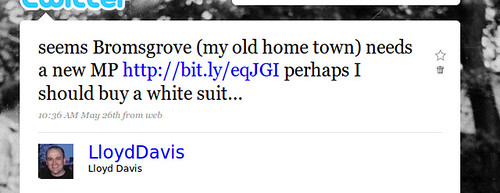
It started with a tweet, like so many things in my life today.

mptweetscreen

And of course a bit of banter arose and a hashtag was suggested but then I started to talk to other people about it and realised that they were taking the proposition seriously, being encouraging saying things like “Oh yes, I think that would be marvellous” So I’m writing about it here so that I’m quite sure that I’m not being blindly selective and only telling people who I know would be supportive but also to better understand what I might do next.

Because I’m up for it, I think. It fits very well with making social art and building community, which is what I (and others) see myself doing. I’m just not sure how.

I see our current national political system suffering from similar issues to those faced by other large organisations – that large-scale centralised bureaucracies do some things extremely efficiently but mostly at the cost of the people who are supposed to be served by them as well as the people who spend their time trying to run them. I think that working out what it might mean to run this country (or any country) in the next century is something worth putting time and energy into.

The expenses row shows just how vulnerable the system is to abuse of trust. I’m quite sure, from the gobsmacked faces and embarrassed shuffling that most MPs considered they were playing the game as it’s supposed to be played and that from their perspective, the goalposts have been moved. Yes, they knew it was probably wrong, but everyone seemed to be doing it and it’s easy in that situation to tell yourself that you’re doing the right thing. Very easy, that is, if the only people you talk to about it are other people who are engaged in the same activity.

So there’s a choice for those of us who see that change is needed. I could write about this over and over and work out what I think and tell other people what they should do or should believe and engage in endless conversations about policy and designing a better system, or I could say, y’know what, I don’t think it’s possible to stand outside a human system and tinker with it, design a desirable future state and then implement it – that’s the process that got us into this mess and innumerable messes before. I think we have to participate in our democracy in a much more active way.

Which brings me to our current parties. I joined the Labour Party in 1983, soon after the second Thatcher election victory. It felt like a grim time. I was a 1 in 10, a number on a list. The economic base that most people at that time had believed would be with us forever, manufacturing industry, was being swept away, restructured or sold off. I instinctively disliked the hard-headed, stubborn, dogmatic and combative style of the Tory party under Thatcher – I preferred the being hard-headed, stubborn, dogmatic and combative in my *own* way, and on the side of people more like my family and friends, so I joined the Labour Party Young Socialists (which for those unacquainted with the history of such things, means what the press at the time dubbed “The Militant Tendency” though that wasn’t what I thought I was getting into at the time). And then throughout the 1980s I took part in political activity that didn’t work. At a local and national level, we lost again and again. I wasn’t forced out of the party over Clause IV or for being a member of a party within a party or anything like that, the reality was that when my son was born in 1991, I had just been made redundant and I needed to spend more time on caring for my own family than fighting for others. I have voted in every election I’ve been entitled to and on each occasion I’ve voted Labour or spoiled the ballot paper where there was no Labour candidate. And perversely I’ve always lived in Conservative constituencies – the only time that the candidate I voted for has won has been in District Council and European elections. But now I’m done with combat and dogma of whatever flavour and you should judge me on what I do and say today, not the things I went through on the way.

And now I feel quite distanced from any of the parties. They don’t seem to live in the same world as the rest of us. They seem to be still trying to play the same game and the game has become more important than the original function.

Those of you who’ve seen me at Tuttle will, I hope, have seen me being of service to the group, to the community. The more that I’ve done that, the more I’ve let go of trying to run it, or make it go in a particular direction, the more successful it has been and the more I’ve enjoyed being part of it. I’d like the opportunity to try that out on a grander scale. And representing local people at a national level seems where there’s most improvement to be made.

We’re all quite exercised about how public servants should act with integrity and honesty – my definition of integrity is simple – you do what you say on the tin – you are open and clear about the principles that you apply when making decisions and you do what you said you’d do.

So the idea of standing as an independent candidate is quite appealing, running on a ticket of integrity and true service. And I’m attracted to serving Bromsgrove because I lived there, I know and love the town and because they seem to have had a rough deal with MPs for a while. I’m open though to doing something elsewhere or accepting that I’m completely wrong about the whole thing and should just get on with something else.

And of course, I have some interesting ideas about how my knowledge of the use of the social web could support both a campaign and the day-to-day business of being a sitting MP.

I’m very interested in what others think on this. Are there qualities that you think I’m lacking? Can you see a more suitable way for me to contribute to this issue?

To Bletchley Park

190520091486I’d only had fictional accounts of Bletchley Park until yesterday. I’m really glad that I took the opportunity to go up and sample it first hand for one of the StationX social media cafe events.

I first heard of Bletchley Park in 1986 when I saw the pre-west-end run of the stage version of Breaking the Code with Derek Jacobi as Alan Turing at the Yvonne Arnaud in Guildford. It’s a hugely touching human story of course but also intriguing that so much was going on during the war that we had no idea about.

I went at some point around 1991 I think, to a Computer Conservation Society open day at the Science Museum and Tony Sale was talking about the prospect of rebuilding Colossus. Some people were looking at him clearly thinking he was bonkers, but he did it nonetheless.

Then I read Robert Harris’s Enigma about ten years later when I was in need of fiction to read just after my finals. It is fiction, it is a bit Ripping Yarns but it’s also thrilling and brings the whole story to life.

So I was not at all surprised at what I saw when I arrived yesterday morning. It was good to see Christian as always and Bill Thompson was there, recording some stuff for his Digital Planet show. Highlights were the ever growing National Museum of Computing with it’s mainframe room, new PC gallery and nascent supercomputing room with a stonking great CRAY YMP-EL sitting in the middle of it. Adam Bradley is working on getting it going, apparently. He’s 14.

190520091458Then we popped over to the mansion and a special treat to be allowed to see and photograph inside Station X itself, an MI6 transmission station, high up in the tower. I heard yesterday that the X is like the X in OS-X it just means Station Ten, rather than being anything particularly top secret, although of course it was, y’know, particularly top secret.

Another unexpected treat was the cinema and film projection museum. Real geekgasm material here, mainly because it was such a surprise to find it all in such a small nondescript building. Great place for a solobasssteve gig, I think. By the time we got to the reconstructed bombe machine, I was running short of time and blood sugar. But there’s still an awful lot more to see. I’ll be back.

One particular idea that Christian floated was to turn some of the derelict concrete buildings into a geek warren – make it safe, run in a big fat net pipe, add some soft furnishings and get some use out of the space again at least for a few years, with a use that’s congruent with the place’s history for housing the sharpest mathematical and computing minds.

And if you haven’t done so before or recently, chuck some money in the pot to keep them going.

190520091470

On being a social artist

A couple of people have described me recently as a “Social Artist”. Most obviously with regard to my finding and continued curation of Tuttle. I looked around for other references but could only find this site, which contains much that resonates with me, but is a bit more new agey than I’m prepared to be today.

So I looked at definitions of art and pulled together this:

“The process or product of skilfully bringing people together in such a way as to create a sense of beauty in those that see or participate in it”

It’s not the entire picture of me, but is that something you see me do?

Oh and for those who haven’t seen it yet, here’s David Pinto’s interview with me that touches on this subject, including a lovely intro from Debbie Davies.

Using the Canon HG10 for G20

IMG_0525Just reflecting on my G20 experience last week and whether asking for the HG10 was the best choice. Yes. It was.

I just asked Colin from 1000heads when I saw him at the Oxford Tuttle to see if I could get a loan camera because they had run the HG10 trial that I was part of before and I knew it worked well for me as a combination video and stills camera.

For this gig, it helped me enormously that I knew my way around the camera already. And it works beautifully, it’s light but robust and to
demonstrate the quality as a stills camera, that pic above of Obama is at the full extent of the zoom, without a tripod.

As a video camera, I thought that I’d be mostly zipping around with my flip for interviews and using the HG10 for stuff that needed to be higher quality especially with zoom. It turned out that pretty much all the video I shot was with the HG10. This is because switching from video to still and back again is so simple so I just wandered around with one camera.

It meant that I had to be a bit more ballsy to stand up at the front with the big camera boys and a couple of times in briefings I was told that I couldn’t video and had to point out I was just taking stills. Minor hassles given what outputs I was able to get.

I could have done with some time to mess around with the colour balance for the video – a lot of it looks more washed out when processed than it did on the viewfinder – but of course I’d left it to the last minute to get it. I’ve blogged everything I shot, I think, but it’s all here if you want to compare and contrast. Make sure you check out the HD versions.

Also I should have remembered that I’ve switched over entirely to Ubuntu since I last used it and I had a moment of panic when I thought that perhaps I wouldn’t be able to get the AVCHD files transcoded without some serious linux-wrangling. As it was I wasn’t able to find the solution until after I’d left the Excel, but Handbrake is a great DVD-ripper and general transcoder (also available for Mac OSX & Windows, I believe) and once I’d had a little fiddle to get the settings right (using the FFMPEG codec rather than h.264 was the main thing for me), I just set up a big batch process to pump out .mp4’s

Big thanks to Canon and to Colin & Donna at 1000heads for facilitating the process – now what do I have to do to get to keep this baby?

You can quote me on that

I chatted with lots of people about my involvement with G20Voice and the G20 summit last week, but a few of them happened to be journalists who ended up quoting me in their pieces.

Rory Cellan-Jones on the BBC dot.life blog was looking for the angle on how social media can be used to organise protest as well as report news:

Also among them is Lloyd Davis, a British social media consultant who told me that 25 years ago he’d stood on picket lines during the miners’ strike but was now a little old for that kind of thing. “They might say we’ve all been ‘captured’,” he told me, “but I’m interested in the issues here, and how we can organise our way through this recession or depression.”

Mr Davis and his fellow bloggers have had security clearance so that they can get into the Excel centre and attend the press conferences, which means there could be an alternative view of events from that provided by the mainstream media.

Laura Oliver on journalism.co.uk asked me more generally what we thought we were doing, of course I told her I haven’t a clue:

Yet while coverage has been opened up beyond traditional news organisations and platforms, the independence of reports from NGOs and other interested parties must be considered, Lloyd Davis, who is involved with both the G20 Voice project and the Reuters events.

“How do people like me get to report on thinks like this without getting some help from somebody – including technically?” he tells Journalism.co.uk

“I have been lent an iPod Touch, lent a camera by Canon to do some photographs and video – this enriches what I’m going to produce but in a political environment like this, there’s a question of patronage and sponsorship.”

There is an opportunity however to find new things to say other than the mainstream media, who ‘will already have got an idea of what the story is’, says Davis.

“I think there’s a gap to be filled in the middle that’s not mainstream media and the people on the streets. There are people being brought in to for some kind of semi-social thing,” he says.

“I have to admit we don’t really know what we’re doing. As usual as bloggers we’re jumping in and seeing what we can do.”

Then Lisa Devaney chatted wiith me on home turf at the Tuttle club and reported on her BrandRepublic blog and caught me rambling about what it all meant:

I saw Lloyd today following his exciting experience being part of G20Voice and got to hear his thoughts:

“What gets me is trying to understand what $1 trillion dollars really is, and how it will make a difference in our everyday lives. There is also a huge gap between the content of what was discussed in the communiqué planning, and how this information translates to ordinary people. The people at the top aren’t very good at communicating what the ideas mean to the rest of us and I think we need layers of communication to push through the concepts and better understand the complexity of what is happening. I don’t understand it all, and that leaves me, and others, to have to trust our leaders. But do we and can we trust these leaders? What also struck me is that here was a gathering of great leaders from 20 of the world’s leading economic powers, and not too long ago we were all in a tense situation of possibly killing each other. It is really important that we are at a point in history they were able to sit down and talk to each other about the economy.”

What’s the point of Earth Hour?

earth hour at oxford stIt’s Earth Hour here – but by the time I finish this post it will be over. From 8.30 local time people across the world we’re told that people have been turning their lights off to show their support for action on climate change – it’s being presented as a chance to vote and the organisers intend to take some count of the people who participated to the Global Climate Change Conference in Copenhagen later this year.

Why would you do this? Will it make a difference to what “world leaders” decide in Copenhagen whether 1,000,000 people do it, or 10,000,000? Probably not, at least the numbers don’t really matter. Some action will be promised, some suggested action will be refused. I can’t imagine anyone in power saying “Well because several hundred thousand people sat in the dark for an hour in my country, I’m going to make sure something gets done”.

So will the switching off of lights have a big effect in itself? Especially with compulsory low power light bulbs, switching off the lights for an hour in this house represents a reduction of much less than .5kwh. In our total monthly consumption that’s nothing. And anyway, it looks like shops in the West End weren’t doing much.

Is it an empty gesture then? In a world where stuff is only achieved if it is done by “world leaders” then yes, probably. But we don’t live in that world, we never have and we’re just realising that we can do an awful lot for ourselves – both as individuals and members of corporations and organisations. (I plan to write about this more over the next week in the run up to the G-20 summit)

So what use is it? Well of course we social media types like to point to the fact that it’s part of a conversation. Those of us even further up our own arses will point out that earthhour is a “social object” something around which many of us have come together whether you said “Yes, I’m part of this” or “God, this is a waste of time” doesn’t matter as much as the fact that we’ve taken part.

But surely that’s still an empty gesture? Does talking about it make it any more useful? Do any fewer polar bears die? Does the economy get any better at all? No, it depends on some action. I won’t tell you what to do, but here’s a suggestion for people who are on twitter.

Take a look at some tweets marked among people you already follow and who live nearby. Get in touch with them and arrange to have a coffee in the next week and talk about earth hour properly, about what you did, about what you think about climate change, about what you’re doing for the environment, what you’d like to do, maybe what you can do together or with other people – and then do it. Even better if you write about it on your blog. A bonus suggestion for the brave: find someone on twitter who lives locally whom you don’t already know or follow (easier in smaller places than in large ones – use Advanced Search on search.twitter.com) and do the same.

Or not.

Guerilla Street Cleaning

please clean meI heard Dougald speak yesterday on the “why don’t you…?” web, the web (immediately recognisable to UK readers of a certain age) that enables us to “turn off the tv set and go and do something less boring instead”.

I then saw someone on twitter point to Guerilla Gardening, a site that facilitates small groups going out and making urban spaces more green, leafy, flowery or otherwise lovely.

And then this morning when I got some cash out, I noticed how bloody filthy this cash machine in Cockspur Street is. And I wondered if anyone would want to do some off-the-cuff street cleaning – the nightmare is that you’d probably be arrested immediately with tampering with a cash machine, no matter how much you protested that you were performing a secret civic service. But might it have legs (particularly for urban dwellers) are there things you could clean without getting into trouble, especially if there were a group of you and are there lessons buried in the Guerilla Gardening site that might help it happen?

Implementation is left as an exercise for the reader.

Deconstructing Panel Sessions

nudgonomics debate at demosI spent a lot of time (well not that much actually, but it *felt* like a lot) in panel sessions at SXSWi and today I attended a debate (two person panel) at DEMOS.

It seems to me that there are always a few things going on in such a session and that sometimes these things are in conflict with each other. Initially I got narked about the use of “questions in threes” but I think there’s more to it than that.

So one way to pull it apart is to look at the motivations of each player. Who’s there? In any panel session let’s say there’s a moderator, a bunch of panelists and audience members – there are different kinds of audience members too – those who want to contribute, those who want to only listen – also perhaps those who are part of the organisation holding the event and those who are from “outside”.

Moderator – The moderator opens up, introduces the speakers and manages any question and answer process. What do they want? A smooth running event, which people remember. Presumably they also want people to remember that the moderator was really good and maybe they might like to hire them to do something else. They want to please as many people in the audience as possible by giving them the opportunity to ask loads of questions or have lots of questions answered.

Panelists – usually have something to sell, maybe it’s a book, or strategic advice, or consulting services or maybe they’re looking for more speaking gigs. They want to show off their erudition and quick wittedness by answering questions eruditely and wittily. They want to be right.

The audience – want to learn something, want to be seen by their peers, want to see who else has come, want other people to hear what they have to say on the subject, want to be associated with the panellists, or disassociated from them. If they are part of the host organisation, they may want to impress their boss and other colleagues or else push the company line. If they are from the outside they may want to impress prospective clients or intimidate competitors with their superior intellect. They might just want to hear an intelligent, flowing conversation about the subject and make their own minds up about things. They might have come to collect ideas for a blog post or something else that they’re writing.

We all (well most of us, in this country) like to pretend that we’re not selling ourselves all the time, but the reality is that we are, especially those of us who are freelance, whether we’re doing it consciously or explicitly or not.

Questions in threes is a technique where the moderator takes three (sometimes more!) questions and lets the panelists answer them all together. It’s presented as a way to get more questions in and to give panelists more time to think about their answer, but it actually only serves the moderator’s desire to look good by letting lots of people in and getting things done quickly. Patrick Hadfield summed it up in a tweet to me this afternoon:

“…all that happens is that the first question gets ignored, or if it is answered, the rest of the audience has forgotten it!”

Exactly that happened in the session today. The panelist is also panicking because they’ve got another random question coming at them while they’re still thinking about the first one. And the audience is not sure which question is being answered. The moderator however is achieving the goal of getting through lots of q&a swiftly without any regard to whether the questions are being answered sensibly.

I’m getting tired, and I’ve written more than I initially intended, so I’m probably wrong. Let me know in the morning.