Category Archives: What I’ve Been Doing

Figures of Speech at A-Frame

020420091185Last night, I was invited by Siôn Parkinson to speak at a meeting of a-frame a network that he runs with Maria Georka at the ICA. It meant I got to visit the posher bits of the ICA again, which was nice.

The brief was a five minute talk based around an object that inspires you – the same as the Figures of Speech format that I saw at the ICA gala last year. I looked through boxes of old stuff for inspiration over the weekend but in the end chose something new, something that was given to me last week and which I fully expected to have to give back before I left: my accreditation pass for the London Summit – which describes me as “Blogger”.

I had a comfy fourth slot on the programme. I was preceded by Tom Lucas from UKTV talking about a buddha he gave to his mum and humility; Toby Moores from Sleepydog talking about a microphone, loudspeaker and amplification; and Frances Croxford from Jane Wentworth Associates talking about a book of “Beautiful Writings by Latin Authors” which she picked up in a bookshop when she was fifteen. I was followed by Jonathan MacDonald who talked about the Cluetrain Manifesto and how it changed his life.

For once, I did some preparation beforehand, in fact I wrote out what I was going to say in full. So I thought I’d post it here to expose my pretentious waffle to a wider audience. This is what I said:

This is my pass for the London Summit 2009 – the meeting of the G20 industrialised nations held last week. The bit of it that I’m most proud of is that it describes me as a Blogger. And that’s what I am. My business card says Social Media Consultant or Social Media Tart or Freelance Subversive depending on which version you have, but the bottom line is that I use a variety of media to tell stories and publish them on the internet where other people pick over them. And last week I was doing that at the summit.

And I’ve been thinking a lot about how I got there. How it happened to be me that was one of a few hundred people squeezed into a room up close with the president of the united states of america. And it comes down to telling stories with purpose, telling stories to make sense and learn about yourself and the world. No doubt that’s also how I stumbled into being invited to speak to you tonight. Because I believe that telling stories (and engaging in conversation about them) at this human scale, where you can see the whites of my eyes is something that’s going to be very useful to us in the 21st Century as we grapple with unprecedented rates of social, economic and technological change. Talking at this scale is a skill that I think we all need to learn again and practice regularly.

So there are four people who taught me the value of small scale story-telling and conversation.

The first was my mother. I would hear her tell stories over and over again. The substance of these stories were not earth-shattering, they were everyday stories of shop-keepers, milkmen and her at number 27. They were about everyday events and what they meant. Women are still telling these stories, making sense of their lives through conversation. “So he said and she said and I think there was a bit of, ‘you know what’ going on.” And I heard these stories get little tweaks whether we were visiting my Nan or my Grandma or Pauline next door but one or the Methodist Young Wives Coffee Morning. These tweaks and embellishments came as she gained insights and realised that some things were perhaps best not said. There were always one or two “stories of the day” that everyone was treated to and then a sprinkling of other subjects depending on the intimacy of relationship and the time available. I was a quiet little boy. I just sat and listened and took in every word.

The next person who taught me the value of story telling was Brian Dear. Brian taught me German from 1978 to 1983. Poor man. His first class started with him marching into the classroom, swinging his leg up onto the desk, pointing at his foot and shouting “Das ist ein Schuh! Was ist das?” waiting until someone whimpered “ein Schuh?” and then going on through various pieces of clothing and body parts. Once we’d mastered basic vocabulary and grammar our weekly homework was to retell a story that he had told us at the end of the week. He read it very clearly for us to write down and illlustrate. The stories revolved around a farming family from Bavaria. Bauer Bumm, his wife, two children and their pet crocodile Kroko. Kroko was the star of every story except invariably the ending came with him being hit over the head with an umbrella by Baeuerin Bumm – “Paeng!” which seems to be the noise made when you hit a crocodile on the head with an umbrella “Aua!” which is what a crocodile shouts when hit over the head with an umbrella. As we gained confidence we were allowed to add our own embellishments. The only things I remember inserting were references to Brustwarze, the German for nipple and the use of “Zimbabwe” as a swear word. I’m not sure how much of this sort of creative learning through storytelling and experimentation is allowed under the National Curriculum.

Ian Ricketts was much much quieter than Brian Dear. Ian taught me first on a course called “Character Building” when I was a student at the Guildford School of Acting. It was not supposed to have anything to do with improving the quality of my personal character although there was plenty of sacrifice, rigorous honesty and forced humility.

It was essentially a guided improvisation class to show us how to be part of a story by being truthful and surpressing our own needs to show off. It was about being. Being honest and true to your character and trusting that one needs to show far less than one thinks. That the truth is apparent to those watching. So from Ian I learned the importance of authenticity but also that you can’t help being a part of any story you tell.

And then I met Brent Work at the University of Surrey who introduced me, in his Information Strategy course to an American academic style of teaching through narrative and conversation. He’d sit at the front and tell stories in a gentle Garrison Keeler style and then we as a class would have a chat about it and it was up to us to pull out the lessons from him through discussion and conversation.

Brent also said something that really made me sit up and take notice and get very excited about the future.

In 1994, I heard him say “The job you have in 10 or 15 years has probably not been invented yet”

And he was right. The word “blogger” hadn’t even been invented. The world wide web was a year or so old and the I had absolutely no idea that my job would involve, in 15 years time, standing in a room a few yards away from the British Prime Minister and then the President of the United States of America (let alone the fact that the prez would be an African American btw) and then writing about it on the internet. Or organising an event at the Institute of Contemporary Art where ordinary people could ask questions of the President of the World Bank. My life seems odd right now, but from the perspective of 15 years ago it seems completely insane.

So what I wanted, in addition to telling you a story that helps me make sense of who I am and how I got here, what I wanted was to capture this transitional moment when “Blogger” (perhaps temporarily, who knows) became a legitimate category of attendee at a major international summit. And to let you know that I got there by doing not much more than telling stories at a human, personal level to help me and people like me understand our world and our lives.

Thank you very much.

G20: Lessons Learned

IMG_0256The G20 Voice team did a brilliant job. The first I heard about this gig was a phone call from Shane McCracken on the day I’d returned from SXSWi (ie when I’d just finished a 16-hour journey and was trying to stay awake to stave off jet-lag) and then two weeks later I was sitting in the Excel Centre a few yards from President Obama.

Not everything went perfectly, but the problems were not of the obvious kind that could have been predicted and mitigated against. They were mostly things none of us knew about how the day would run, what the content would be and how a group of 50 bloggers would react to being thrown together to report on something so huge. The main feedback I gave to G20Voice was that I was very impressed by their flexibility and willingness to learn with us over the course of the two days we were together.

So there’s a bunch of things I think I learned in the course of the two days we had together that I’d like to work out and share here.

The only events I’ve covered before have been traditional conferences or trade shows. There’s always *something* going on, whether it’s plenary sessions, product demos or just delegates hanging around chatting at lunchtime, and so it’s easy to blog without very much preparation or knowledge of the subject area. You can do the standard in through the ears, out through the fingers liveblogging or get out among the people with a camera, jump in and ask open questions, following up with intelligent probes.

The G20 summit was not like that.

The summit happens in private, away from any reporters at all. They talk all day, perhaps have a little argy-bargy, but then emerge with a summary of what they’ve agreed – the communique.

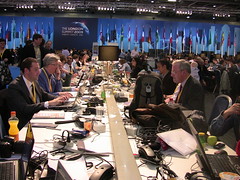
IMG_0348I felt cut off. Cut off from the action and cut off from my online tribe because I was being boring – I had nothing of interest to say for most of the day, because nothing was really happening except the occasional entrance of a Minister or Celebrity Activist. I blogged during the day (and the day before) that I didn’t know what to do to be useful. I wanted to be like the other guys who seemed to know everything about everything and were, no doubt, writing Pullitzer Prize-worthy copy all day long. I kept thinking that I should be doing something else, but when I went and did something, I thought I should be back at the desk and online.

But just because it’s a news event, doesn’t mean you only have the day to publish stuff in. I’m lucky, I don’t have any deadlines or a target for how much to write or create, except those that I make for myself. And I was forgetting that I do have an eye for interesting stuff and so the behind the scenes content that I’ve shared with you seemed like it was a cop out, too easy, just hanging around behind other people being photographed and filmed. It wasn’t until I got it all out and had a look at it that I realised where the story was and that I had stuff that was unique.

So Learning Point #1 Remember you are unique and have a unique perspective. Be yourself and trust that you will be enough.

my workstation at the G20 summitIt helped me to have plenty of equipment so that i knew that when I did have something to report, I’d be ready. I had two laptops, one mainly for tracking stuff on twitter, flickr and the G20Voice site and the other for getting stuff done, writing, encoding video and uploading photos. I was lent an HG10 by Canon (thanks to Colin & Donna at 1000Heads) so I could shoot anything I wanted to. I was also lent an iPod touch and handsfree set (thanks to Best Before TV, especially Karen & Steve, whose touch it was!) so that I could record Audioboos – I like this a lot. I also had my flip camera in case I needed to just do something simple and quick, my N95 for backup photos, video and Qiks and my Edirol in case I wanted to do longer audio interviews.

The thing I’d forgotten was that I’ve switched to Linux on my two laptops since I last had an HG10 and I could have done without all the faffing needed to start from scratch in order to transcode from AVCHD to MPEG. I’ve now found Handbrake which is actually very good indeed especially once you have time to play around with it.

Learning Point #2 Take more than you need and ask for what you want and need. Make sure you’ve got all your software up to date and test loan kit before you get there.

Yes, I felt cut off. But surely I was on a table full of bloggers, just like me? Well no, I was actually on a table full of specialist journalists (in some cases operating in a tiny niche) who choose to mainly communicate online. They were mostly lovely, but there wasn’t a great deal of playful collaboration. There were few other media hacker types of the sort that frequent the Tuttle Club.

I quickly tired of us being referred to as “The Bloggers”. I think if there’d been a media hacker table or just a few more of the folk I normally play with, we’d have come up with something more creative. It might have got us chucked out or severely reprimanded, but it would have been more fun.

Learning Point #3 is for the G20Voice team (or anyone else doing this sort of work) and comes in two parts: a) All that bloggers might have in common is that they have a blog. and b) Focus the Briefing Day on helping the bloggers get to know each other, trust each other and collaborate and interact online (there’s a whole nother post on this, I think)

IMG_0525I was really pleased with the photos I took of the president at the podium. I know they’re all much the same and that people all around me were taking the same shot too, but I really like that I got them for my very own. I could not have done so if I’d done what I was told. Firstly, I went to the front of the queue when photographers were called. I took advantage of the fact that my pass said “Blogger” while others had, I imagine, “Journalist” or “Photographer”. I used the ambiguity to be a writer when it suited me and a photographer when that’s what I wanted to be. So I then just went up to the front of the hall with the other photographers. It was crowded and the press office guys were going back and forth trying to weed out people who weren’t official photographers. I felt a little inadequate with my little video camera, but I just stood my ground and avoided eye contact with them by looking at my viewfinder.

Learning Point #4 Be confident, use ambiguity to your advantage, go for what you want.

So by the Friday morning, I felt like I was just about ready to get started. I guess the overall point would be it’s OK to learn as you go, keep asking the question of how you can be useful and remember what you learn for next time.

G20: Behind the scenes

I decided that much of the time, the most value I could add would be to give you a feel for what it’s like in the press room, on that floor that you, watching at home, could see behind any TV presenter reporting live from the summit.

Of course, the press room itself is “behind the scenes” of the summit itself. The 22 leaders and their delegations were off in the Red Zone working out the detail of what was agreed and published. Only occasionally would red-lanyarded people wander into the press & TV area to be ambushed by crowds of bored journalists eager for a story. But what I’m sure you saw most of was well-crafted, polished presentations of those moments and the pieces to camera on the TV stage.

So I’ve three bits of video that show you what’s going on from another angle.

First, here’s Simon Berry getting ready to talk to Bob Geldof. We’d spotted Bob talking to our colleague Todd Lucier and Nick Booth had encouraged Simon to go round and talk to him too and show him the idea of colalife. Nick filmed the real substance of the exchange here but my clip tries to show that even when the people filming and being filmed are fellow bloggers, there’s some further enrichment to come from seeing how it was set up.

Sticking with Geldof, I captured a little of him being interviewed (by someone in the studio) for Channel 4 News (I think). He’s a great performer, as I noted when I saw him at Innovation Edge and you see here the point at which the feed goes live to him and he launches into his spiel. I think it’s good to see what’s going on right next to the camera – can anyone find a clip from C4 to compare with this?

Even when we were in the briefings with Brown and then Obama, pretty much the same pictures were being taken throughout – the great man, at the podium – I was as guilty of that as anyone. So finally, if you watched the Gordon Brown press conference on the telly, you’d have seen a few flashbulbs going off. This is what it looked like from the floor where I was kneeling next to the press photographers.

G20: DFID Youth Bloggers

Sunball and Joe are two of the DFID Youth Reporters, a group of young people who are part of a mentoring programme to help them bring a youth perspective to debates about “poverty, climate change, growth, stability and jobs”

My experience of them both was that they combined a startlingly deep knowledge of current affairs with the determination of the young to call the previous generation out on the mistakes that we have made so that together we can all put the world right.

They were a great reminder, if one were needed, that I’m too much of a grumpy old man most of the time.

[disclosure: DFID are a client of mine, I have advised their web team on using social media to get information quickly out of crisis areas. I’m not involved with the Youth Reporters scheme.]

G20: Tom Watson MP

I also asked Tom why people should care about what goes on at the summit and he explains the importance of what the bloggers were doing to help us all make sense of the high-level economic stuff from our own perspectives.

Tom is one of the earliest adopters of online social tools among national politicians and he uses them to complement the doorstep manner that makes him a popular local MP. I remember hearing about his early blogging through Tim Ireland in 2004. He’s matured well with the rest of us – he’s a top choice to follow on twitter, skillfully navigating the line between speaking as just another tweeter and speaking as an MP and Government Minister.

Tom sat with us on the G20 Voice desk all day, even when he was in danger of being crushed by the hack-pack when Bob Geldof passed by.

G20: Todd Lucier

Todd was one of my fellow bloggers with G20 Voice. He’s a passionate Canadian nominated to be in London for climatecafe.org and he explains here just why it was so important that a bunch of bloggers were given accreditation to come along to the summit.

I only found out during the day that Todd is also a fellow seesmic-er. If I’d known and thought about it beforehand perhaps we could have done something together to get people talking on seesmic. I’m writing a post about the lessons we learned – one of them is how to get the bloggers to know each other better and ready to work together better before going into the event. It’s hard.

The video may need some fiddling with – I’ve not been used to using such a flash camera of late and the HD from the Canon HG10 I was loaned might still need compressing down a bit.

Deconstructing Panel Sessions

nudgonomics debate at demosI spent a lot of time (well not that much actually, but it *felt* like a lot) in panel sessions at SXSWi and today I attended a debate (two person panel) at DEMOS.

It seems to me that there are always a few things going on in such a session and that sometimes these things are in conflict with each other. Initially I got narked about the use of “questions in threes” but I think there’s more to it than that.

So one way to pull it apart is to look at the motivations of each player. Who’s there? In any panel session let’s say there’s a moderator, a bunch of panelists and audience members – there are different kinds of audience members too – those who want to contribute, those who want to only listen – also perhaps those who are part of the organisation holding the event and those who are from “outside”.

Moderator – The moderator opens up, introduces the speakers and manages any question and answer process. What do they want? A smooth running event, which people remember. Presumably they also want people to remember that the moderator was really good and maybe they might like to hire them to do something else. They want to please as many people in the audience as possible by giving them the opportunity to ask loads of questions or have lots of questions answered.

Panelists – usually have something to sell, maybe it’s a book, or strategic advice, or consulting services or maybe they’re looking for more speaking gigs. They want to show off their erudition and quick wittedness by answering questions eruditely and wittily. They want to be right.

The audience – want to learn something, want to be seen by their peers, want to see who else has come, want other people to hear what they have to say on the subject, want to be associated with the panellists, or disassociated from them. If they are part of the host organisation, they may want to impress their boss and other colleagues or else push the company line. If they are from the outside they may want to impress prospective clients or intimidate competitors with their superior intellect. They might just want to hear an intelligent, flowing conversation about the subject and make their own minds up about things. They might have come to collect ideas for a blog post or something else that they’re writing.

We all (well most of us, in this country) like to pretend that we’re not selling ourselves all the time, but the reality is that we are, especially those of us who are freelance, whether we’re doing it consciously or explicitly or not.

Questions in threes is a technique where the moderator takes three (sometimes more!) questions and lets the panelists answer them all together. It’s presented as a way to get more questions in and to give panelists more time to think about their answer, but it actually only serves the moderator’s desire to look good by letting lots of people in and getting things done quickly. Patrick Hadfield summed it up in a tweet to me this afternoon:

“…all that happens is that the first question gets ignored, or if it is answered, the rest of the audience has forgotten it!”

Exactly that happened in the session today. The panelist is also panicking because they’ve got another random question coming at them while they’re still thinking about the first one. And the audience is not sure which question is being answered. The moderator however is achieving the goal of getting through lots of q&a swiftly without any regard to whether the questions are being answered sensibly.

I’m getting tired, and I’ve written more than I initially intended, so I’m probably wrong. Let me know in the morning.

Walkin’ in Austin

From the earlier part of the week before the festival started and definitely before the sun came out. Our experience was that walking anywhere more than a couple of blocks marked you out as either a tourist or poor. Or like us, poor tourists.

This happened to me a couple of years ago too when I went to Barcelona and it felt more like Bangor. We seem to have brought the sunshine back with us from Texas, but not the temperature, I think it’s still up in the seventies there.

urinals

110320091025 Here’s something half-baked: In the UK, urinals in the gents (God, I can’t wait to be home and to stop having to ask for the mens room or restroom!) flush themselves on a timing mechanism so that (as long as it’s working) it gets washed out every few minutes. Here in the US, there are two types of flush that I’ve seen: a manual knob (as in the picture) or else an automatic one based on a sensor which causes it to flush when you walk away.

I don’t know what this says about our respective cultures, if anything at all, or what point you could use it to make, but I thought it might live in the analogy library until someone could work out how to use it for good or for evil.

And don’t get me started on the lack of soundproofing in the sit down loos or the ones that flush as soon as you stand up.

Random notes from Austin

1. This is America, we’re really in America not just a strange city in England that I’ve never been to before. And America and Americans really are different from us.

2. I am too much of a mimic, I nearly said “y’all” non-ironically and last night at dinner I asked for the “check”

3. You can choose to be seen or not seen here, since the convention centre is so huge – you can hide – or you can easily sit on one of the thoroughfares and someone interesting will walk past.

4. More than ever we (I) can’t get away with trying to sell premium stuff at the cutting edge. What people want right now, especially is how social media can help people get stuff done, even more so when the stuff you’re getting done is selling.

5. It’s cold here, it was supposed to get a bit warmer, but my weather widget still says 45 degrees.

6. We saw a bat on it’s own circling a lampost near 6th Street. We haven’t seen the bats properly since Tuesday night, I think it might be too cold for them.

7. I had a full-size American meal last night and I found it difficult to walk back to the hotel unaided. I then slept particularly well.

8. It’s the complementary stuff that really works. I wrote yesterday: ” Our experience has been that the most powerful uses of the social web have come where the technology has been used to complement and enrich existing face to face engagements. ” and incidentally where real-life stuff has been layered onto the technology plays.

9. I’m now in my first panel and treating it like a podcast or radio, it’s kind of on in the background, occasionally my ears will prick up but mostly I’m just letting it wash over me.