Projects for Funding


Originally uploaded by _Gid

OK, I’ve had three projects knocking around in my consciousness for a while now, that I know would be cool to get done and as I accept the Social Artist tag more and more, I see that they’re things that I need to do.

The question is how to get to do them, while still paying the bills – these aren’t just spare-time, pootling in the attic projects, they require getting out and talking to people and then thinking and writing about what they say. It seems that this is not an unusual position for artists to be in, so I’m asking people how they pull money in to support their projects, but I’m also going to try some creative ways too, y’know using the “power of the social web” sort of ways.

And I’m also finding it difficult to work out which project’s more important or useful or popular or whatever, and this reminded me of the thing in Waitrose where you get given a token at the end of your shop, to vote for local charities.

So, I thought, why not let the readers of this blog (and anyone else on the internet who might stumble here) decide by putting their money where their mouths are, so to speak. I’m setting up 3 chip-in funds for these projects – they’re all the same – £3,000 (currently $4,800) to get each of them started and give each of them a month or so of my time – maybe that’ll be enough for one of them, maybe another will grow and I’ll need to look for more support, but that would give me the space and time to get them started.

The progress of each of them will be reported on a separate wordpress.com blog – they don’t need fancy infrastructure, especially at first – the money will go on creating content, getting round the country to collect it, and on my time writing about it and working out what to do next. The people and institutions who contribute to each project will get acknowledgement on each respective site.

I’m not necessarily expecting to raise so much money directly from you, my regular readers and twitter followers but I am hoping that you will be able to say to other people: “There’s this bloke I know and he does some interesting stuff on the web and he needs some financial support for some new projects, so why not bung him a few quid?”

These are the projects:

A New Generation

According to ONS, “in 2002, women who were aged 65 could expect to live to the age of 84, while men could expect to live to the age of 81. Projections suggest that life expectancies at these older ages will increase by a further three years or so by 2020. The expectation of life for people at 70 and 80 has also gone up. At present there are more older people aged 70 and 80 than ever before.”

There is, undeniably, a New Generation of people, a social group that simply did not exist in any significant number in the past. But these men and women are not only living longer. A large proportion are also living out their ‘old age’ very differently to their parents. Some occasional volunteering or fund-raising won’t satisfy them. Those people who started their working lives rebuilding our entire nation after the war are not necessarily ready to settle into retirement at 60, 70 or even 80. Many want to go on contributing fully to the economy and to society.

And when they do relax, gardening, bingo, golf and a couple of pints down the pub are not enough for this generation. They started partying in the fifties and sixties – these people know how to have fun!

This generation has appeared in media a lot talking about the past. What was it like growing up during and immediately after the war? How did you deal with post-war austerity? What do you remember about the beginnings of rock and roll?

This project will start as a videoblog highlighting the voices and stories of this fascinating new segment of society but focusing on what life is like for them now and how they see the future.

Among other things, we’ll be asking people:

  • What is your experience of being a member of this “new generation?”
  • What grand schemes have you initiated recently?
  • What would you do, if you knew you had another thirty years of productive life?
  • How did you envisage later life when you left school or got married?
  • How’s it different now?
  • What’s it like being 70 years old and still having your mother alive?

Chip in to make this one happen


What’s the Web for?

This one’s simpler – a collection of short video responses to three questions:

In your opinion:

  • What is the web for? What is its primary purpose
  • What do you mostly use the web for?
  • What do you think your parents use the web for? / What do you think your children use the web for? (Depending on age of participant)

You may remember this from when I did some initial try-outs with Tuttle people. This project is about asking a broader range of questions and opening it up to a much broader population. My guess/prejudice is that there are at least two main groupings: those who see the web as being about connecting people with information and those who see it as about connecting people with other people. But I’m also interested to see what shades of grey there are between these groups, what perspectives I’m ignoring and whether there’s a difference between generations. There’s also something interesting about what people say they do and what they think other people are doing.

Chip-in to make this one happen


Townhead’s Communities

In 1974 my aunt, uncle and two cousins sold their home and bought into a community housed in two terraces of mostly derelict railwaymen’s cottages at Townhead, on the edge of a South Yorkshire moor. As kids, my sister and I spent a few weeks over a couple of occasions staying with them. My memory of those times are of cold, the wind howling in the chimneys, woodsmoke, tobacco smoke, dope smoke, someone making cheese in their room, no meat, lots of beans, rice, vegetable stews and soups and weetabix (and beans). But this project isn’t about me and my short experience of the place, it’s about the lifetime of those buildings and the communities that have lived in them over the years.

What’s interesting to me is investigating and documenting the life of a community, of the people who have lived there as well as how and why change arose. Through writing and a series of interviews in a variety of media, I intend to tell the stories of the people who have lived at Townhead working back through time, starting with the present day and what they know of the place and the people who were there before. For residents present and past, what drew them to this place, what have they learned there and what if anything they think is special about those two rows of terraced houses.

Chip-in to make this one happen

Perhaps there’s time to learn to walk first

Thank you everyone who commented on the previous post – wow!

This reminds me very much of what happened when I wrote my original Social Media Cafe post – I had an idea, I fleshed it out a little and then people went and took it seriously 🙂 Which of course, in truth, was my intention, but I still cling to a little English self-deprecation and false modesty.

I also feel the need to remind newcomers here, that I consider this blog to simply be my thinking ground, this is where I get to understand what I think and why – that’s why I write. Then it’s great also to hear what others think of what I think, because it helps me clarify that through conversation. You may think me mad or a pointless dilletante. There’ll be reasons for that.

I also want to let you know that I am comfortable holding the apparent paradox that I am both entirely committed to following through on this *and* consider it a thought experiment and social art object.

I had some good chats about this at Tuttle today too, it certainly seems to have caught some people’s imagination. The question now is what to do about it.

I think I need to explain some other things more.

Firstly, let’s be clear, there is no election currently being held that I’m interested in standing at. After I posted yesterday (and doubtless as a direct result) Julie Kirkbride announced that she would not be standing at the next general election, but that could still be quite some time off yet.

I believe that if an election were called tomorrow, and if I could garner enough financial support to cover my deposit and living expenses for the three weeks or so until the vote, I would stand, if only for the experience of doing it – I may start a fighting fund for just this purpose.

However it is unlikely that Gordon will go to the country so soon and so I’m asked what I’ll do in the meantime.

We’ll see. I’m not in a position to put all of my time and energy into building a base in any particular constituency. I am not, today even sure of where I might stand, I need to think about where I really feel I could be of most service.

What is clear to me is that the three themes that I’m interested in exploring are Service, Representation and Governance. What does it mean to serve a community, how can one person best serve several thousand at a national level? Who do MPs represent and how does it really work, how could it work? If they are there to represent the interests of their constituency why do so few people feel represented or feel inspired enough to turn out to vote? And what does governing a country mean? How do you “run” a country? Is there room to start running it in the way that large swathes of the internet are “run” on a far more decentralised and libertarian (with a small ‘l’) basis?

The party question is an interesting one. Many people have said something like “if you want to get elected, why not join a big party, you have much more chance that way” to which my response is that the overall purpose of this is not to win a seat at any cost. But in that case, why would anyone vote for me, don’t we vote for the person we think has a good chance of winning or else for someone who represents a party that we’d like to see forming a government? Well, yes, we do but that doesn’t mean it always has to be like that or that it has to be like that for every constituency. And anyway this sounds like the people who said, “why would anyone want to go to your social media cafe?” which elicited a “well if
you don’t know I can’t tell you” kind of response from me. It turns out

And another thing. What do you do with supporters who aren’t voters? There are some lovely people who’ve said, I can’t vote for you, but I’d love to help in any way I can. What role is there for such folk, especially if a large part of the campaign is online. Perhaps there’s an example in the Obama campaign and what contribution people from overseas made to his success – anyone measure this?

It has shown me how I think differently about the world from other people. I am quite convinced that we do not know what the future holds and that the economic situation is so shocking to many people not because of the severity of its effects but because their illusion that they knew what was coming up over the next year, and that it included their house going up in price, their job paying more and prices remaining pretty stable has been shattered. So I find attractive the idea of coming clean on this and giving up the idea that you’ve got to know everything you’re going to do before you get started.

I was also interested in the fear and smear factor that Terence brought up in the comments. Most of the things he talks about, I’m quite comfortable with. I think the issue is how perfect do we expect our representatives to be. Is government just a game where we put people on a pedestal, cultivate extreme and unrealistic expectations of them and then gloat when they fail, in order to make ourselves feel better about our own falings? Possibly. Is that something we want to spend so much time, money and energy on or is there a better way of doing that? Not me.

I think overall, my point is “Let’s stop talking about what the job is, what it has become, but rather get back to what we want and what sort of people can deliver that”

I was most relieved however that Ewan Spence recognised that I want to find a way of taking this seriously without being too serious and pointed me to the advice of the Monster Raving Loony Party.

To run or not to run

Now this feels weird.

It started with a tweet, like so many things in my life today.

mptweetscreen

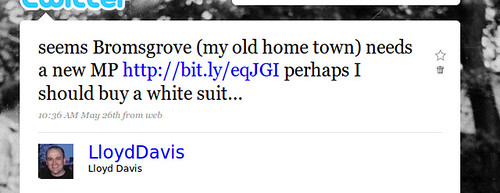
And of course a bit of banter arose and a hashtag was suggested #LloydDavis4MP but then I started to talk to other people about it and realised that they were taking the proposition seriously, being encouraging saying things like “Oh yes, I think that would be marvellous” So I’m writing about it here so that I’m quite sure that I’m not being blindly selective and only telling people who I know would be supportive but also to better understand what I might do next.

Because I’m up for it, I think. It fits very well with making social art and building community, which is what I (and others) see myself doing. I’m just not sure how.

I see our current national political system suffering from similar issues to those faced by other large organisations – that large-scale centralised bureaucracies do some things extremely efficiently but mostly at the cost of the people who are supposed to be served by them as well as the people who spend their time trying to run them. I think that working out what it might mean to run this country (or any country) in the next century is something worth putting time and energy into.

The expenses row shows just how vulnerable the system is to abuse of trust. I’m quite sure, from the gobsmacked faces and embarrassed shuffling that most MPs considered they were playing the game as it’s supposed to be played and that from their perspective, the goalposts have been moved. Yes, they knew it was probably wrong, but everyone seemed to be doing it and it’s easy in that situation to tell yourself that you’re doing the right thing. Very easy, that is, if the only people you talk to about it are other people who are engaged in the same activity.

So there’s a choice for those of us who see that change is needed. I could write about this over and over and work out what I think and tell other people what they should do or should believe and engage in endless conversations about policy and designing a better system, or I could say, y’know what, I don’t think it’s possible to stand outside a human system and tinker with it, design a desirable future state and then implement it – that’s the process that got us into this mess and innumerable messes before. I think we have to participate in our democracy in a much more active way.

Which brings me to our current parties. I joined the Labour Party in 1983, soon after the second Thatcher election victory. It felt like a grim time. I was a 1 in 10, a number on a list. The economic base that most people at that time had believed would be with us forever, manufacturing industry, was being swept away, restructured or sold off. I instinctively disliked the hard-headed, stubborn, dogmatic and combative style of the Tory party under Thatcher – I preferred the being hard-headed, stubborn, dogmatic and combative in my *own* way, and on the side of people more like my family and friends, so I joined the Labour Party Young Socialists (which for those unacquainted with the history of such things, means what the press at the time dubbed “The Militant Tendency” though that wasn’t what I thought I was getting into at the time). And then throughout the 1980s I took part in political activity that didn’t work. At a local and national level, we lost again and again. I wasn’t forced out of the party over Clause IV or for being a member of a party within a party or anything like that, the reality was that when my son was born in 1991, I had just been made redundant and I needed to spend more time on caring for my own family than fighting for others. I have voted in every election I’ve been entitled to and on each occasion I’ve voted Labour or spoiled the ballot paper where there was no Labour candidate. And perversely I’ve always lived in Conservative constituencies – the only time that the candidate I voted for has won has been in District Council and European elections. But now I’m done with combat and dogma of whatever flavour and you should judge me on what I do and say today, not the things I went through on the way.

And now I feel quite distanced from any of the parties. They don’t seem to live in the same world as the rest of us. They seem to be still trying to play the same game and the game has become more important than the original function.

Those of you who’ve seen me at Tuttle will, I hope, have seen me being of service to the group, to the community. The more that I’ve done that, the more I’ve let go of trying to run it, or make it go in a particular direction, the more successful it has been and the more I’ve enjoyed being part of it. I’d like the opportunity to try that out on a grander scale. And representing local people at a national level seems where there’s most improvement to be made.

We’re all quite exercised about how public servants should act with integrity and honesty – my definition of integrity is simple – you do what you say on the tin – you are open and clear about the principles that you apply when making decisions and you do what you said you’d do.

So the idea of standing as an independent candidate is quite appealing, running on a ticket of integrity and true service. And I’m attracted to serving Bromsgrove because I lived there, I know and love the town and because they seem to have had a rough deal with MPs for a while. I’m open though to doing something elsewhere or accepting that I’m completely wrong about the whole thing and should just get on with something else.

And of course, I have some interesting ideas about how my knowledge of the use of the social web could support both a campaign and the day-to-day business of being a sitting MP.

I’m very interested in what others think on this. Are there qualities that you think I’m lacking? Can you see a more suitable way for me to contribute to this issue?

Steve Bowbrick & Bloggers-in-residence


Originally uploaded by Rain Rabbit

I caught up with Steve Bowbrick at the BBC a few weeks ago to have a chat about something I’d seen him doing on a site called Common Platform – describing himself as “blogger in residence” at the BBC looking at the theme of openness in that august institution.

It’s over now, and Steve’s moved on to run the BBC Radio 4 blog but it’s fascinating for to hear the who, the how, the why and the what the jiminy he was up to.

Needless to say, if you work for the type of institution we were chatting about here and you fancy a blogger in residence to explore a theme for your organisation, we can discuss terms. You know where I am 🙂

Podcast: Steve Bowbrick on Openness at the BBC

Download MP3 (25MB)

To Bletchley Park

190520091486I’d only had fictional accounts of Bletchley Park until yesterday. I’m really glad that I took the opportunity to go up and sample it first hand for one of the StationX social media cafe events.

I first heard of Bletchley Park in 1986 when I saw the pre-west-end run of the stage version of Breaking the Code with Derek Jacobi as Alan Turing at the Yvonne Arnaud in Guildford. It’s a hugely touching human story of course but also intriguing that so much was going on during the war that we had no idea about.

I went at some point around 1991 I think, to a Computer Conservation Society open day at the Science Museum and Tony Sale was talking about the prospect of rebuilding Colossus. Some people were looking at him clearly thinking he was bonkers, but he did it nonetheless.

Then I read Robert Harris’s Enigma about ten years later when I was in need of fiction to read just after my finals. It is fiction, it is a bit Ripping Yarns but it’s also thrilling and brings the whole story to life.

So I was not at all surprised at what I saw when I arrived yesterday morning. It was good to see Christian as always and Bill Thompson was there, recording some stuff for his Digital Planet show. Highlights were the ever growing National Museum of Computing with it’s mainframe room, new PC gallery and nascent supercomputing room with a stonking great CRAY YMP-EL sitting in the middle of it. Adam Bradley is working on getting it going, apparently. He’s 14.

190520091458Then we popped over to the mansion and a special treat to be allowed to see and photograph inside Station X itself, an MI6 transmission station, high up in the tower. I heard yesterday that the X is like the X in OS-X it just means Station Ten, rather than being anything particularly top secret, although of course it was, y’know, particularly top secret.

Another unexpected treat was the cinema and film projection museum. Real geekgasm material here, mainly because it was such a surprise to find it all in such a small nondescript building. Great place for a solobasssteve gig, I think. By the time we got to the reconstructed bombe machine, I was running short of time and blood sugar. But there’s still an awful lot more to see. I’ll be back.

One particular idea that Christian floated was to turn some of the derelict concrete buildings into a geek warren – make it safe, run in a big fat net pipe, add some soft furnishings and get some use out of the space again at least for a few years, with a use that’s congruent with the place’s history for housing the sharpest mathematical and computing minds.

And if you haven’t done so before or recently, chuck some money in the pot to keep them going.

190520091470

On being a social artist

A couple of people have described me recently as a “Social Artist”. Most obviously with regard to my finding and continued curation of Tuttle. I looked around for other references but could only find this site, which contains much that resonates with me, but is a bit more new agey than I’m prepared to be today.

So I looked at definitions of art and pulled together this:

“The process or product of skilfully bringing people together in such a way as to create a sense of beauty in those that see or participate in it”

It’s not the entire picture of me, but is that something you see me do?

Oh and for those who haven’t seen it yet, here’s David Pinto’s interview with me that touches on this subject, including a lovely intro from Debbie Davies.

Social Media versus a Pandemic

Betty the pig and the sheepWe don’t know what’s going to happen. That’s all we can say. But since mainstream and broadcast news needs stories to keep filling up the column inches and rolling news hours, we’re seeing large amounts of speculation about what *might* happen, what effect we *might* see of pandemic swine flu and when that’s exhausted itself, we can have a wave of scepticism and cynical fun-poking at “over-reaction” while breathing a sigh of relief that it’s all OK.

This is all part of mainstream media’s schizophrenic stance on news and uncertainty. Swinging this way and that and promptly forgetting that today’s chip paper was the thing that they desperately wanted us to believe and buy yesterday.

Depending on your temperament, the effect of all this is either panic or complacency – neither states help you to assess the risk accurately or be ready to act if or when you need to.

It’s all helping me remember:

1. Thank God I’ve got a blog where I can say what *I* think today without worrying about it being taken as gospel, or worrying about anybody reading it at all. Also that I have so little invested in it that I can say half-baked stuff without fear of having it all taken away from me. I will probably change my mind tomorrow, but that makes me human, not stupid. I am comfortable (here at least!) with saying where I’ve been outright wrong.

2. I’m happy for my stuff to stick around on the web. Maybe it will be useful to someone today, maybe tomorrow, maybe sometime in September, maybe not (and for all values of “useful” including ‘finding some fat fool to have a laugh at’ and whatever I haven’t yet thought of)

3. There’s so much more we can do together than pass on information. We are not information processing machines and neither is this internet that we have made in our own image. We had the idea and carried it out, that’s all I wanted to do with it. So the movie below is released entirely into the public domain for you to do with it whatever you will.

4. The internet *is* for porn. Well, at least it’s for fun as well as for serious stuff. So that’s why, when faced with what to write or do about #swineflu I looked for something that would have more utility than playing aporkalyptic rhyming games (as fun as that may be)

I guess what I’m feeling about it all today is that we seem to be in a first mild wave that seems to be not as serious as we first thought, but if we are to Keep Calm and Carry On, isn’t it worth thinking about what we might do in the case of it getting worse, isn’t it a good time to have a good laugh now in case it all gets too serious to snigger at in a few months time?

We don’t know, none of us know, all we do know is that things can change very quickly and we forget what we thought we knew equally quickly.

In the spirit of this, if we get to a situation of serious pandemic, how might we act responsibly to protect others as well as ourselves? Are we mature enough to be able to think about that in time, recognising that if it gets bad quickly, we might not have much time to weigh up the evidence from research?

Well, one idea is the ultra-simple flu code proposed by Vinay Gupta and picked up this week by Wired. What I like about it is that it’s focus is not “How do we get away from The Infected” but more what can we all do to look after ourselves and each other.

Note: the code used here is v0.1 and subject to change – keep an eye on flucode.com if you’re interested in how it develops (or doesn’t)

So on Friday, I got lots of help from my lovely allthisandbrainstoo collaborator Debbie Davies and Vinay himself to make an alternative public information film based on the code, just to throw another perspective into the mix and approach a serious subject with a bit of silliness.

For anyone without a sense of humour (folk like that do creep in here from time to time), let me be absolutely clear, we in the UK are not in a serious pandemic situation at the time of writing and making this film. I am not suggesting that you have to go out and do these things today. Neither am I suggesting that you follow the code in exactly the way portrayed in the film.

So yes, It’s silly, as you might expect, and I’m sure it won’t be to everyone’s taste, but our hope is that if you pass the video on, we might avoid passing disease on. Oh and kids, the bit at the end of the video is dangerous if copied at home – it’s just a joke, laugh at me, don’t try it yourselves.

PS the whole process of doing this was delayed a little because blip.tv wouldn’t transcode stuff nicely no matter how hard Debbie hit it with a wrench. vimeo on the other hand, seems to rock.

Using the Canon HG10 for G20

IMG_0525Just reflecting on my G20 experience last week and whether asking for the HG10 was the best choice. Yes. It was.

I just asked Colin from 1000heads when I saw him at the Oxford Tuttle to see if I could get a loan camera because they had run the HG10 trial that I was part of before and I knew it worked well for me as a combination video and stills camera.

For this gig, it helped me enormously that I knew my way around the camera already. And it works beautifully, it’s light but robust and to
demonstrate the quality as a stills camera, that pic above of Obama is at the full extent of the zoom, without a tripod.

As a video camera, I thought that I’d be mostly zipping around with my flip for interviews and using the HG10 for stuff that needed to be higher quality especially with zoom. It turned out that pretty much all the video I shot was with the HG10. This is because switching from video to still and back again is so simple so I just wandered around with one camera.

It meant that I had to be a bit more ballsy to stand up at the front with the big camera boys and a couple of times in briefings I was told that I couldn’t video and had to point out I was just taking stills. Minor hassles given what outputs I was able to get.

I could have done with some time to mess around with the colour balance for the video – a lot of it looks more washed out when processed than it did on the viewfinder – but of course I’d left it to the last minute to get it. I’ve blogged everything I shot, I think, but it’s all here if you want to compare and contrast. Make sure you check out the HD versions.

Also I should have remembered that I’ve switched over entirely to Ubuntu since I last used it and I had a moment of panic when I thought that perhaps I wouldn’t be able to get the AVCHD files transcoded without some serious linux-wrangling. As it was I wasn’t able to find the solution until after I’d left the Excel, but Handbrake is a great DVD-ripper and general transcoder (also available for Mac OSX & Windows, I believe) and once I’d had a little fiddle to get the settings right (using the FFMPEG codec rather than h.264 was the main thing for me), I just set up a big batch process to pump out .mp4’s

Big thanks to Canon and to Colin & Donna at 1000heads for facilitating the process – now what do I have to do to get to keep this baby?

I'm the founder of the Tuttle Club and fascinated by organisation. I enjoy making social art and building communities.