
Tag Archives: culture

The Climate Crisis Will Be Televised Trivially

A screenshot of me sitting in church on local news on the evening of 8th March 2023. Caption reads “Lloyd Davis, Community Worker, Guildford United Reformed Church”

We got a call just after 10:30am on Wednesday from ITN saying that they had a film crew in Guildford reporting on the overnight snow and wondering whether they could come and film at our Warm Hub.

In the late summer, you know when we had a change of monarch and several prime ministers and for all the reasons it was becoming clear that fuel prices were about to go up very quickly and probably stay there, we decided to open our doors every weekday morning during the winter (very loosely November to March) for anyone who might need warmth either physical or metaphorical. Lots of people were talking about it at the time and that got crystallised into the #WarmWelcome movement and Surrey County Council put some funding towards supporting “Warm Hubs”. We didn’t care much about the branding, though it was nice to have the funding. As it’s turned out, for many reasons, most of which we can only speculate about, few people came for help (here and in other hubs around the county) but those who have done have really appreciated it.

Anyway, that’s not today’s story, that’s just something you need to know because I’ve been naughty and not writing here as much as I should have. If I were the natural-born blogger that sometimes people say I am, you’d be sick of hearing about this by now.

So I said yes of course (just say yes!) but couldn’t guarantee whether anyone would still be there when the crew turned up. There were a few people in the foyer and we were doing our dementia-friendly Sunflower Café in the sanctuary. They did come quite soon afterwards (two women carrying all the kind of kit that you’d expect for proper grown-up TV, not like those social media amateurs you get these days!) and we chatted and gave them tea and then I did a little interview and the camera operator got some B-roll and then they also interviewed some of the people at the café about how they were dealing with the cold weather. Everyone was very polite, as Guildford people are, and answered the questions without revealing what’s really going on.

Because really, who wants to go on TV and say “oh it’s miserable, I’m having a terrible time, can’t afford to keep warm, can’t afford to eat, and my life-partner, who I’ve loved to bits for fifty years, has dementia and needs constant attention… but it’s great that I can come here and have a free cup of tea and some biscuits and maybe some advice on how to save energy.”

It was easier for me because a) I’m not in the same predicament; b) I have a job title to hide behind; c) I’ve always got lots to say when asked; d) we had a similar media request before Christmas and I prepped some talking points then.

All the same I did end up rambling a bit about how “isolation” means something different for rich people in Surrey versus poor people in inner cities, but the bit that made it to broadcast was me saying “It’s just been grey and it’s felt like the sun’s not gonna come back and that just has a massive effect on everybody’s mental health, both in terms of feeling a bit down but also just feeling tired.”

My mug, used as an illustration for the “hot tea” served at church.
It has the slogan “Keep Calm And Play The Ukulele”

After another cup of tea and stocking up on custard creams, they left us to visit the gritting depot.

I was left feeling really sorry for them, dashing around town in the cold, trying to tell a story out of all of this, for an early evening TV audience who probably get up after the main news to put the kettle on. And what’s the story? It snowed and it was cold but people, being people, just got on with their days – those that can, had fun; those that have jobs to do, did their jobs. My suspicion/prejudice is that the demographic that watches ITV local news mostly couldn’t have fun in the snow and probably don’t have jobs.

This link might break soon, I don’t know how long they keep this sort of thing up for, but looking at the resulting 2m18s of film made me think of the mirror-image, the news items we get in the summer, the ones that go “oh blimey, isn’t it hot?!” and show a bunch of pink English people in the park and someone trying to deal with molten tarmac before cutting to a warning to be careful near water. At what point do we stop doing this? I mean, stop treating these weirder weather patterns as comic/tragic filler between the “real” news and the early evening soaps. No it’s not unheard of for us to have snow in early March, but what I said about it feeling that the sun isn’t coming back is unusual and it comes on the back of earlier winter months when it felt like it was never going to stop raining and then the summer last year when it felt like it was never going to rain again. That’s the description of climate change that feels closest to my direct experience.

It leaves me thinking about what media we *could* be making about what’s really going on, so I guess that’s why I seem to be blogging again.
One way to get people in

animation2

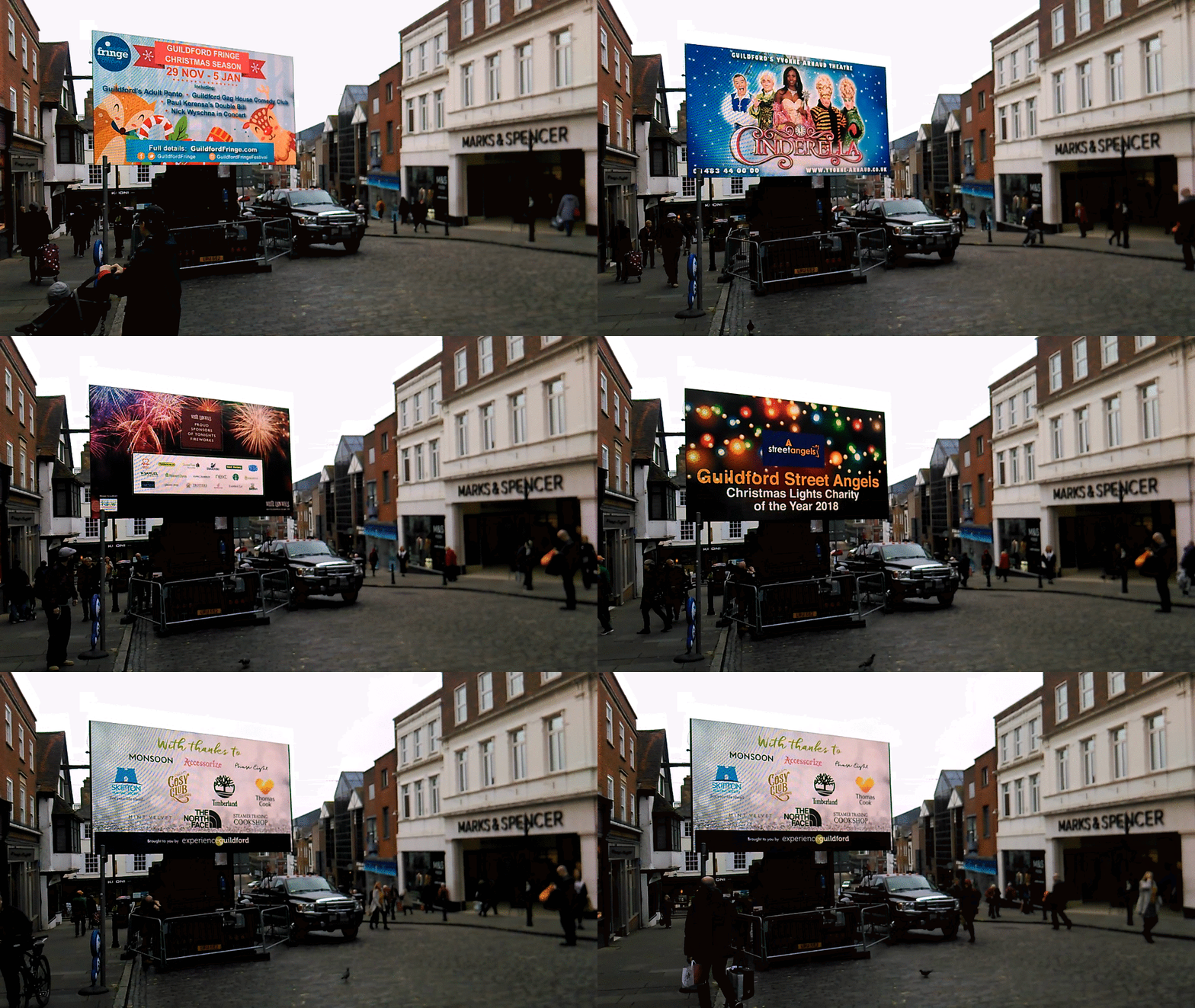
It’s the time of year that without cultural cues like sweet sticky chocolately smells or repetitive music from (mostly) happy times in our childhood, we’d stay at home.  But that would be derelicting our civic duty to shop and engage with our favourite brands downtown!

So someone hires the chocolate peanut man and pays the PRS for tunes and erects a great massive lit-up billboard to help spread the word about the SHINY LIGHTS that will now be twinkling above Guildford High Street until well after Santa’ been.  Bring the people out of their caves.  Lure them with lights and music and chocolate, because the machine needs to be fed!

It’s an important part of following the money – who pays for the lights?  Who pays for the publicity around the lights?  Why is it so important for people to keep shopping? What would happen if they didn’t?  What is the payoff to retailers of having an intense commercial season like this?  What are the costs to people?  What are the costs to the environment?   Why the appeal to charity?  Some of these questions are easy to answer, some of them are a bit more meaty.  All of them lead to further questions.

Suburban Station Slashers

28032010535

Two things I notice about this group of posters at Epsom station:

1. The common use of Black, Red & White both between the dark fiction titles but also with an exhibition about Victoria & Albert – does this tell us anything about our attitude to Victorian times?

2. Why are these books so popular with suburban rail passengers? Or at least why are suburban rail passengers routinely targeted by the publishers of these books? What does it mean that large numbers of people pouring into London every morning have just spent half an hour immersed in blood, slashing, and psychopathic torture?

Cloud Culture: any new threats?

I’m yet to be convinced that the internet can’t look after itself. We may need some forms of organisation to help make sure we’ve thought through the risks and continue to do the next right thing but that organisation isn’t anything that should be modelled on governments or corporations. It needs to be native to the net and it will emerge in the same way that organisations have emerged on the net before. That’s how the net looks after itself, it adapts.

In 1997 or so, I remember talking to my then boss about what an intranet might look like for our team and how it differed from the internet and how it might be useful to us. If you were around in those days, you’ll be familiar with that conversation with someone who kind of got some elements of what the web was about it but wasn’t rooted in the culture like us. It’s pretty much the same one that people have been having about social media for the last few years.

We then drifted onto the idea of .com and what commerical entities on the web (we were part of government and so could sit and theorize about such things) might do with this new thing and how they might behave. I was very bullish about this. I’d just come from the Computing Department of the University of Surrey where I’d been immersed (probably to the detriment of my degree class, but hugely to my personal benefit) in usenet and the nascent web-culture.

I was quite sure that there’d be a fight. A fight between the cold commercial forces of capitalism and the warm, fuzzy, hippy-dippy types committed to openness and co-operation and collaboration for the greater good. And naturally “we” would win.

And how did it turn out? What actually happened? Well I don’t think there was a big battle – both sides lost something, both won something – we all adapted and the web became something that had a more commercial heart, but wasn’t just another channel for business as usual.

Is the web now full of people wanting to make a quick buck, pushing advertisements and 20th Century mass production business models in our faces? Well yes and no. Is the web full of anarcho-hippies, knitting their own yoghurt and urging us all to wear sandals? Well yes and no. Both extremes exist but can be ignored if you wish. Where the really interesting stuff is, is in the middle where social entrepreneurs are creating new value in many forms, giving stuff away, being open about their processes, sharing but still making enough money to enjoy a comfortable standard of living. More than that we’re finding new ways of working together, organising and making stuff happens that benefits us and the whole community.

My personal experience with Tuttle has been that the network is much stronger and more robust than we imagine. Whenever it get’s a push against it, it either repels invaders or morphs into something similar enough to still be Tuttle, but different enough to survive.

So yes, I remain to be convinced that the accelarant properties of the cloud are any more of a risk to the cultural effects that we value than any other infrastructure changes we’ve seen.

Counterpoint will publish Charles Leadbeater’s report Cloud Culture on 8th February with a debate and conversations at the ICA featuring Catherine Fieschi, Charles Leadbeater, Ekow Eshun, Paul Hilder and me. If you haven’t booked a ticket yet, there are still some left here

SXSWi in 2010 via oh I don’t know loads of places

homage to wankergirlSo here’s my poorly thought-out, unplanned, half-baked, undetailed, but totally awesome idea for the Spring of 2010.

I’ll be attending SXSWi in Austin, Texas again. My panel was not picked, but emotion aside all that means is that I’ll have to pay $blah or so for a ticket. So I’m definitely still going to go – it’s just well, you know, too lovely and awesome not to.

Last year we flew over a few days before and had some holiday time hanging out and getting acclimatimed and then flew back the day after interactive closed.

This time I want to take it a bit more gently. Here are the bare bones of the evil plan, which I’d prefer to do with a gang of tuttle-istas if we can find ways of funding it:

1. Find the shortest flight to North America possible (does that mean least-polluting? I don’t know but that seems like a good aim to bear in mind) and fly at least a week before SXSWi opens ie arrive March 5th at the latest.

2. Devise a series of train journeys from wherever I land, down to Austin, preferably going via New Orleans to visit that good friend of Tuttle, Mr Taylor Davidson and see how his Crescent City adventure is panning out. Yes, you read that right, train journeys. I understand that the US train system is not quite as beautiful or efficient as its European sisters. However, train travel rocks, it just does.

3. At stopping places throughout the journey hold Human-scale Conversation sessions with local people talking about differences between US and British culture – not trying to solve anything particularly, just getting the subject out on the table and seeing what comes of it. There will be heavy-duty social reporting of these conversations. Note that the format has been refined since July with some extra flourishes – this is how I introduced something like it at the Tuttle/Counterpoint event in December.

4. Once in Austin, continue to hold Human-scale Conversation sessions on the same subject and present #kebab-style what we heard, found, learned, saw along the way.

5. Make our way back to the east coast overland again, putting together a documentary film from the footage shot during the first part of the trip, so that we have something ready to show when we get back to London.

Howzat grab ya?

150320091095

Here’s 8 ways you can help (and I’m sure you’ll come up with more)

1. Tell me how you’d improve on the plans and make them even more exciting.
2. Tell me why this is oh so very wrong-headed, misguided and stupid (I won’t listen very much, but I’d rather ask you for this than you just provide it out of the blue!).
3. Help me work out rough costings for each variation.
4. Provide money (just loads of it, regardless of the costs!)
5. Suggest routes and interesting stopover points, tell me why you think it’s interesting.
6. Volunteer to tag along and tell me how we’d pay for that.
7. Find other supporters with more money than time who’d like to see this happen.
8. Introduce me to sponsors who might provide help in terms of cash, food, shelter, transport as well as social reporting equipment.

UPDATE (18/01/10): The planning for this trip is now going on over here Come see!