
I started going for a walk but almost turned back after five minutes or so. Then I saw something on my phone that made me carry on and record this.
Some links that might help you understand/remember bits:

I started going for a walk but almost turned back after five minutes or so. Then I saw something on my phone that made me carry on and record this.
Some links that might help you understand/remember bits:
This is by no means a canonical list, but I remembered on Saturday that I had it with me and so I shared it with people. It occurred to me that it might be useful to share here too. I could add to it, so could you, but it’s just what came out one day when I sat down to write “Things I need to do to take care and resource myself.”
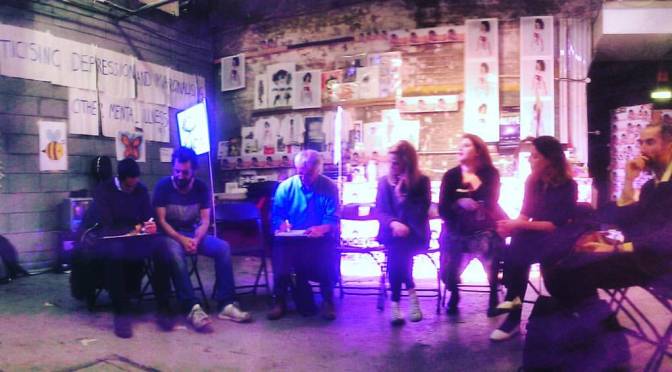
I recorded this on Waterloo Station shortly after the Devoted & Disgruntled Vaults Festival Open Space on Saturday. The space was opened to discuss “Let’s stop romanticising depression and marginalising other mental illness” and I called a session called “Why So Serious?” about the issue of taking oneself too seriously, dealing with other people’s expectations, the link between adopting a serious persona and depression or burn-out.
I reported like this mainly because I’d called a session at the previous week’s space but had then spent the whole week not being able to write a report. It’s reminded me how much I like making this format. Expect more…
I went to hear Michael Mainelli talk about blockchains (actually Mutual Distributed Ledgers) at Truphone this morning. Michael brought the voice of reason and long-term comprehension to the some of the excitable bubble-watchers in the audience.
Over coffee beforehand, the vox populi was excited by the efficiency possibilities inherent in this technology. The ground I covered a little in “Eaten by Code, Replaced By Robots?” but from the perspective of financial services firms – ie the Banks have all got to do this, because: previously unimaginable productivity.
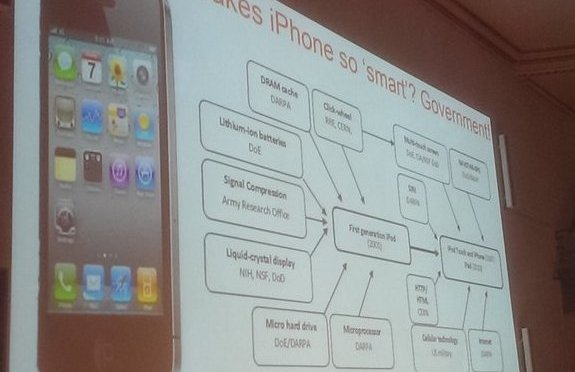
All that productivity and efficiency also means potential unemployment for a swathe of white-collar paper-pushers/keyboard-jockeys who make up the mass of our Financial Services industry. But that’s not the Private Sector’s problem, that’s something Government needs to deal with. This is the view criticised by Mariana Mazzucato at the John McDonnell #neweconomics lecture last week – that Government shouldn’t only be seen as a means to fix things that markets can’t (or won’t) deal with.
But we’ll give public services the problem to solve even though we’re simultaneously taking away the money they have to spend. Have a look at Evgeny Morozov’s piece in The Guardian on the relationship between tax avoidance and private investment in services like Uber:
To put it bluntly: the reason why Uber has so much cash is because, well, governments no longer do.
Follow the money…
We have seen some cultural icons pass in the last month. And whenever we hear of another individual death, we’re tutting on social media and giving January 2016 a bit of a hard stare.
It’s had me thinking about death, how it’s always a surprise even though we know it’s coming. How the War Babies and Boomers are getting older and will naturally be starting to disappear and what it also means about our culture.
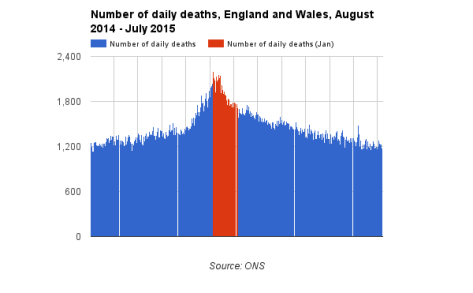
First of all, January. Yes January is a bastard. Even if you’re well it’s long and dark at our latitudes and I think lots of people who aren’t so well decide consciously or not that they’re not up to sticking around for another winter. From the ONS Winter mortality statistics from England & Wales you can see that January 1st was the number one day to die in the period 1/8/2014 to 31/7/2015 and that January was the peak month for deaths with just under 60,000 people.
But what about Bowie, Lemmy, Rickman etc? Well they’re the early-ish ones of a much bigger trend. Although life expectancy at birth for males in the UK is currently about 78, back in the late forties it was 63-64 (presently ONS don’t produce life expectancy tables for people who took extremely large amounts of drugs in the seventies like Bowie and Lemmy). A bit like house prices, most people have come to expect average life expectancy to keep going up even though they realise it can’t keep going forever. Sooner or later everyone who had a top ten hit during the sixties and seventies will be dead, shortly followed by everyone who bought a copy of said hit.
And during the sixties and seventies we had something that we hadn’t had before and haven’t had since – the primacy of youth. If you look at the people playing on number one hits during 1965, for example, most of them are aged 25 or under (the youngest was Dave Davies of the Kinks who was just 18, the oldest was Ken Dodd at a venerable 38). That means we have a bubble of very famous people all around the same age who will probably be dying in the next few years. We’ll have to get used to losing our heroes.
[Help me improve this. Can you see better ways to use available data to make the point? Can you see some more important points to make? Pointe them out, let’s improve it together.]
A couple of weeks ago, John McDonnell MP, the shadow chancellor, announced that he’d be organising a series of events on New Economics to “broaden the debate around economics in Britain.”
I booked up for the first four in London straight away. The first lecture was last night at the Royal Institution. It was good, I heartily recommend you getting along to others in the series if you can. I had a few reactions to it that might be expected by regular readers here.
I’m really not good at post-lecture Q&A. There may be some people who enjoy it, who get to hear things they didn’t hear before, but I don’t think that justifies the mic-hogging and mansplaining and all of us having to sit through another half (if we’re lucky) hour of one person speaking at a time.
I came away really wanting to know who else was in the room (other than Jeremy Corbyn) and what they thought. And what all of this was doing to “broaden the debate”. I may just be being impatient. Let’s see what the next one (on Tech & the Future of Work) is like. I’d much rather have some Open Space/Unconference events where people really get to talk about this stuff and we all have an experience we couldn’t have had through a screen.
Which ties in conveniently with two evening events I’m doing in February at WeWork on the Southbank! After the Future of Work spaces we did before Christmas, I wanted to continue the conversation but with a more practical angle. So rather than talking broadly about new technologies, I’m asking “What are we actually going to do?”
You can book on Eventbrite:
Future of Work: What are we going to do about Artificial Intelligence?
and
Future of Work: What are we going to do about The Internet of Things?
See you there if not before!
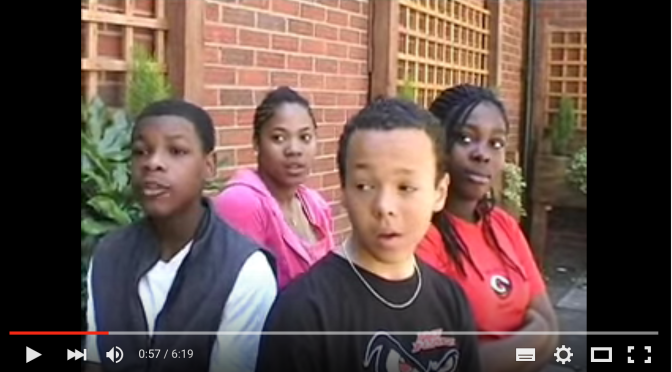
Last night, someone commented on an old video of mine on YouTube. It was from some work I did in 2006 making content for a site supporting a consultation around education for the creative industries. That’s as much as I remember really. Mostly it was talking to “grown-ups” about what “skills are needed by industry” but I also got to go down to Peckham and interview a bunch of young people about their experience of Theatre Peckham (then known as New Peckham Varieties).
The commenter had said “Omg is that John boyega 😭 so happy for him” And so I had a look and yes, about one minute in, there’s a fourteen-year-old future Finn looking surprised to hear that not only had Sir Ian McKellen worked in the West End, but also that he was in the (then) new X-Men movie.
Go on, watch the whole thing. He pops up later too. If you spent any time around theatre when you were young, you’ll recognise yourself and your peers in there somewhere.
It made me realise that I’ve been on YouTube for nearly ten years. 2006 was the year it all got going. At the start of the year it was some experiment that guys at PayPal were doing, I joined in the March (but didn’t fully commit to only posting video there till much later – hence the broken video links in some of my posts!) and by the end of the year it had been bought by Google. And still people were saying video on the web was just a fad 🙂
It might be time for a retrospective!
Eva Pascoe came and gave us some insights particularly into recent uses of Virtual and Augmented Realities in retail.
Discussions afterwards included:
At all of these sessions, we’ve ended in a circle asking people to record their reflections. Listening to this should give you a better feel of what it was like in the room.
If you were there and have written about the experience, do let me know.
Priya Prakash from Design for Social Change came along to our third Future of Work event at Truphone to talk about how work might change when some of our colleagues are a network of sensing machines talking to each other.
Discussions that followed included:
At all of these sessions, we’ve ended in a circle asking people to record their reflections. Listening to this should give you a better feel of what it was like in the room.
If you’ve written something about the evening or inspired by your conversations, do let me know.
We started the second Future of Work event with an introduction to Mycelia from Imogen Heap. If you haven’t read it yet, the two-part interview she did on Forbes is a great starting point. In a nutshell, she calls it “Fairtrade for musicians” it’s intended to be a way of using smart contracts on the blockchain to manage metadata about an artist’s works (including that important metadata about price and how money gets distributed after each sale).
The discussions afterwards included:
We finish each evening with a circle where we pass around an audio recorder to capture people’s immediate reactions. Have a listen to get more of a feel for what it was like in the room.
If you were there and have written anything about the evening or inspired by your conversations, please do let me know so I can spread the word.

![[insert celebrity name] died in January what’s up with that?](https://perfectpath.co.uk/wp-content/uploads/2016/02/image-7.png?w=600&h=371&crop=1)
 Perfect Path