The Climate Crisis Will Be Televised Trivially

A screenshot of me sitting in church on local news on the evening of 8th March 2023. Caption reads “Lloyd Davis, Community Worker, Guildford United Reformed Church”

We got a call just after 10:30am on Wednesday from ITN saying that they had a film crew in Guildford reporting on the overnight snow and wondering whether they could come and film at our Warm Hub.

In the late summer, you know when we had a change of monarch and several prime ministers and for all the reasons it was becoming clear that fuel prices were about to go up very quickly and probably stay there, we decided to open our doors every weekday morning during the winter (very loosely November to March) for anyone who might need warmth either physical or metaphorical. Lots of people were talking about it at the time and that got crystallised into the #WarmWelcome movement and Surrey County Council put some funding towards supporting “Warm Hubs”. We didn’t care much about the branding, though it was nice to have the funding. As it’s turned out, for many reasons, most of which we can only speculate about, few people came for help (here and in other hubs around the county) but those who have done have really appreciated it.

Anyway, that’s not today’s story, that’s just something you need to know because I’ve been naughty and not writing here as much as I should have. If I were the natural-born blogger that sometimes people say I am, you’d be sick of hearing about this by now.

So I said yes of course (just say yes!) but couldn’t guarantee whether anyone would still be there when the crew turned up. There were a few people in the foyer and we were doing our dementia-friendly Sunflower Café in the sanctuary. They did come quite soon afterwards (two women carrying all the kind of kit that you’d expect for proper grown-up TV, not like those social media amateurs you get these days!) and we chatted and gave them tea and then I did a little interview and the camera operator got some B-roll and then they also interviewed some of the people at the café about how they were dealing with the cold weather. Everyone was very polite, as Guildford people are, and answered the questions without revealing what’s really going on.

Because really, who wants to go on TV and say “oh it’s miserable, I’m having a terrible time, can’t afford to keep warm, can’t afford to eat, and my life-partner, who I’ve loved to bits for fifty years, has dementia and needs constant attention… but it’s great that I can come here and have a free cup of tea and some biscuits and maybe some advice on how to save energy.”

It was easier for me because a) I’m not in the same predicament; b) I have a job title to hide behind; c) I’ve always got lots to say when asked; d) we had a similar media request before Christmas and I prepped some talking points then.

All the same I did end up rambling a bit about how “isolation” means something different for rich people in Surrey versus poor people in inner cities, but the bit that made it to broadcast was me saying “It’s just been grey and it’s felt like the sun’s not gonna come back and that just has a massive effect on everybody’s mental health, both in terms of feeling a bit down but also just feeling tired.”

My mug, used as an illustration for the “hot tea” served at church.
It has the slogan “Keep Calm And Play The Ukulele”

After another cup of tea and stocking up on custard creams, they left us to visit the gritting depot.

I was left feeling really sorry for them, dashing around town in the cold, trying to tell a story out of all of this, for an early evening TV audience who probably get up after the main news to put the kettle on. And what’s the story? It snowed and it was cold but people, being people, just got on with their days – those that can, had fun; those that have jobs to do, did their jobs. My suspicion/prejudice is that the demographic that watches ITV local news mostly couldn’t have fun in the snow and probably don’t have jobs.

This link might break soon, I don’t know how long they keep this sort of thing up for, but looking at the resulting 2m18s of film made me think of the mirror-image, the news items we get in the summer, the ones that go “oh blimey, isn’t it hot?!” and show a bunch of pink English people in the park and someone trying to deal with molten tarmac before cutting to a warning to be careful near water. At what point do we stop doing this? I mean, stop treating these weirder weather patterns as comic/tragic filler between the “real” news and the early evening soaps. No it’s not unheard of for us to have snow in early March, but what I said about it feeling that the sun isn’t coming back is unusual and it comes on the back of earlier winter months when it felt like it was never going to stop raining and then the summer last year when it felt like it was never going to rain again. That’s the description of climate change that feels closest to my direct experience.

It leaves me thinking about what media we *could* be making about what’s really going on, so I guess that’s why I seem to be blogging again.

At Work In The Ruins, Dougald Hine, 2023

ruins-os-status
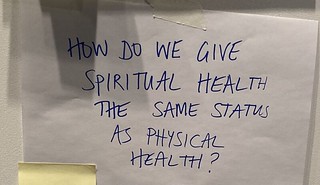
“How do we give Spiritual Health the same status as Physical Health?” a session called at an Open Space on Infrastructures of Care, in response to “At Work In The Ruins”.
London, 8th February, 2023

This week, I’ve finished reading Dougald’s excellent book. (also on Audible, read by the author). I don’t really do book reviews – this is more some initial notes after reading.

The book’s subtitle is “Finding Our Place in the Time of Science, Climate Change, Pandemics and All the Other Emergencies” so yeah, “all the *other* emergencies”.

I’ve tried talking about this as the “global polycrisis” in my day job at church – lol. It’s clear to me that we need better ways to make sense of this because we think we’re good in a crisis, that it brings out the best in us, but what we’re seeing now is a seemingly never-ending series of crises and while it *does* bring out good, it doesn’t feel like anyone can keep it up much longer.

It’s a hard word for people to get their heads round, polycrisis, and my explanation (that it’s all the things that we see stacking up in the news every day, while recognising that they’re all interconnected and that the complexity that therefore arises is only going to make for more surprising and potentially horrible events that we keep perceiving as individual crises <breathe!>) doesn’t always help.

Dougald’s book is a wander through many more of the things that are hard for people to get their heads around. It looks at some explanations for how we got here, some critiques of the current ways of looking at the problems we face and some ideas for how to move forward without minimising or continuing to deny the trouble we’re in.

The first two of these cover the period/era/machine/ideology that he refers to as ‘modernity’. So you get to dive into what (or who!) modernity is and how it’s affected the way we think and behave. It is the impending ruins after the end of modernity that the title refers to.

It’s still working it’s way through me, even though I’ve been lucky enough , through my friendship with Dougald, to have been immersed in many of the concepts in the book while he was forming them and writing about them.

I want to lay out here some of the core things that I noticed as I made my way through the book. Lots of reviewers have noted that it’s a poetic piece as well as being a well-crafted argument so some motifs do pop up throughout as the narrative builds and this helped me both to consolidate what I was learning, but also to see how my thinking was being changed.

Predicaments – this was a biggie for me. It refers to John Michael Greer‘s idea of the difference between a predicament and a problem (that a problem has a solution whereas a predicament is something you have to live with and hopefully find better ways of doing so) – it came up many times to remind me that the “problems” that so many of us are trying to “solve” are actually unsolvable predicaments and that all of these are facets of modernity.

“the price others have been paying all along” – one of the rearrangements in my brain that needs to be reinforced is to shake off the idea that “we” (ie people like me) are the only ones who matter. I mean of course, right? But it’s embedded in so much thinking and it also echoes Vinay’s line that “collapse means us having the same standard of living as the people who grow our coffee.” This was a good reminder that whatever we have to go through, much of our comfort still comes at the expense of other people in other parts of the world.

“people who work in places like that” – this generally means people who work in government or public policy. It’s the people who produce policies and statements and thought leadership and other bullshit that claims to improve the world and be “part of the solution” but in reality keeps working against all of our interests. It’s the people who work in places that support the propping up of modernity. I’ve been one of those people and saw myself in the phrase “Those involved in policymaking now thought of themselves as pragmatic technocrats”. It’s a bit of my work (from the nineties) that I need to revisit and think through in the light of where we find ourselves now.

“no left turn” – this helped me reframe my view of my own political activism and how I’ve thought about the world since I was first shaken by exposure to Marxist analysis. There’s a nagging part of me that wants the answer to this whole thing to be socialist revolution but especially since 2015/16 I’ve been as uncomfortable with the certainties of my friends on the left as with those of the people we stand against. This is not to say that we shouldn’t oppose vehemently the policies of the current UK government but we also can’t continue to pick our enemies or bedfellows solely on where they sit on the traditional left/right axis.

Small path(s) – in contrast to the “big path” which is the road we’re on when we imagine that large-scale efforts (even if organised at a small- or even individual-scale) will create a sustainable version of the world which can continue as it has been all along. Often using technologies that haven’t actually been invented yet. It’s the “business as usual, but sustainable at any cost” mindset. I felt reassured that the work I’ve been doing in the last five years, at a local level, building community capacity and the sorts of relationships that ought to be more resilient no matter how poorly the big path solutions serve us. It’s helping me to let go of the fear that in coming here and working in a small-town church I was doing the equivalent of (in Dougald’s words) moving to Devon and retraining as an acupuncturist.

So yeah.

The image above comes from an Open Space that I organised with Liz Slade at Unitarian HQ to welcome Dougald back to London at the beginning of his UK launch tour in February. It was just one of many conversations inspired by the ideas in the book on the day, but there are many, many more to come. I’m looking forward to opening more space to talk about them.

Half A Pound Of Monkeybread (2023)

So first, here it is, the thing I was talking about yesterday:

But I feel I should say something more about it than “here it is”. Perhaps where it came from, how it came to be. And as usual where to start that story is hard to pin down.

In terms of writing the words, the first bit that I wrote was about 12 years ago when I wrote a limerick on a napkin in the Pret at Hyde Park Corner, shortly after the end of a sweet but doomed-by-long-distance relationship. And it’s still there as the first verse of “Keeping My Pictures of You”

Then it grew because at the time it was becoming a thing, in certain corners of the internet, for people to be sending intimate photographs of themselves to each other, because they could. And it seemed like there might be some fun in thinking about how that might play out in a light-hearted way (before the concept of revenge porn came and ruined some people’s lives) – the perils associated with the persistence of digital media.

The other three were all written in 2015/16 – Blockchain Blues after I went to some technical seminar on how Bitcoin works, which is why it has references to “merkle trees” that most people won’t understand. Enemy Within came days after the election of the 45th President of the USA. It was slightly different then, more repetitive (using “choose not to” over and over again) and was more inspired by the shock that someone could say all the things he’d said and still get elected. And at the same time, we were seeing the Brexit vote here and the same sorts of people involved. Finally The Ballad of Ned’s Head came about as part of a fundraiser songwriting challenge for some good cause or other. I think the prompt was simply a picture of a guy called Ned and it seemed like the quickest thing to do would be a nonsense song based around things that rhyme with Ned.

I had them all as demos with me singing to ukulele, as is my way. Ned’s Head and Blockchain Blues are a 12-bar and 16-bar blues respectively. Enemy Within is set to something like the traditional tune “Red River Valley” and Keeping My Pictures just came out like that, I don’t have enough music theory or history to know what it is. I just knew it was a waltz – are limericks particularly suitable to a 3/4 setting? I don’t know.

And then over the years I’ve performed them all live, which helped to refine the lyrics based on audience reactions – always much less outrage than I anticipate and oddly, more laughs than expected, so you work up the laughter – this particularly applied to performing Ned’s Head to see what kinds of picture you can paint and how the character of the storyteller emerged.

I’d never done any proper home-recording. I’ve been in proper recording studios with proper engineers doing things with tape, because I’m old, but never really got the hang of stuff like Garageband.

Then in October, I had Covid and had time to watch “Get Back” and seeing them in the studio sparked something in me. People always say that the Beatles were successful because they were ordinary and just like us and it reminded me too of the beginning of Mark Lewisohn’s book where he goes through their family trees and it struck me that not only were they “just like us”, their whole families were just like mine – the same characters, the same stories and so I was watching “Get Back” with them practicing and recording and evolving the material, with much less technology than I’ve got on my desktop and I thought “perhaps I could have a go at making something a bit more polished of the songs I’ve got” – Y’know, if they could do it…

So the short version is that I then downloaded Reaper (it’s great!) and found an online course in how to use it to record your own things at home and did that. Spent a couple of weeks coming out of Covid recording a version of Sweet Georgia Brown and once I’d done that, I set myself the 30-day challenge of making something every day with the four songs that are here. That’s all.

So do have a listen, you can stream for free (though I think there’s some limit, I can’t remember what) and if you like it, chuck us a fiver.

Release Day

I’m doing something unusual for me tomorrow. I’m releasing some musical recordings that I’ve been working on since the beginning of November.

The main oddity in all of that is that I gave myself a release date ahead of time and have finished the work a couple of days ahead of it. My custom has been to make things quickly and just put things out there as soon as they’re done, because earlier on in life I found that deadlines would always be missed and then I had the awfulness of delivering late and often it felt like just not delivering at all would be preferable.

In reaction to that, I developed this style of producing material in the now – rough and ready, improvised, immediate – maybe you’ll like what I make today or maybe you won’t but don’t worry, there’ll be something new along tomorrow (or maybe the next day). It suits work that is performative, but what if I don’t have the capacity to put on a performance today? And for my writing, over time, if I (or anyone else) ever wanted to draw stuff together and make something new out of it, or develop ideas at length it’s been difficult and disjointed – it’s made to be read now(-ish), like you just bumped into me and we went for a coffee or like I left you a really long voicemail. That’s why I found my voice in blogging and podcasting and then Twitter. There’s polish, but it isn’t used to improve the individual items, it’s spent on the practice of being able to create rough and ready items that are just about good enough and which might, if you’re lucky, have some charm for showing some humanity in this world of slickly, machined “content”.

And there’s a defence in there too, that you’re being brave and putting stuff out there and of course if people don’t like it, you can hide behind the fact that you didn’t put much work into it anyway.

And yet. And yet I yearned to make something that had clearly taken some time and effort, something that wasn’t just the first or second take. The most recent breakthrough came at the end of October when I decided that I’d set myself a “30 days of making something” challenge – no project plan or milestones but a simple plan to do something towards a project every day in November and allow that to be enough. The first thing off the top of my head was to work on these songs, to make something more than a demo and to implement ideas I’ve had about making music ever since I saw someone making weird shit with a portastudio.

The practice became just letting myself do something towards it today, rather than trying to get it to a particular stage or be able to share the latest half-baked version. I had four songs. Some days I did something with all of them, some days I focused on the tiniest part of just one. But I kept going through November, just ticking off the days. About half-way through I thought perhaps it would all be ready for release at the beginning of December. That soon evaporated as a goal, but I was OK with it. I’d succeeded in the actual goal, which was to pay attention to something every day for thirty days. The day job got in the way at the beginning of December and then I had a viral wipeout over Christmas, so in the new year I edged towards the idea of fixing 1st Feb as release day. That gave me something to work towards, which was eminently do-able and suddenly it was last weekend and everything was pretty much done.

But also I’ve been working alone on this. I know that the songs are alright in themselves (they’ve all been out in the wilds of YouTube for some years and I’ve worked them out live, with audiences of varying sizes and levels of friendliness) but the only other person who’s heard them in this form is my wife and as she’s pretty much guaranteed to be positive about them, I’m now feeling the first-night nerves of unveiling something in public.

What I’m ignoring though is the fact that I’ve been working on this for a while now. And you can’t work on everything all the time, so you do a bit on one and then come back to it a few days later and that’s a collaboration between “past you” and “now you” – sometimes nothing has changed in you in relation to this thing, but most often you will hear something new or have another idea while doing something completely different that means you can come back to it fresh. So I’ve not been working alone after all, but it’s not just a collaboration between teenage me day-dreaming about multi-track recording on cassettes, with ten-years-ago me writing silly words on napkins in Pret a Manger and me sitting in my front bedroom in front of a microphone with my ukulele, it’s all the bits in between that have fed me and the material and continue to do so.

Opening Space – Invitations

The crafting of an Open Space invitation will be iterative.

I like to have an overarching single question as the title of the event. How broad it is does depend on the subject and also how big the gathering is – invitations stumble when their scope is too wide or abstract or else too narrowly defined.

And then it’s nice to have some personal observations or explanations from people who are already committed to being there. But you can start with these personal stories first and draw out what the question is from there if that’s what works better.

Sometimes, there’s an idea or question that is nagging at you and so that’s where you can start, by just writing the question out and perhaps sharing it with others. I am drawn to asking questions that start “What are we going to do about…?” I think this is because of the way that I think about Open Space primarily as a way to work out the “what we’re going to actually do” bit. This probably arises because I find detailed top-down planning really hard and so gathering others feels like a good way to surrender the whole thing. But when what we are going to do “about” something is already well-understood, it can be better to go for “What are we going to do in order to….?” which gets under the skin of the kinds of outcomes we want. The most important thing is to get something out and then toss it around with others – the initial reactions to the question among your closest collaborators will help you tease out a more detailed explanation of why you want to talk about this and what sorts of people you think ought to come.

Other times, none of that will come out though. You’ll just have a kind of soup of ideas that it feels like it would be good to work on, but what’s the thing that holds them all together? I find this out by just writing them all down, like the advice we give people learning how to draft an essay “Just write everything you already know about the subject” and see what comes out.

Oh, hello.

I’m doing a couple of things at the moment that have reminded me that I have a blog to do things that other things can’t do. And it’s not nearly as horrible to use as I make up it is.

The first is that I’m using Mastodon and the wider Fediverse quite a lot (isn’t everyone?) and it’s rekindled my ability to post shit quickly and sometimes impulsively in short bursts. One of my resistance points with blogging is that it can so easily seem like I’ve got to write an essay and get it right before hitting “Publish”. And that’s bollocks – it certainly wasn’t true when I started – go back to 2004/5 around here and you will see it very clearly! So I’m here, trying to blog like nobody’s reading… again. Because there are things that I don’t want to pour into my stream in tiny chunks. I do want to be able to take some things a bit slower and more thoughtful and catch up with bigger themes rather than the things that pop into my head and “need” to be said immediately. The open web feels like it’s coming back or rather that we have another chance at building an open web.

The other thing I’m doing is that I gave myself a 30-day challenge at the beginning of November to record four songs that I’ve written and performed over the last twelve years or so and release them. The main aim was to give myself something to focus on every day (you’ve heard that one before) but it has also become a thing in my head where I’ve committed to releasing my best work ever next Thursday and if I don’t then the whole month will have been wasted. Also bollocks. Working consistently is the thing that I find very difficult to maintain but I *have* maintained it for (looks at calendar) 26 days on this project and that’s fantastic already. This too feels like “another chance” – it’s a chance to remember that I am a musician and that I can do this stuff as well as it being a mega learning experience both in technical terms (performance *and* recording) and in being able to commit to making a something in manageable chunks.

And right now, it’s creeping up to midday, so I have to let go of the need to document because there’s a greater need to do the actual work.

What even *is* an idea?

David Lynch talks about ideas as fish. He says if you sit still and wait and are open to catching one, they’ll just pop into your consciousness, so you right them down and then others come and join it and you write them down too and then you can express them in whatever way seems right – a film, a poem, a piece of wood, whatever. For a long time I was stuck in wondering what this meant in my experience, “is *this* thought an idea?… or this one?” – that’s a sticky place to be and it stuck me good. From the perspective of today it’s easy to say, well that’s the mind getting tangled up in asking stupid questions instead of just doing what you’re supposed to do. It’s hard to admit that one’s mind has been so stubbornly in control – especially when you’re supposed to be thinking up ideas! I’ve been meditating for years. Have I been doing it all wrong all that time?

But I had an experience a couple of weeks ago that shifted my understanding. And funnily enough, it happened down by the river. I didn’t go fishing, I went for a run and I ended up at the river just down the lane from us. It was one of those going-to-be-hot days but it also felt like there was more moisture in the air than had been, and I’d gone out later than I’d intended. So I was hot, sweaty and worried about being late, but I had also run enough to shut the chatterbox up a bit. So I’m walking towards the path up to the main road and I see a guy whistling for his dog. He’s holding a lead but I can’t see the dog. He’s not agitated or doing anything wildly physical, just standing there and whistling and calling for the (invisible to me) dog to come out of the water. And I made up a little story, which I won’t spill out onto here, but “making up a little story” is something that I feel like I’m always doing, but this time I recognised it as and idea, as the kind of idea we were talking about when I started writing this post, the fish kind. And as I let it swim around in me, it did indeed attract more ideas and ways in which the story could expand and make sense and then by the time I was home and had stretched and showered, I could sit down and write the whole thing out and yes even more fishy little ideas came swimming along, to help me make sense of this weird story. And suddenly I’m sitting there with a notebook full of words and I feel like I’ve just sat by the riverbank and filled my nets, it’s so satisfying.

And it reminded me of some blurb I wrote for myself a few years ago when I performed some of my own songs, “that writing songs could mean just typing out those strange and silly words in his head, in a kind of sensible order, while strumming his ukulele”.

I’m thinking and writing about this now because there’s an idea kicking around that has some similar dimensions to the fish/idea I wrote down in August 2007 which then became all that stuff that happened since then (if you know, you know – if you don’t then just re-read the last 15 years of this blog and follow any links that work). But my mind is fighting writing it down and I recognise that that’s because I don’t have all the answers ready yet. But that’s not how it works, you don’t have the idea and immediately get all the other ideas and know how to implement it, how this particular set of ideas need to be expressed in the world, you just sit still with it, write it down, write down the other things that come along to join it and before you know it, it will have taken some physical form and you’ll need a few more hands to make a home for it.

Simple body maintenance things

One of the things they tried to instill in us at drama school was the idea that if you’re going to be someone who creates through performance or just your presence in the world, some exercise first thing is really good for you. This was too hard a pill for me to swallow even when I was training, let alone when I got out into the “real world”, but I’ve found it to be true for me and it’s one of those simple things that slips into my blind spot, especially when I get busy, and then I wonder why I’m not at my best. I went for a run this morning and bingo-bongo, I’m writing already.

I guess hearing “your body is your instrument and that’s why you have to look after it and warm it up every morning” was just too wanky for 19-year-old me, but also I know that not looking after myself, despite knowing what’s good for me, is a long-term pattern.

Drink more water! That’s another one. Since I started my ADHD medication, and was strongly advised to minimise caffeine intake with them, the only alternative I could face was decaf coffee. So I have one “proper” coffee first thing and then I’m onto the decaf. I try to get good stuff, not too chemical-ish, but really it’s just flavoured water, so why not just go with water? I generally work at church in the morning, come home and have some lunch and then do some writing and talk to folk in the afternoon. But when I sit down here after lunch, my brain tells me I need a big pot of coffee, so I get a big pot of (decaf) coffee and invariably feel worse by the end of it and forget that I really just need simple hydration. Big pot of water next time please, brain.

For the ❤️ of Guildford

I’ll be opening space, as part of my work with Guildford United Reformed Church, on 14th May, for the question:

“What are we going to do to nurture and nourish the spirit of Community in Guildford?”

There’s a booking page with the full invitation, but here’s a little video version I did:

I’ve called it “For the Love of Guildford” but I thought using a heart emoji was cuter, which then led me on an interesting journey of discovery about which places it’s impossible to render an emoji (FB event titles for example!)

As usual, I’m not sure what people will bring to this yet. I’m keen not to imply that there’s a dearth of community spirit here, rather that in extraordinary conditions, it might need something else to help nurture and nourish it. There might be some things missing (again, I find it hard to articulate exactly what – and that’s why a big room full of people is a good idea).

I’m also aware that, despite practicing opening space for nearly twenty years now, this is the first time I’ve done it right on my doorstep with a community that I’m part of. It feels easier to do this kind of thing when I don’t have a direct stake in the outcomes (or responsibility for the situation), so this is growing up a little bit for me.

In any case I’m glad for an excuse to come back and blog here today and perhaps reach some of the brave RSS warriors who are still subscribed 🙂

Tony’s Memorial (day 2? or 4?)

It was good to give myself a break over the weekend even if it means I’m thinking about trivial things like day numbering…

Untitled

Having chosen this topic, it was easier for me to tidy up the most immediate stuff around my desk, making a “Tony” box and putting everything else away. But that did also remind me of the sheer amount of stuff that I’m giving myself to work through.

That’s good, it’s a stage in the project, it’s working out the actual scope of something doable in the next four weeks rather than trying to fool myself into thinking I can do the most perfect, most complete job and never have to ever think about any of this again.

One way to come at this is to ask “What would be a good end product, something that you’d feel good about sharing, that was beyond the most basic, but still had room for extension in other projects? What would that end product look like? What elements would it have?” That reminds me that there are roughly three high-level processes to go through, which I will call “Cataloguing”, “Digitizing” and “Presenting Online” – ie a first product would be a complete catalogue of all the things I have, some description or whatever metadata is appropriate and where it is. This is a first round of organisation, going from vaguely-known chaos to some initial structure and some boundary around what’s in and what’s out. It also gives some pointers to where to start with digitisation and how much effort there may be involved. Going through the digitisation not only give us something that looks more like the end product, it helps to refine the catalogue or index and to improve the metadata. Then thinking about how to present it online, how to talk about the stuff, how to link it together into a collection of stories and actually writing those stories.

Having written all of that down, I’m now better informed about the size of the whole thing and the likelihood of completing all that in 28 days is pretty low. So I’ll have more of a think about what I’d be satisfied with before starting to make some lists.


The picture is from a family trip to Oxford in the mid seventies. My brother’s age is probably the best indicator – he was born at the end of 1970 and he could easily be five or six here but probably not seven, so I’d say summer of ’77 (because you know what the British Summer of ’76 was like and it wasn’t wet like this!)

I'm the founder of the Tuttle Club and fascinated by organisation. I enjoy making social art and building communities.