
If you need help not getting things done, feel free to use this in any way – I’ve made it cc-by so you can do what you will with it as long as I get a smidgen of blame.
Happy? New? Year?
 Isn’t happiness weird? I often find myself being choosy about who to give it away to – but why would I withhold happiness from anyone? And anyway, the more I give away, the more I get back 🙂
Isn’t New Year weird? How did something that should be about innovation become so fixed in tradition? I spent last night equally bored and nonplussed.
Isn’t time weird? This year’s a leap year and so just because we all agree that it’s going to happen, we’ll have an extra day in February. If we can agree on bending a rule about how many days there are in a year, surely we could agree on something else. You know, silly stuff like “let’s stop fighting” or “let’s make sure everyone’s got enough to eat today”
Love & hugs everybodeh!
Another year
 It’s my birthday again – I’ve already had lots of lovely good wishes on twitter, facebook and seesmic. It really doesn’t seem like yesterday since the last one.
I’m very glad over the last year to have kept up with lots of my long-term bloggy (and less bloggy) friends but I’ve also added a huge number of new “nodes” particularly through twitter, seesmic and social media club and I’d like to mention a few here, in no particular order – many feel to me like I’ve known them forever (and of course I kind of have, those whose blogs I’ve followed but whom I only met and got to know this year).
Deek Deekster, Roo Reynolds, DK, Russell Davies, Charles Frith, Charlie Gower, Mark Earls, Katie Ledger, Mike Atherton (sizemore), Alex (ledretch), Fred2Baro, Warzabidul, Giselle Kennedy, Whit Scott, Johann Romefort, Christian Payne, Nic Butler, Adam Tinworth, Andy Roberts, Vero Pepperell, Ged Carroll, Chris & Kristie Heuer, David Terrar, Ronna Porter, Richard Sambrook, Tim Duckett, Tom Armitage, Grant McCracken, Janet Parkinson, Guy West, Gordon Joly, Chris Hambly, Emma Persky, Sam Ismail, Eaon Pritchard, Hylton Jolliffe, Rupert Howe, Richard Stacy, Thayer Driver, Nick Poyntz, Steve Clayton, Jamie Coomber, Amanda Gore – sure I’ve missed some but please don’t take it personally, just shout at me in the comments 🙂
I’m also amazed looking back over this blog at all the stuff that’s gone on – and this is just the stuff I’ve shared here! 😀
January – Leading my first Social Media Club meeting
February – The coining of “Social Media Tart”
March – Open Coffee started and I took a quick trip to Barcelona
April – New batch of Moos and a romper suit
May – My first time in Rome and Pants made out of potatoes
June – Interesting2007 ZOMG! and Adriana was poorly, but she got better – yay!
July – Started sharing 8 things
and met up with some old luvvies
August – jam packed – Social Media Café was conceived, musing about FB privacy, and the first game of Mornington Crescent on Twitter
September – I met a troll and had a holiday
October – Seesmic took over my life
November – Went to Berlin, prototyped the café/club and talked at barcamplondon3 about relationships
December – having spent most of the year in the application process, got my busking licence and got started
Wow! Thanks everybody for such a fab time! See you in a few days when the Christmas madness has abated.
Always adding nodes
 I love the ability that blogging gives me to connect with unexpected people anywhere in the world just as well as folk in the next postcode.
Ramon commented on my busking post and so I subscribed to his blog about his daily adventures crossing the border into Mexico to do his thing. It’s fantastic – here’s a snip:
“As I was arriving at the pedestrian area of Velarde St. I saw that the place where the Andean musicians where last time was taken by this gentleman selling a sort of dancing magical skeletons. He sells them by putting on a show with them. These things are made of plastic, about three inches tall and hang by a very thin, invisible almost, fishing wire and he sort of inadvertently makes them dance while speaking to the public. I kept on walking to my usual spot in the shoe store area. I was so focused on finding out if the PA system of the big shoe store was on that I didn’t noticed that the Andean musicians where already setting up right there. When I saw them I noticed one of the agents of commerce talking to them and telling them that they should get a permit, I think it’s because they have the whole kit, including CD’s and flutes to sell. I talked to them and found out thatthey are actually from Mexico City and not from the Andean region, they usually busk at Malls during this season.”
I had a giggle closer to home seeing Lars’s comment on flickr about my busking photos:
“Ah I get it now. I thought you were going to be king of a bus for a day” – you crazy literal Danish person, you.
LOLinator
if u iz board reedin this stuff u can find moar better stuff if uz puttin thru da LOLinator – moar better pix 2 =)
i tips hat 2 Dave Snowden at Cognitiv Edge News
Oh dear
Oh God, I know, I’ve sat at the “centre” and written this sort of stuff – it needs a few more buzzwords to make it truly awful:
“BLAHBLAH has released enhancements to BLAHBLAHBLAH , its professional-networking website for support
of more effective collaboration and knowledge sharing across BLAH.
This is the first major refresh of the design since the platform was launched over 12 months ago and is the result of the feedback we have received from our growing number of registered users and the recommendations received from a detailed usability study commissioned by BLAHBLAH.
We are confident that users will find the new design more intuitive to use and will benefit from the enhanced help and guidelines that are available on the site. We anticipate making a number of other functional enhancements to the site over the coming weeks and will advise you about these soon.”
Clearly the excitement was too much for “users” of this “community” and they all tried to click at once…
Error 500: SRVE0207E: Uncaught initialization exception thrown by servlet
Busking 2.0
So just a quick thought before I stroll over to Embankment tube for 2 hours of ukulele fun.
When they hear I’m busking, I get some funny reactions from some people – they immediately assume it’s about the money, or that it’s a bit low and dirty. It just occurred to me that sometimes these are people who don’t have any problem with blogging, but the reactions seem to me to be the same as, say, mainstream journalists to social media.
So, thanks guys for helping me see that my busking is just the same my blogging – just because I’m busking doesn’t mean that I’m trying to get to the top of the CD charts, I’m not doing it for the money, or that I’m slumming it with the low lifes – and it’s not about whether everyone likes what I do or not, it’s for the odd glances of recognition and those people whose day is made a tiny bit better by hearing some old git singing his little heart out today – and it’s for me – I’m having a great laugh 😀
Tuttle Club – getting to the nub of why
So in the previous post I went on (and on) about relationships online and off-. The next point is that we seem to have grown up with a prejudice that online relationships are “not as real” or “not as good” as those we create offline.
While I am prone to this myself, when I think about it, it turns out to be piffle – people are people and the way we relate to each other doesn’t deteriorate as a matter of course just because we do it online. Some people behave very badly to others online, in ways that they wouldn’t dream of doing “IRL” but I’d argue that most of us now have more than one solely online relationship which is every bit as good as some of those that we have with people we see every day. And what is interesting, and I’ve noted before, is that online activities enhance relationships that began offline and vice versa. The distinction is disappearing, but I think that while things are still blurry, at this stage of our learning about relationships mediated by technology it’s a good time to look at some of the dynamics of how we get things done in this environment.
As well as Online/Offline, there are two other dimensions that I think are important to look at. These are the Formal/Informal and Group/Personal axes. We’re more used, I suppose, to thinking about the informal/formal axis in the context of the group, but I see both in my personal, individual life too (though there it can be easier to think about it as what’s conscious and unconscious). I don’t like gratuitous use of 2×2 matrices any more than the rest of you, so I hope you’ll forgive me, but I think it’s worth thinking about this space.
One of the first things I notice when thinking about this is that on the one hand social software is bringing more of a focus on the informal lives of groups (organisations, businesses if you like) while it brings a kind of formality at the individual level, by simply codifying our relationships, making things explicit that before were just understood – turning huge chunks of our personal lives into data (which by the way still doesn’t seem to belong to us – but that’s a whole other VRM kettle of fish – and I’m glad brains like Doc’s and Adriana’s are working on it).
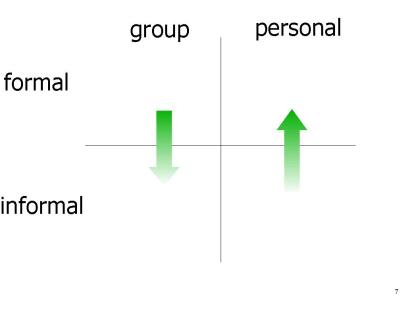
However, that’s just another diversion from the story. Phew. The real point is what we can see when we extend the 2×2 to a 2x2x2 (cue: strangers in the night) with online/offline as the third axis.
In a purely offline world, think about how new stuff happens. I have an idea one morning, maybe in the shower, it percolates up out of my unconscious in a formal-ish way, maybe I write something down but perhaps I just take it in my head to work. Around the coffee pot, or the water cooler, I have a conversation with people and mention my idea. “OMG,” somebody says, “that is awesome, I’ve been thinking about just the same thing” – (OK, so this doesn’t *always* happen, often people have more interesting things to talk about, like their cat’s arse) “and what we could also do is X, Y and Z”. “OK,” I say, “let’s get together later and talk it through” So we do, and we work it out and we come up with a really cool way of expressing it and it gets adopted as part of the way we do things around here (or a ‘pro-see-dure’ if you are a dork).
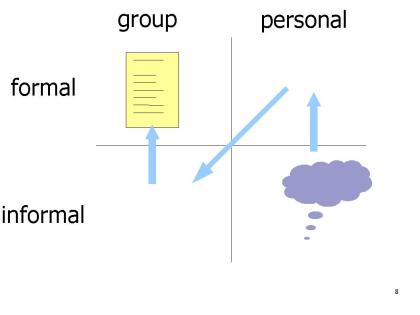
In the purely online world, there’s a similar process. “Ping! Idea!” (personal/informal) write on blog (personal/formal-ish), a few people comment, create a google group or suchlike, knock up prototype, show it to friends (group/informal), come up with neat way of inviting new people in – bang – it’s an every day part of the web that we suddenly can’t do without (group/formal).
When the online/offline distinction gets blurry, the group/informal space is the interesting one, but unless we work for YaGoogleSoft, or are willing to sell our souls to Starbucks, we don’t have a wifi-enabled space to meet and chat around the coffee machine, dropping our little ideas into the conversation and seeing where they might end up. So the Tuttle Club idea is to create a physical space for the rest of us to play around with the offline counterpart to the read/write web and online social networking and to see what happens when (at least in this city) we have somewhere to facilitate that online/offline bootstrapping for a whole group of people who have little in common yet except that they’ve seen the social media light (and that, if we’re lucky, will be tomorrow’s story).
Relationships, Online and Off-
 So here’s some of the thinking behind the Tuttle Club idea. I’ve talked mostly about what it should be, to help people understand, but there are actually some important things to say about *why*, which really help me see what is important to keep in and what things can go by the wayside.
Once upon a time all there was was offline – so much so that we didn’t think about it, we just walked over the street and talked to people. And they took our lunch money and told us to bugger off. Sometimes we built more positive relationships too. I think it’s odd that we have to remind ourselves that this was the case but we do, increasingly, especially as time goes by and more and more people come into the world who’ve never known anything different – you know, people who were *born* in the 80’s – weird.
Then we moved into a kind of binary place where you were either one or the other – from 9600 to 14.4k to 8MB broadband, for lots of people you’re still either online or offline and online means being sitting at a computer.
However increasingly it’s whatever (and wherever) works. The boundary is blurring and we can see a time when we’ll be always on, which means that on is as meaningless as off used to be, the distinction may disappear.
A quick reminder – what we’re talking about is ways of people connecting with each other. When I first got an internet connection pre web, there were three things pretty much that you’d want to do. Email, Usenet News and MUD (Multi-user Dungeon) – ways of finding things like gopher, veronica and archie were ways of finding people who’d created cool stuff as much as finding the cool stuff itself. I never was much of a gamer, so I was attracted to reading and writing and getting to know people through usenet and e-mail. Now Web 2.0 is supposedly doing something new, but it’s simply giving people more sophisticated ways of doing what we’ve always been doing on the net.
So I’m asking whether there’s any real difference between online relationships and those we do offline, whether you draw the distinction between based on where they started, or where most transactions currently take place. And the answer seems to me, to be no, there isn’t any significant difference, what is more important is that relationships can be enhanced by interaction online and off- and that these different types of interactions build a deeper, stronger sort of relationship than those that only happen in one “place”. I have more and more of these relationships, people who once I would only ever have read or read about, I see face to face and we get to know each other better and then our relationship online is even stronger.
My “friendship” group then (and put on one side the question of the definitions of “friend”) gets bigger and more diverse and so the question of the Dunbar’s number comes up – 150? WTF? I have more than 300 facebook friends and for every one of them, I can think of a little circle of others who aren’t there, or whom I’ve not yet linked to.
The Facebook friend wheel shines a bit of light on this. I can see the little communities, constituencies, compartments that hold people together in the way they are grouped around the wheel. This is how we’ve managed the transition between the pre-industrial world of only being able to meet at most a hundred or so people in your life to where we are now where potentially you can have some contact with hundreds of thousands. We compartmentalise. These are my friends in my team. These are people I go to the pub with. These are my “friends” in Accounts Payable. These are the people I know who are into ska. These are my golf friends. (This is the me-focused way of looking at the fact that I belong to multiple communities as JP’s talking about this morning). This reduces the cognitive load – if we’re only really comfortable with up to 150 people but we have to deal with more, then we can handle it by divide and conquer – we only have to deal with a smaller number at any one time. Before social software we all knew the potential stress of having members of more than one group meet up with each other (that’s one reason why weddings can break people). Before this point we could get away with being different people in different situations and to a certain extent be dishonest with some groups of people about who we are or who we want to be. What online social networks like Facebook do is make these communities or compartments explicit and then shares that with everybody. It therefore just got harder to keep those people apart – great opportunities for innovation in my social graph, but oh bugger, *they* are going to find out about *that*.
Now, this is just a prelude to the other thoughts that I’ve included in the presentations I’ve done at Web2Open and barcamplondon3 and the feedback I’ve had is that it’s really useful to see the background. As usual, I’ve done it the wrong way round, should really have written it out, then made a presentation then talked about it, but I really can’t be arsed to do things the way I should. I’m writing this at barcamp by the way, so that might just be a reaction to being in a place where the average person thinks that it’s *very important* to do things *the right way* gaaah!
BarcampLondon3: Raising the social bar – Mark Simpkins
#rough notes
Mark from BBC
Sites that include comments. He’s been trying to get them to do it and now they’re doing it wrong. This is not official just a bnch of ideas.
The main thing is how the audience percieves the (BBCs) content and how that content is seen in the context o f the whole web. bbc is seen as big shiny edifice part of the problem is that comments now get trapped.
What are the interactions? – contact, comment, annotation and tagging – producers can look at various analyses.
contact – we’ve had for ages – send an e-mail – we just get feedback in, it’s nice
annotate – done some of but tricky to manage interfaces for and there are other things going on in bbc eg audio annotation
tagging – newly introduced ad-hoc use of various OSNs
comment – eg The One Show (half-hour magazine prog, a conversation with the audience) but most comments are actually something of a contact.
The mechanisms for having comment exist everywhere, what we don’t do is say “I want you to comment so just blog it and tell me where the link is” Cos we’re a big shiny globe in cyberspace and we want to keep you inside. Although this is not the remit of the bbc part of which is to help people use the web more.
The social bar experiment is to start putting buttons on the site to try to automate this – ie if you have a blog, tell us what the link is, if you don’t, then this is how to set up a blog. However, this is tricky cos bbc isn’t supposed to be getting into this bit. got a prototype greasemonkey script – posts to your twitter stream rather than a blog (and send back a link to the bbc so that they can be aggregated easily)
Probably better to be run somewhere else, maybe as part of PSP.
Q: Isn’t this more complicated than it needs to be?
 Perfect Path