What are we selling? #tuttleconsult

In the day or so since I posted about the “airbnb for brains” I’ve had lots of interesting reactions.  A couple have been like the comment Patrick posted there which boils down to: “my initial reaction was yeah, there’s something in that, but I don’t want to be part of something exploitative” – and this reflects the experience and perception that the collaborative economy is about companies that making big profits at the expense of workers’ wages and driving down working conditions.

OK, I’ll say it clearly.  I’m really not interested in making or being something like that either.  I don’t believe that it’s a natural consequence of organising like this (and we don’t know quite how we’re organising yet!) and if it turns out that in order to make it succeed then people will be working for less than they get now and under worse working conditions then we’ll stop.  I will pull the plug.

So what am I thinking about doing?  How do you bootstrap a platform like this?  Forgive me for making it simple to the brink of simplistic:

we start by working together to make and sell some knowledge products and then we make and sell some more.

This post is another piece in the puzzle.  It’s not that I have the whole picture laid out in detail and I’m giving you one piece at a time because I’m mean, the picture is formed by sharing what’s in the front of my head right now and you reacting.  Please do react in the open and point at the holes you see as well as the excitement you feel.

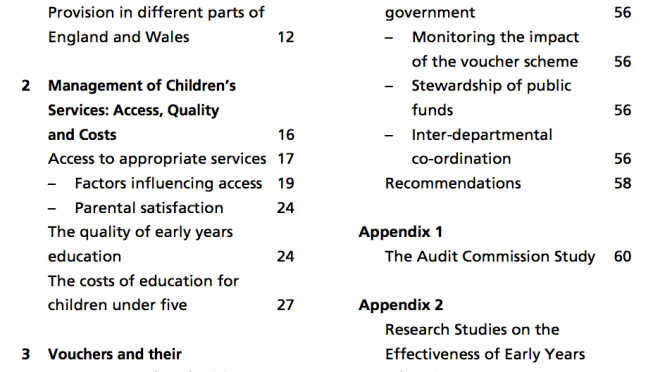
I’ll explain a bit about what I mean by knowledge products.  In the mid-nineties, I was working at the Audit Commission.  Specifically, I was working in the Local Government Studies Directorate (LGS).  Our overall job was to ensure the economy, efficiency and effectiveness of local public services and our products were known as “value for money studies”  Every year we would consult with our customers (local councils) and other stakeholders (government departments, other quangos, NGOs) on what policy or service areas we should study.  Small teams would then be formed to spend 12-18 months looking at one of these areas in great depth through talking to stakeholders and service providers, doing fieldwork, collecting data and analysing it.  In general, there’d be a policy specialist in charge who would write the National Report (a kind of state of the nation assessment of the service) and an auditor who would create a value for money audit product (a set of diagnostic and benchmarking tools perhaps) for District Auditors to use as part of their value for money work with councils.  If you listened to the Today programme on Radio4 at all during the nineties, you may remember the periodic publication of these studies often with a headline like “The Audit Commission has today expressed concern at the state of services in England and Wales for some of the most vulnerable people, blah blah blah…”  We would then run some training for auditors in how to assess the services against the national picture and they would go out and sell it to their customers.

Did you spot the products in there?  There’s

  • the study itself – events perhaps involving an advisory board and fieldwork, none of which was only one-way, the councils and others contributing to studies learned stuff as they went along too;
  • the big report findings of the study, written in a standard, pithy style, with lots of data tables and charts;
  • the audit product, a set of checklists, processes, benchmarking or context-making data that help auditors to deliver value on the ground to end-clients; and
  • the training for auditors in how use this product.

So how does that help us now?  How do we transfer this into our domain of interest and update it for the 21st Century?

Say, for example, we started with a focus on the Future of Work.  Helen and I have run some successful Open Spaces on various aspects of the subject so we know it’s a topic that’s rich and interesting to people.

What if we got a bunch of people together to write the Tuttle view of the Future of Work as at March/April 2016?  We’d work out how best to organise it and hold the principle that everyone gets paid for their contribution (which would include me and Helen for our initial work in the Open Spaces) and then write something, as quickly and as dirtily as we were happy with (there might be a bit more research to do) and then package it for sale as an e-book/print on demand/transmedia experience.

At the same time, a group would look at creating a consulting product that we can license members of the network to use.  We also offer engagement in the style of the original Tuttle Consulting with a focus on Future of Work type problems.

We run (un)conferences that present some of the work and encourage more conversations (which might lead to further written or consulting products).  Some sessions might be training people to use a diagnostic tool or some other way of using the work inside organisations.

All of these are paid for and all contributors get paid a proportion, but are also responsible for sales and marketing there are no Central Services creating an overhead that has to be met regardless.  The key to building it up is that each product is also a marketing channel for other engagements, so people might come to a conference and realise we could do some consulting or get some standard consulting and realise we could do some bespoke research for them etc.

I’m going to keep developing this idea in the open as much as possible, if you want to talk about it 1:1, we can skype and record a podcast, or come to Tuttle and we’ll record it there – everyone should be able to add their thinking and see how others are doing so too.

Maybe we won’t be able to find people who’ll pay for this, or who’ll pay enough.  Maybe we won’t be able to find enough people to work with us.  Then we’ll decide, together, to stop.  But I’d like to have a go.
 

The Airbnb of Brains #tuttle

Consulting around technological change is a very large market indeed, dominated by accounting and strategy consulting firms – if you were going to build a firm from scratch to compete with the big four/five/six professional service firms, you’d need to spend a lot of money over a long period of time, wouldn’t you?

When Tuttle started, eight years ago, I called it a prototype but I wasn’t quite sure that I knew what it was a prototype for.  At the time it felt like we were making a new kind of space for work, and that looked like the emerging co-working model, of which, at the time, there were no real examples here in the UK.  So yeah, we were probably going to be a co-working space.  But then we carried on meeting and it turned out that even when there were co-working spaces, there was still something to be done, there was still much life in the marketplace for people and ideas that is two hours between 10 and midday every Friday, somewhere in London.

We created together a consulting offer, which we took out with some success, but most of the economic, commercial and energetic work happened in small autonomous groups, peer-to-peer.

I’ve been thinking again recently about how we can open up aggregated knowledge and skills, sliced in interesting ways to help businesses and large organisations deal with technological change.

Silicon Valley may be bubbling right now, but it’s unlikely to ever stop lobbing over these little bombs of change and disruption in the form of new hardware and software and ideas for organising the world more effectively.  When I’ve spoken to people recently about VR, Blockchain, IoT and Artificial Intelligence, they’ve expressed weariness in the face of yet another wave of tech.  Most people my age say “We lived through the introduction of PCs to the workplace, then we had to deal with e-mail and the web and now you’re saying it’s all going to be turned upside down again?”  Well yes and the biggest mistake we can make is to think this is the last round.

Silicon Valley is an engine for ongoing disruption and if we can accept that, stop fighting it and instead accept that we need people who can map out what’s really going on;  distinguish between hype and those things that look crazy but are true;  and help you make good decisions about what to do next.

Tuttle can do this.  We have many people in our near and extended network who have immersed themselves in watching how technological change happens and coming up with new processes for dealing with it.

I’ve been thinking about how to unlock the capacity that we have in the network.  And so I’ve been looking at co-operative business models, blockchain-based methods for recompensing creative work, internal currencies etc.

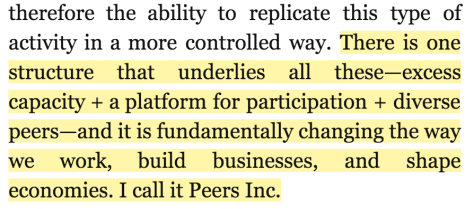
And then on Tuesday night I met Robin Chase and finally looked properly at the ideas in her book Peers Inc.  There, in the introduction, was a sentence that echoed what I was thinking and helped me make sense of our network in a different way.

Screen Shot 2016-03-04 at 17.06.15

We are definitely a group of diverse peers – one of the sticking points for many people hearing about us for the first time is “If these people don’t all have something specific in common, then what do they talk about, and how can it be of any value?”

We have a platform for participation – it’s every Friday morning at 10am for a couple of hours, it’s a marketplace where ideas and opportunities are traded.  It’s a very very limited form, compared to what it could be but because we’ve practiced it for many years now, some of us understand it very well.  I’m starting to think about what a web platform for this might look like.

And we have excess capacity, as I wrote yesterday – lots of people with underused or misused brains.

What if we could leverage these things together in the service of large organisations?

Which is why I just tweeted:

That’s what we’re going to make next.

Join me, comment, argue, nod vigorously, come and help, whatever works for you – but if you need help with thinking about how you can ride the waves of technological change  instead of being swamped by them, my friends and I are the ones you should be talking to.


Capacity

We get all sorts at Tuttle, but over the years there’s been a consistent pattern within the whirl of on the one hand, freelancers, artists, startup founders, pet geeks and others all of whom hustle their way from gig to gig and on the other hand people with jobs who manage to escape the desk-shackles for a couple of hours of thinking differently.  In between are the people who are “resting”, between jobs, on gardening leave, or have had a few bits of freelance or interim work.

Most of these people have been in full-time employment in large organisations for many years.  They’re not lacking in skills (except perhaps hustling) but they’re loath to jump straight back into another corporate role (they’re likely in their late-forties or early-fifties) to take them through to retirement.   They also haven’t made enough money to live on that long even though they’ve enough from a redundancy package or savings or a small inheritance to keep them going for now.  They’d like to work and they’d like to have an income but none of the things on offer look tasty enough and the thought of starting a new business from scratch is too much.

The question is, how can a network like Tuttle help people like this (more accurately, how does the network help itself)?  We do it week by week in informal ways, lots of opportunities arise, good conversations and connections are made, projects get kicked off and people disappear to do them, but it feels like time again to have a go at something a little more formal, enough structure to make something happen (and hopefully not much more) – come and talk about this tomorrow and any Friday, but also let’s talk openly (here in the comments or on your own blog) about how to organize for making the most of this excess capacity because I have a feeling we’re only going to have more of it.

Chat about #Tuttle, Unconferences, Open Space with @zosiaap

Download (34MB)

I spoke this morning with Zosia Poulter who’s studying for an MA in Creative & Cultural Entrepreneurship at Goldsmiths (thanks to lovely Sian Prime for the intro). She was interested in hearing more about my approach to gathering people together to talk and do stuff.  I said yes, on the condition that I could record the conversation and publish it.

You might find it interesting if you’ve only had a little experience of self-organising conferences/events or you’ve heard of them but haven’t been able to get to one. I found it interesting to have a forum to join some of the dots for myself.

Some things that I mentioned that might be useful further reading:

Open Space Technology
The First BarCamp
An Early Sign-Up Page for Tuttle
Current Tuttle Facebook Group

Patreon February Update #tuttle

I just wrote this for the lovely people who support #tuttle with a regular donation every month.  If you’d like to be part of the gang, head over to patreon.com

Hi Patrons! Thank you again for your support this month.

We’re still going strong at Z/Yen every Friday morning, it’s given us a slightly different flavour being in the City and we get drop-ins who we may well not have been able to attract on the Southbank.   It’s less convenient for some of course but overall I think we’re doing well.  Michael has invited us to stick around for another month so we’ll be there till the end of April.

This month I ran a couple of Open Spaces with Helen at the WeWork Southbank offices.  We looked at “What are we going to do about…” for Artificial Intelligence and for the Internet of Things.  It’s good to see these conversations moving on.  We have a bunch of regulars who are tiring of just talking about things abstractly and wondering what they can actually do.  Great!

As commercial opportunities seem to be knocking more frequently on Friday mornings, I’ve relaunched a Slack Channel for us to talk about such things in semi-privacy and try to revitalise the Tuttle Consulting offer.  I’d like to be doing more work under the Tuttle umbrella, with the lovely smart people I already know, so if you’re interested in taking part in this, just let me know and I’ll pop you an invitation.

I’ve also enjoyed going to other people’s things this month.  The John McDonnell MP, New Economics series continued with a panel discussion in one of the House of Commons Committee rooms about Technology and the Future of Work.  The irony of doing this while sitting at desks that still have inkwells was not lost on many in the crowd.  I’ve also been able to go to a couple of Open Spaces from Devoted & Disgruntled and I really appreciate being able to sit back and be part of the crowd rather than leading things all the time.

Thanks very much for helping make all of this possible.  Do come down on Friday morning if you’re able (and bring a pal) And please encourage other people to support me here however you’re able.

Love & hugs

Lloyd

How do you find a smell?

Often, if I’m out in town, I will catch a whiff of something nice.  Some cologne or perfume or something that transports me to a happy warm childhood place or an image of someone or something or just a feeling of rightness, a rightness that isn’t there all the time.  And I think wouldn’t it be nice to smell that more often.

But how do you find a smell?  Even if it’s a mass-produced thing that you can find behind the counter in Debenhams, how would you start?  How does this happen?  I’ve never done it.  I can remember buying after-shave perhaps once or twice in my life and then it was always pretty random.  Oh yes, that one will do.

I know there’s a vocabulary, “lemony”, “sharp”, “tweedy”, “high notes”, “musky” etc. but I’m not sure what they really mean – they can only be subjective can’t they? There’s one that reminds me of a playgroup I went to more than forty years ago – how do I communicate what that is?  I know it when I smell it but I can’t conjure it up in the same way as I can say, the smell of cut grass.  It’s just out of reach.  When I come across something I like, I want to say to someone, “what’s that smell?  How would you describe it?  Do you know what brand it is?” but that wouldn’t go down well on the Waterloo & City Line at 08.51 on a crisp Thursday in February.


Blogging about blogging, chapter 479

I don’t like it.  I don’t like writing about blogging, but sometimes it needs to be done to be cleared out of the way.  If I write on paper about writing on paper that seems OK because it’s only here on my table and it might just go in the bin or in that file of many ideas not quite finished enough.

I’m angry about it.  I’m angry about the way we, me too, I have let it slip away, have let others take the form and make it more like what they wanted to do in the first place.   And then decided that I needed to fit in with that.  We’ve made our newspapers into gigantic blog-like content machines, but none of them have much of the spirit of the people who write them, they’re just self-serving self-obsessed web-borgs.

A real person is in here, behind this screen, behind these words you’re reading.  With all the ups and downs and back and forth and painfully, oh jesus, p-a-i-n-f-u-l-l-y slow learning about life and how to do it and who I might be and how not to be who I’m not.

But even I’ve forgotten that and started to believe that what I write here needs to be a certain way, needs to deliver “my message” to “my audience”, get more hits, trigger more likes, avoid feelings, avoid criticism.  It doesn’t.  And it seems I need reminding of that every now and then.  Maybe you do too.

All right, thanks for listening, go back to what you were doing.

Theatre Blogging: it’s not what it could be

I heard recently about a director having the nasty experience of inviting a journalist into rehearsals and then having an unhelpful (I haven’t read it, it’s paywalled) preview article published just before the show opens.

Yuk.

Reading about it sent me back to look at what I wrote nearly eleven years ago (!) about using blogging in theatre.  I was surprised to see what emphasis I put on buzz and PR (that was how the original question had been framed).  And it’s that angle that all the marketing people picked up. I went to see John Berry at ENO because (see the comments on the post) they were doing something like this a couple of years later.  And a year after this first post, I did a little site about the opening of Avenue Q.  It had to be done, and I’m glad I did it, but I don’t read any of the West End theatre blogs or the mainstream journalism that has taken on our blogging form but sticks to traditional writing styles of reporting and criticism.

But I was thinking about more than marketing.

What I was thinking was of a kind of collaborative production journal, where everyone contributes…  think “The Making of…” fly-on-the-wall documentary style, only on the web, and released in chunks as they happen, day by day rather than being stitched together after the show has closed.

I think this points to something much more interesting to do – about using these tools as part of the production, as part of the artistic process, to log progress and reflect on thinking and how things are emerging, for the benefit of the team themselves much more than prospective audience members and to create something bigger and longer-lasting and more networked than traditional documentation or archiving.  It’s “sources going direct”, cutting out the dependence on news organisations (and their sodding paywalls) and making our own media.


Podwalk 160223 – Soundscape through Paddington Station @NetworkRailPAD

Download .mp3 (9.4MB)

Oh my, it’s been a while but I did this yesterday. I ended my canal walk at Little Venice and took a phone call and then thought I’d grab this before heading home to “work”.

Seconds after I pressed “stop” I saw that there was some interesting pop-up jazz happening at Old Street and that I’d got a ticket to the People’s PPE session with Ann Pettifor and Yanis Varoufakis. So I jumped on a tube in the opposite direction.

Overall, a day of reminders of how lucky I am to live in this city and be able to go with whatever flow comes along.

Audioblog 160223 – Walking by the canal thinking about @solobasssteve

Download .mp3 (7.9MB)

Walked by the canal this morning, nice and slow and easy. Reflective, as canals are and encourage us to be. Not much to do except dodge buggies, joggers and duck poo. And think about something Steve Lawson wrote on Facebook this morning.

6m 11s I pass by a jackhammer, mind your ears.
It made me realise how long I’d been talking for, so I finished.

I'm the founder of the Tuttle Club and fascinated by organisation. I enjoy making social art and building communities.